10 REASONS YOUR COMPANY SHOULD BE USING AI DUBBING AND CAPTIONING - STARTING TODAY
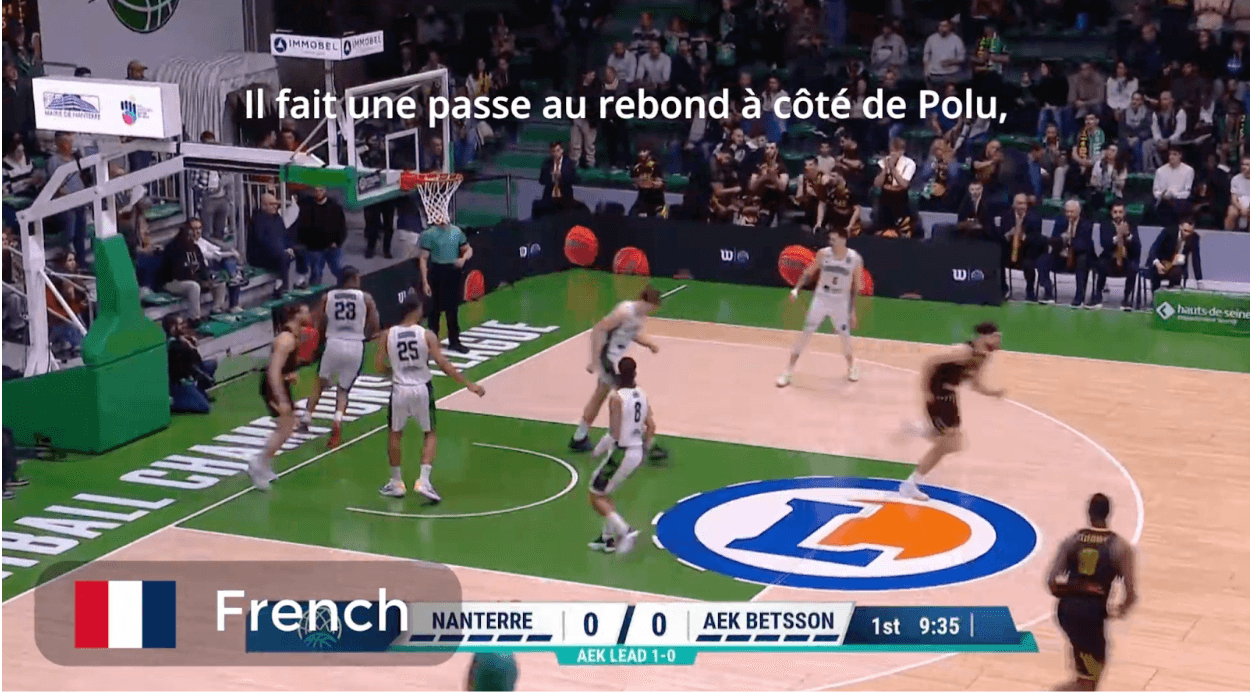
If your organization is rich in video content and looking to expand its audience, that’s reason enough to leverage the appreciable powers of AI translation, captioning and dubbing. As of 2025, 60% of companies that use AI in some part of their video workflow report having used AI captioning (or plan to). 38% say the same about AI dubbing. Their rationale is straightforward: these tools provide an economical, scalable way to radically increase your addressable audience, drive engagement and increase revenue.
It’s hardly an exhaustive list of the advantages, but we’ve included a few more below if you’re still on the fence (or - more likely - just beginning to navigate your search for an AI translation partner).
1. Grow internationally (and monetize it)
AI dubbing and captioning let you ship multilingual versions of the same video library without rebuilding your entire production workflow. That matters because language directly affects conversion: 76% of consumers prefer content in their own language, and 40% won’t engage at all if it isn’t available. If video is a top-of-funnel onboarding engine for you, or if it’s the product outright, multilingual access is effectively “new distribution.” The practical win: broader reach, higher conversion rates, and more pipeline (or impressions) from outside your core language market.
2. Lower cost than human localization, with rapidly improving quality
Human localization is excellent, but it’s hard to scale across thousands of hours of content and dozens of languages. It also isn’t fast enough for livestream or live broadcasts. Pricing for human-translated captions runs anywhere from ~$5/min to $10/min, with dubbing/voiceover often much higher depending on production requirements. AI reduces those costs more than tenfold so you can localize more content. With services like Lingopal, AI also achieves sufficiently low latency to handle live events - and the quality gap between AI and humans is rapidly tightening.
3. AI doesn’t sacrifice customization
AI localization in 2026 isn’t one-size-fits-all; it’s increasingly configurable. You can standardize product names and account for neologisms and industry-specific jargon via glossaries and controlled terminology, so “Feature X” is always “Feature X,” everywhere. Platforms like Lingopal support transcript/caption management as a workflow, making it easier to iterate and tighten accuracy over time.
4. Better viewer experience drives loyalty (and improves satisfaction/NPS)
People don’t just understand content better in their native language—they feel better about the brand behind it. 68% of consumers say they’d switch brands to get service in their native language, and 64% affirm they’d pay more for a product/service with a native-language experience. From live sports to educational videos, news to entertainment, when viewers don’t have to work to follow along, duration of impressions and overall sentiment tends to rise. Over time this manifests as stronger retention and brand advocacy.
5. More domestic engagement
Few domestic markets are truly monolingual. Most include large multilingual communities (expats, immigrants, older generations in bilingual homes) that are underserved by single-language video. Language preference shapes comprehension and purchasing behavior, and the same consumer data behind international growth applies locally. Captions and dubs help you reach viewers who live in your core region but aren’t fluent in the dominant language. It also reduces friction for complex topics (product setup, workplace policies, legal matters, training), which lowers support load. All told: you expand share-of-market inside your existing footprint.
6. New languages unlock new advertisers and revenue lines
Multilingual content expands inventory: you can package sponsorships by language, geography, and diaspora audience. This creates a narrative advertisers love: “Bigger reach, new segments” and “higher conversion because the CTA is understood.” Digital ad spend continues to be pulled toward online formats where targeting and measurement are strong, and localized audiences are extra valuable when they’re hard to reach elsewhere. Practically, you can sell region or language-specific placements, run localized affiliate offers, or build partnerships that weren’t viable before. Your content becomes a monetizable asset in multiple markets instead of one.
7. Accessibility + Compliance
Captions are a core accessibility feature for Deaf and hard-of-hearing viewers—and many organizations treat them as a compliance baseline. WCAG includes captions for prerecorded synchronized media at Level A, and live captions at Level AA, which is why they often appear in procurement and policy requirements. Likewise, realtime translation for parent-teacher conferences or lectures is increasingly leveraged by school systems across the United States to accommodate ESL students and their families, observing local requirements.
8. Younger audiences reward translation and expect subtitles
63% of viewers under 30 in the United States describe their preferred way to view content as “with the subtitles on and in a language they know”. Subtitles are now a mainstream behavior, not a niche preference. Netflix has taken note, leaning into subtitle options as viewing habits shift, acknowledging they’re increasingly the default. If your content isn’t hip to this new bias, you’re making it harder to consume. Captions meet audiences where they already are - especially when they’re translated into their primary language.
9. A Live Content Differentiator
We touched on it earlier in point two, but this bears repeating: AI translation, dubbing and captioning is imperative for live content. Humans simply don’t have the speed or scale to translate livestreams or broadcast TV in the moment, and though the pace of adoption is hastening, companies that offer high-fidelity translation of live events remain an enviable minority and enjoy a competitive advantage - doubly so with services like Lingopal, which are designed to faithfully replicate announcer and actor voices, handle background noise and make sense of multiple voices talking at once (diarization).
10. Increased content velocity
AI dubbing combined with captions is a force multiplier for video. A single clip of footage, be it an interview, game highlight or episode of a show, can be turned into a dozen localized variants in a matter of minutes. Captions also boost performance in sound-off environments. Meta famously recorded that up to 85% of video is watched without sound, making captions a practical engagement lever. Small wonder caption usage has surged among marketers (specifically by 572% since 2021). It’s one of the highest-ROI upgrades you can ship (after, of course, translation 🙂).