AI Dubbing & Live Translation: The New Language Layer
The internet is global. Speech is not.
More than 6.12 billion people were online at the start of April 2026, equal to 73.8% of the global population. Video is also one of the internet’s core behaviors: across 54 major economies, 53.4% of online adults say watching videos, TV shows, and movies is one of their top reasons for going online.
But the web still speaks unevenly. W3Techs reports that English is used by 49.6% of websites whose content language is known, compared with 6.0% for Spanish, 4.6% for French, 4.1% for Portuguese, 1.3% for Chinese, and 0.6% for Arabic. The audience is global, but much of the content experience is still language-limited.
That gap is where AI dubbing and live translation are becoming essential infrastructure.
For sports, media, entertainment, EdTech, faith tech, and CCaaS, the next growth layer is not only better video quality or lower latency. It is the ability for people to hear, understand, and participate in the language that feels natural to them.
What is the new language layer?
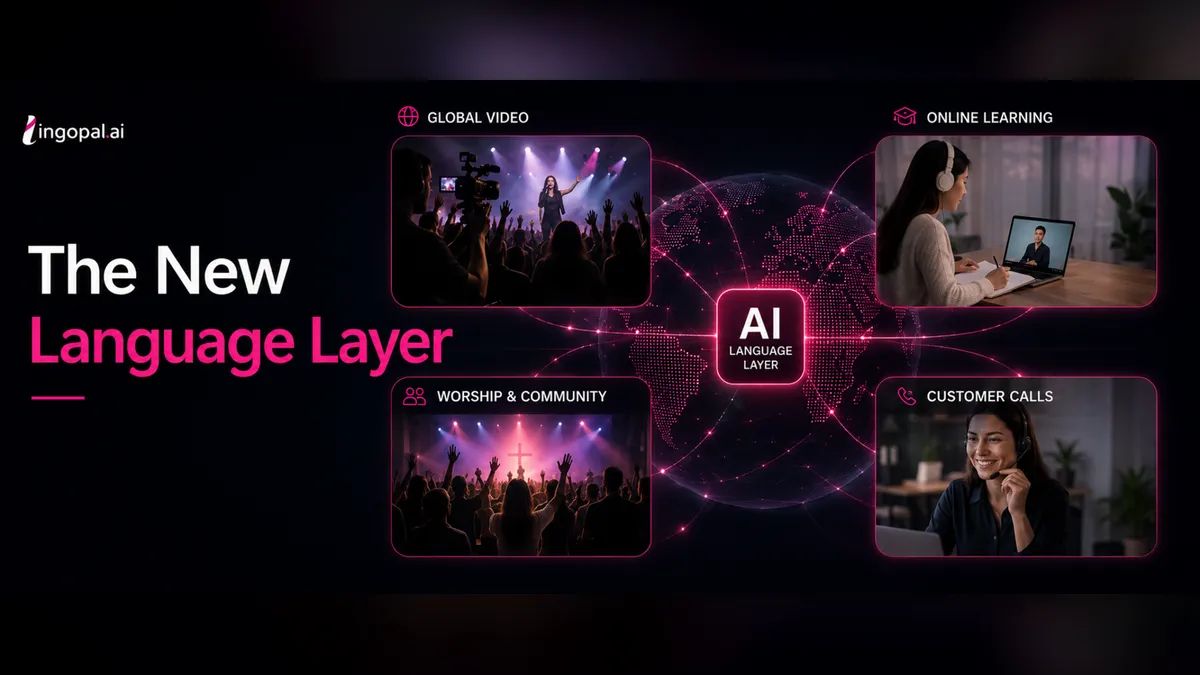
The new language layer is the real-time infrastructure that makes spoken content multilingual across formats.
AI dubbing translates and recreates spoken audio for recorded content. Live translation translates speech while the moment is still happening. Together, they turn language from a post-production step into a distribution layer.
That layer looks different depending on the experience:
- LIVE STREAMING: one broadcast translated for many audiences.
- VOD: recorded content localized into multiple languages at scale.
- ROOMS: one-to-many or many-to-many sessions with translated speech or captions.
- CALLS: one-to-one translation for support, sales, tutoring, care, and consultations.
The old question was: “Which content is worth localizing?”
The new question is: “Why is any high-value spoken experience still trapped in one language?”
Why this is happening now
Several market signals are converging.
The live streaming market is projected to grow from $97.39 billion in 2026 to $318.56 billion by 2031, a 26.74% CAGR. The broader video streaming market is estimated at $212.83 billion in 2026 and projected to reach $356.20 billion by 2031. VOD already represented 61.25% of the video streaming market in 2025, while live streaming is projected to grow at 14.4% CAGR through 2031.
AI dubbing is also becoming its own software market. The Business Research Company estimates the AI dubbing tools market will grow from $1.35 billion in 2026 to $2.56 billion by 2030, driven by multilingual content demand, improved AI voice realism, real-time dubbing tools, and cloud-based media workflows.
Major platforms already understand the demand. Netflix says nearly one-third of all viewing comes from non-English-language shows, and it offers subtitles in 33 languages and audio dubbing in 36 languages across its catalog, depending on the title.
The point is simple: language options are no longer only accessibility features. They are audience expansion tools.
Why live translation is harder than subtitles
Subtitles help people read what was said. Live translation has to help people follow what is being said, while it is still happening.
Research on simultaneous speech translation describes four major technical challenges: long and continuous speech streams, real-time output requirements, the balance between translation quality and latency, and limited annotated training data. Another paper on simultaneous speech-to-speech translation notes that latency-sensitive applications cannot wait for the full utterance; translations should be spoken as soon as the necessary information is available.
That is why live AI translation is not just translation plus speed. It is a complete pipeline: speech recognition, segmentation, translation, timing, voice generation, emotional tone, delivery, and domain context.
In other words, the best systems do not simply translate words. They translate the moment.
Where AI dubbing and live translation create value
1. Sports: one match, many fan bases
Sports is live, emotional, global, and time-sensitive. A football match, basketball game, esports tournament, or fight night can attract fans across continents, but commentary and interviews often stay locked in one language.
That matters because sports media rights are becoming more expensive. Ampere Analysis forecasts global sports media rights spend will exceed $78 billion by 2030, up 20% from 2025.
AI live translation helps sports organizations turn one broadcast into many localized experiences: multilingual commentary, translated press conferences, localized highlight packages, athlete interviews, and language-specific sponsor opportunities.
Lingopal product fit: Use LIVE STREAMING for match commentary, press conferences, watch parties, post-game shows, and creator-led fan engagement.
2. Media and entertainment: dubbing becomes continuous
Media companies used to localize only the titles that justified traditional dubbing costs. But modern catalogs include premium shows, podcasts, interviews, clips, FAST channels, creator content, event replays, and long-tail VOD libraries.
AI dubbing changes the economics. More assets can be localized faster, and content can travel further without waiting for a long post-production cycle.
The key is quality and trust. As AI voice workflows grow, media companies must protect creative intent, voice rights, consent, and audience expectations. The opportunity is not only cheaper dubbing; it is faster, broader, more responsible localization.
Lingopal product fit: Use VOD for multilingual libraries, replays, podcasts, interviews, training content, and entertainment catalogs.
3. EdTech: translation becomes participation
Education is not passive viewing. It is comprehension, interaction, and confidence.
The digital education market is estimated at $30.36 billion in 2026 and projected to reach $98.58 billion by 2031, growing at a 26.57% CAGR. As online learning expands, multilingual access becomes a growth lever for universities, online academies, tutoring platforms, corporate training, and certification programs.
For EdTech, the most important use case is not only translating lectures. It is enabling learners to ask questions, understand peer discussion, receive feedback, and join live sessions in their preferred language.
Lingopal product fit: Use ROOMS for lectures, webinars, seminars, and group learning. Use CALLS for tutoring, coaching, student support, admissions, and academic advising. Use VOD for course libraries.
4. Faith tech: language as belonging
Faith communities are multilingual by nature. Migration, diaspora communities, online worship, and global ministry have made language access a core part of connection.
YouVersion shows the scale of multilingual faith demand: its Bible App offers 3,500 Bible versions in 2,300 languages and has more than 700 million installs worldwide.
For faith tech, live translation can support multilingual sermons, worship broadcasts, prayer rooms, global conferences, small groups, pastoral care calls, and VOD sermon libraries.
The standard is emotional fidelity. A sermon or prayer is not just information. It carries warmth, rhythm, reverence, and trust.
Lingopal product fit: Use LIVE STREAMING for worship broadcasts and large events. Use ROOMS for prayer groups, Bible studies, and community gatherings. Use CALLS for pastoral care and one-to-one support.
5. CCaaS: every agent can become multilingual
Customer support is one of the clearest business cases for live speech translation. Companies want global customers, but customers want help in their own language.
The CCaaS market is projected to grow from $8.33 billion in 2026 to $30.15 billion by 2034, at a 17.40% CAGR. At the customer level, CSA Research found that 76% of online shoppers prefer buying products with information in their own language, while 40% will never buy from websites in other languages.
That same language preference affects support, sales, onboarding, renewals, and customer success. Live translation can help contact centers offer broader language coverage without staffing every language around the clock.
Lingopal product fit: Use CALLS for real-time translation between agents and customers. Use ROOMS for escalations, customer training, onboarding, and multilingual support webinars.
How to measure the language layer
To evaluate AI dubbing and live translation, companies should measure language as revenue infrastructure, not only as a cost.
For live streaming, track watch time by language, peak viewers by language, drop-off, replay views, and sponsor performance by language feed.
For VOD, track incremental views from dubbed versions, completion rate, revenue per localized asset, and time from upload to multilingual availability.
For rooms, track attendance by language, question volume, participation rate, session completion, learner satisfaction, and event NPS.
For calls, track first-contact resolution, average handle time, customer satisfaction, escalation rate, sales conversion, and coverage hours by language.
The key metric is language yield: how much additional engagement, revenue, retention, or satisfaction each new language unlocks.
Quick answers
What is AI dubbing?
AI dubbing uses artificial intelligence to translate spoken audio and recreate it in another language, often with synthetic or adapted voice output.
What is live translation?
Live translation translates speech in real time, helping audiences, students, worshippers, customers, or meeting participants understand spoken content while it is happening.
Why does this matter for global organizations?
Because language affects access, trust, participation, and revenue. A global audience cannot fully engage with a video, event, class, service, or support call if the spoken experience is locked in one language.
The next global platform feature is native-language speech.
For sports, that means fans can follow the match in their own language. For media, it means catalogs travel further. For EdTech, learners can participate, not just watch. For faith tech, communities can feel closer across distance. For CCaaS, customers can get help without a language barrier.
The future of communication is not one language translated later.
It is one moment, many languages, delivered live.
Make every spoken experience multilingual
Lingopal helps organizations make every stream, video, room, and call multilingual from the first second.
Use Lingopal LIVE STREAMING for global broadcasts, VOD for multilingual content libraries, ROOMS for live sessions and group experiences, and CALLS for one-to-one conversations across languages.
Ready to reach every audience in their language? Talk to Lingopal today: https://lingopal.ai/schedule-demo