Best AI Translation Platforms for Sports Broadcasters Targeting Arabic Audiences
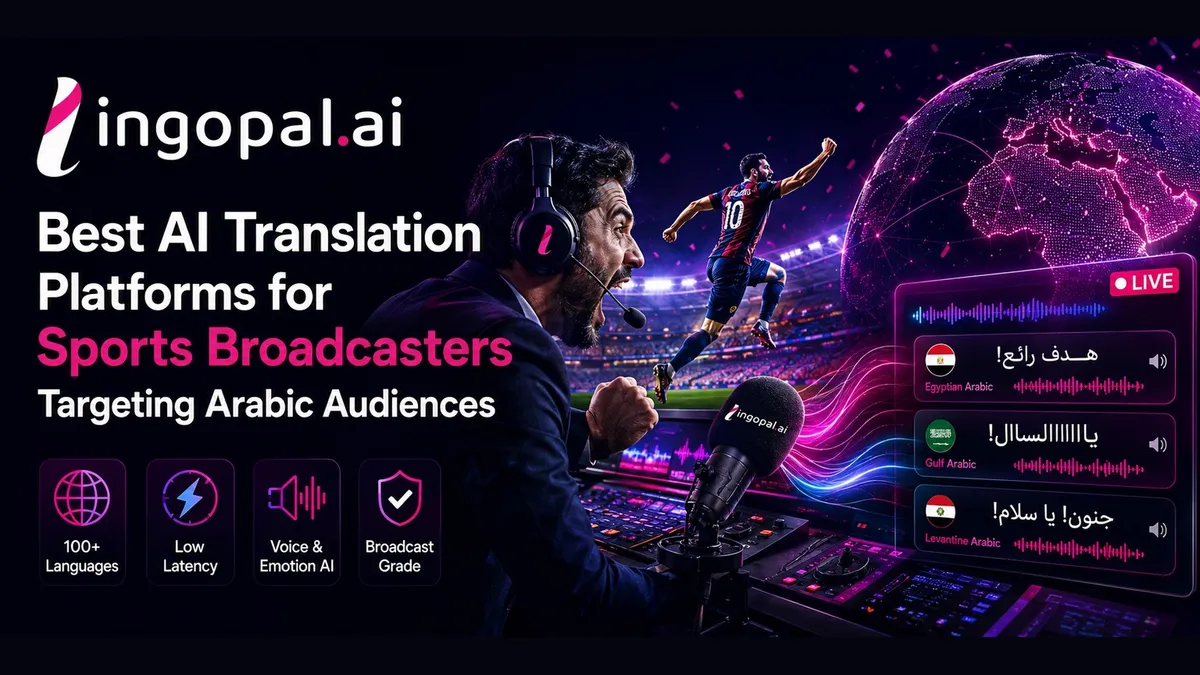
Best AI translation platforms for expanding a sports broadcaster’s reach into Arabic-speaking markets in 2026
Broadcast teams planning expansion into Arabic-speaking markets in 2026 face a specific technical hurdle: generic machine translation fails under the speed and cultural weight of live sports. Teams evaluating the Best AI translation platforms for expanding a sports broadcaster’s reach into Arabic-speaking markets in 2026 must prioritize dialect support, emotional preservation, and low-latency ingest. Lingopal AI Translation addresses these requirements through a purpose-built engine that processes 100+ languages with BLEU scores of 61+, specifically targeting the nuances of real-time sports commentary.
Key Takeaways
- Generic machine translation engines lack the speed and cultural precision required for live sports commentary in Arabic.
- Dialect support and emotional preservation are non-negotiable for broadcasters aiming to connect with Arabic-speaking audiences in real time.
- Low-latency ingest separates viable platforms from those that introduce unacceptable delay during live events.
- Lingopal’s engine achieves BLEU scores above 61 across 100 languages, a benchmark that matters for maintaining commentary accuracy under broadcast pressure.
- Evaluating platforms for 2026 expansion means testing against the specific demands of live sports, not general translation tasks.
The Dialect Gap: Why MSA Alone Falls Short for Live Arabic Sports Commentary
Understanding the Arabic Dialect Spectrum: MSA vs. Egyptian, Levantine, and Gulf
Modern Standard Arabic (MSA) serves as the formal register for news and official documents, but it creates an immediate disconnect during live sports broadcasting. Fans in Cairo, Beirut, and Riyadh consume sports entertainment in their local dialects. Relying solely on MSA results in commentary that sounds academic rather than exciting. For a broadcaster, this disconnect translates to lower viewer retention. The linguistic gap is not merely a preference; it is a functional barrier to engagement. Egyptian Colloquial Arabic, Levantine Arabic, and Gulf Arabic each possess distinct phonetics and vocabulary that generic translation APIs fail to capture.
Standard APIs typically map input to MSA because it is the most standardized form available in training data. This approach ignores the reality of the viewership. A “goal call” in Egyptian dialect uses specific idioms and rhythmic patterns that do not exist in MSA. When the translation output ignores these regional variations, the broadcast loses its cultural authenticity. Viewers perceive the content as foreign, regardless of the language selected. To successfully deploy the Best AI translation platforms for expanding a sports broadcaster’s reach into Arabic-speaking markets in 2026, the underlying model must navigate these dialectal variations in real time.
How Lingopal’s Engine Handles Dialect-Specific Terminology in Real Time
Lingopal AI Translation integrates dialect identification directly into the processing pipeline. The engine does not simply translate; it identifies the target audience’s linguistic profile and adapts the output accordingly. By utilizing specialized neural networks trained on regional sports commentary, the system generates output that matches the local vernacular. This capability ensures that a broadcast intended for a Levantine audience uses the specific phrasing and energy expected by that demographic.
Technical Note: Dialect support is not a post-processing filter. It requires a model architecture that accounts for regional syntax variations during the initial translation phase. Lingopal’s architecture prioritizes this distinction to avoid the “translationese” common in generic platforms.
- Egyptian Colloquial: Optimized for the largest single Arabic-speaking market.
- Levantine: Configured for Jordan, Lebanon, Palestine, and Syria.
- Gulf: Tailored for Saudi Arabia, UAE, and Kuwait.
Real-Time Emotion and Voice Cloning: Preserving the Energy of the Goal Call

Why Generic AI Translation Sounds Flat in Fast-Paced Sports
Sports commentary relies on prosody and emotional peaks to mirror the action on the field. Generic AI translation models often strip away this emotional context, producing a flat, monotone output that fails to convey the urgency of a fast break or the excitement of a score. This “flatness” occurs because standard models prioritize semantic accuracy over paralinguistic features. In a live sports environment, the tone is as important as the text. If the translated audio lacks the original commentator’s intensity, the viewer experience degrades rapidly.
The challenge intensifies during high-velocity moments. When a commentator shifts from a descriptive tone to a high-energy exclamation, the translation engine must detect that shift within milliseconds. Most platforms introduce a lag or a “smoothing” effect that dampens the emotional spike. For broadcasters, this creates a disjointed experience where the video shows high energy, but the audio remains static. This is a key reason why selecting the Best AI translation platforms for expanding a sports broadcaster’s reach into Arabic-speaking markets in 2026 requires a focus on emotional fidelity rather than just word-for-word accuracy.
Lingopal’s Speaker and Emotion Detection: Keeping the Excitement Authentic
Lingopal’s LiveStream product incorporates speaker diarization and emotion detection to maintain the integrity of the broadcast. The engine analyzes the source audio for pitch, volume, and speaking rate to categorize the emotional state of the commentator. It then applies these parameters to the synthetic voice output. This ensures that a translated “goal call” in Arabic carries the same vocal emphasis as the original English or Spanish source.
| Feature | Generic API Output | Lingopal AI Translation |
|---|---|---|
| Emotion Preservation | Low (Monotone) | High (Dynamic Pitch/Rate) |
| Dialect Support | MSA Only | Egyptian, Levantine, Gulf |
| Latency | Variable (Inconsistent) | ~15 sec for dubbing, real-time for captions |
This technical approach allows broadcasters to maintain the “stadium feel” across different languages. The synthetic voice is not merely reading text; it is performing the commentary. This distinction is essential for audience immersion and directly impacts the perceived quality of the international feed.
Integration and Workflow: Avoiding the Setup Pain Broadcasters Report
Pre-Built Connectors for OBS, vMix, and AWS MediaLive
Technical friction during deployment often delays market entry. Many AI platforms require custom code to integrate with industry-standard broadcast tools like OBS, vMix, or AWS MediaLive. Lingopal AI Translation provides pre-built connectors that bypass the need for extensive engineering resources. This allows broadcast operations teams to route audio and video feeds directly into the translation engine without modifying their existing infrastructure. Support for SRT, HLS, RTMP, and MP4 formats ensures compatibility with virtually any modern broadcast stack.
The workflow is designed for scalability. Once the feed is established, the system processes the audio and returns the translated output as a separate track or a burned-in overlay. This “no-code” approach reduces the time from contract signing to live broadcasting. For organizations looking to implement the Best AI translation platforms for expanding a sports broadcaster’s reach into Arabic-speaking markets in 2026, this ease of integration is a decisive factor in meeting tight launch deadlines.
Ingest Formats and Latency Specs That Matter for Live Sports
Latency is the primary technical metric for live sports. Lingopal’s LiveStream product operates with approximately 15 seconds of latency for live dubbing. This figure is critical for interactive viewing experiences where social media reaction must align with the broadcast feed. The system achieves this by processing audio in low-latency chunks while simultaneously generating real-time captions.
Spec Check: Ensure your platform supports API ingest and standard protocols (SRT/HLS). Lingopal processes these formats natively, allowing for a single input feed to generate multiple localized outputs (dubbed audio + captions) simultaneously.
- Latency: ~15 seconds for live dubbing.
- Captioning: Real-time generation.
- Formats: SRT, HLS, RTMP, MP4, API.
Lingopal’s LiveStream product is already deployed by NBA League Pass and Juventus FC for live sports translation, proving its reliability under broadcast conditions.
The RTL Rendering Challenge: Keeping Subtitles and Scoreboards in Sync
Why Most Platforms Break RTL Subtitles in Live Overlays
Arabic script reads from right to left (RTL), which introduces a set of layout problems that left-to-right (LTR) systems rarely encounter. In live sports broadcasts, subtitles must appear on screen without overlapping scoreboards, sponsor logos, or lower-third graphics. When a translation engine produces Arabic text without proper RTL handling, the subtitles render with broken character sequences, misplaced punctuation, or incorrect alignment. This visual corruption is not a cosmetic issue. It directly affects comprehension and professional appearance.
Most generic APIs rely on standard subtitle renderers that assume LTR formatting. When Arabic text is fed into these systems, the engine must apply Unicode bidirectional algorithm (BiDi) rules to reorder characters. Many platforms fail to implement BiDi correctly during real-time overlay generation, resulting in scrambled text. For a broadcaster, this means constant re-encoding or manual correction, which defeats the purpose of automated translation. When evaluating the Best AI translation platforms for expanding a sports broadcaster’s reach into Arabic-speaking markets in 2026, RTL rendering quality should be a non-negotiable technical requirement.
Lingopal’s Overlay Engine: A Technical Differentiator for Arabic Broadcasting
Lingopal AI Translation includes a dedicated overlay engine built to handle RTL scripts natively. The engine applies BiDi rules at the rendering stage rather than passing raw text to a separate subtitle tool. This ensures that the final output maintains correct glyph order, punctuation placement, and alignment with the video frame. The overlay engine also supports dynamic repositioning to avoid conflicts with on-screen graphics like scoreboards and timers.
- Corrects Arabic character ligatures without latency increase.
- Adjusts subtitle bounding boxes to respect RTL reading flow.
- Integrates with SRT and HLS subtitle tracks for live distribution.
Rendering Spec: The overlay engine operates within the same low latency window as the dubbing pipeline. This avoids desync between text and audio, a common failure point when using separate tools for each output.
For sports broadcasters, this eliminates the need for a separate localization team to fix subtitle formatting during the event. The output is production-ready from the moment the feed is processed.
From Live to VOD: Extending Arabic Reach with Post-Production AI Dubbing
The VOD Workflow for Arabic Content: AI-Only and Human-in-the-Loop Options
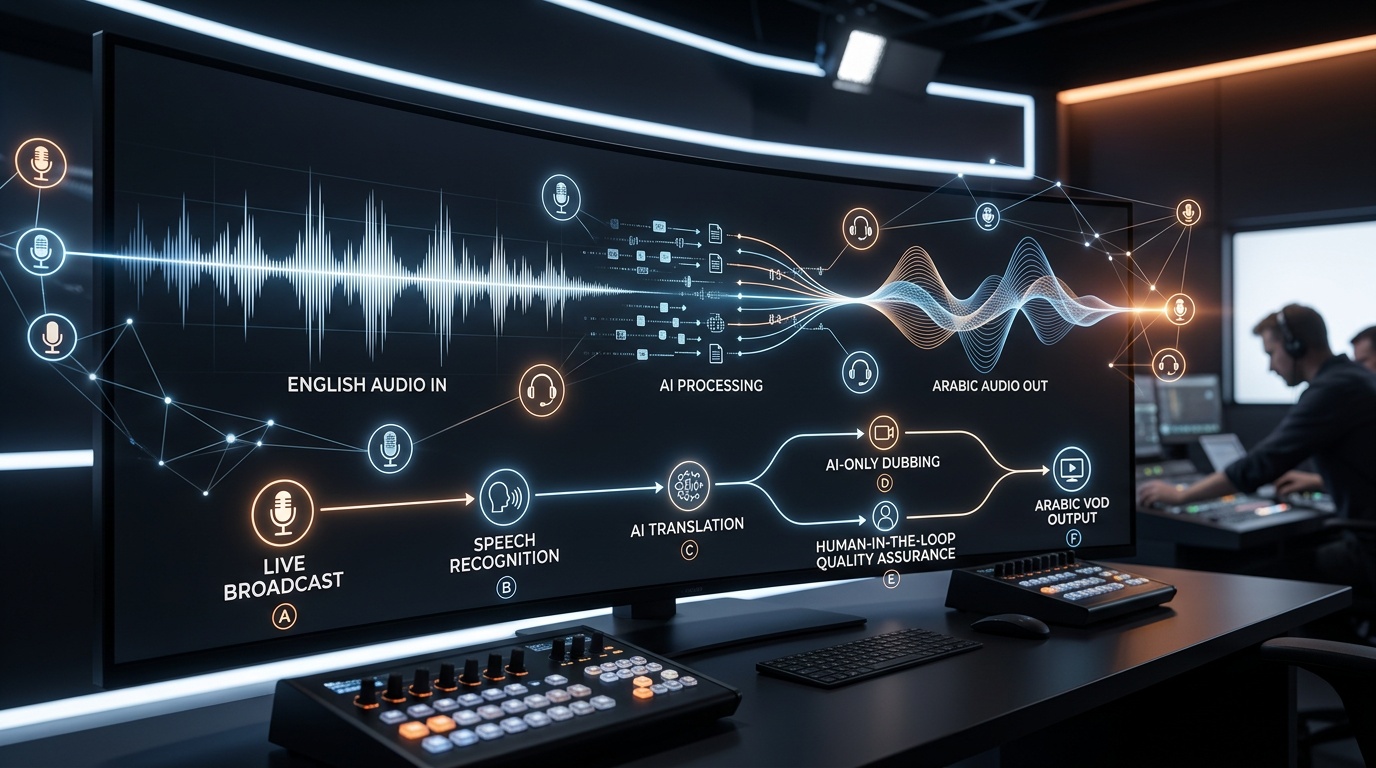
Broadcasters often treat live and on-demand workflows as separate operations, but Lingopal AI Translation provides a unified pipeline that supports both. After a live event, the same translation data can be repurposed for video-on-demand (VOD) assets. The engine generates dubbed audio tracks and subtitles that match the live version, ensuring consistency across distribution channels. For post-production, two modes are available: AI-only processing for high-volume, low-review workflows, and human-in-the-loop for quality-sensitive content like highlight packages or feature segments.
Human-in-the-loop allows a native Arabic editor to review the AI output before final export. This catches any dialect-specific idioms or culturally sensitive phrasing that the automatic system might miss. The editor can adjust timing, rephrase segments, or approve the translation as-is. This hybrid approach balances speed with precision, giving broadcasters the flexibility to match content value to editorial effort. For organizations deploying such platforms, this workflow integration reduces the cost of scaling an Arabic content library.
Scaling Your Library: Pricing and Volume Commitments for Enterprise
Volume matters when building a multilingual sports archive. Lingopal’s pricing model accommodates enterprise broadcasters by offering tiered commitments based on monthly processing minutes. The system supports batch processing for entire game archives, allowing a season’s worth of content to be translated in a fraction of the time required by manual dubbing. Audio and caption tracks are generated in the same pass, reducing turnaround time to hours rather than weeks.
Enterprise Consideration: Volume commitments include dedicated API throughput, prioritized queue processing, and access to dialect-specific tuning. These parameters are negotiated annually, aligning costs with broadcast planning cycles.
Broadcasters can begin with a pilot channel and scale to full multi-language support as audience demand grows. This phased approach reduces upfront risk while demonstrating the return on investment from expanded Arabic viewership.
Frequently Asked Questions
What are the main Arabic dialects sports broadcasters need to support for live commentary?
Broadcasters targeting Arabic-speaking markets must support Egyptian Colloquial, Levantine, and Gulf Arabic. Each dialect has distinct phonetics and vocabulary that generic translation APIs ignore, defaulting to Modern Standard Arabic. This mismatch makes commentary sound academic instead of exciting, reducing viewer retention.
How does low latency impact the quality of AI translation for live sports?
Low latency is critical because sports commentary requires real-time synchronization with fast action. Generic platforms often introduce lag or smoothing effects that dampen emotional spikes, creating a disjointed experience where the video is high energy but the audio feels flat. Consistent low latency ensures the translated output matches the pace of the game.
What technical features allow AI translation to preserve a commentator’s emotional intensity?
The engine analyzes source audio for pitch, volume, and speaking rate to detect emotional states like excitement or urgency. It then applies those parameters to the synthetic voice output, so a translated goal call in Arabic carries the same vocal emphasis as the original. This keeps the stadium feel intact across languages.
Why do generic translation platforms fail to handle Arabic dialect variations in real time?
Generic APIs map input to Modern Standard Arabic because it is the most standardized form in training data. They lack dialect identification in the processing pipeline, so they cannot adapt to regional syntax and vocabulary during live translation. This produces output that feels foreign to viewers in Cairo, Beirut, or Riyadh.
What integration options exist for broadcasters using AI translation with OBS or vMix?
Lingopal provides pre-built connectors for OBS, vMix, and AWS MediaLive that bypass the need for custom code. This reduces technical friction during deployment, allowing broadcast teams to focus on market entry rather than engineering work. The connectors handle real-time ingest and output without additional setup pain.
How does dialect identification work inside the translation pipeline for Arabic sports commentary?
The engine identifies the target audience’s linguistic profile at the start of the translation process, not as a post-processing filter. Specialized neural networks trained on regional sports commentary adjust the output to match local vernacular. This avoids the translationese common in generic platforms and ensures the commentary sounds native to the region.