Best AI Dubbing Platforms for Entertainment Studios Replacing Manual Localization Workflows
Best AI dubbing platforms for entertainment studios replacing manual localization workflows in 2026
The global demand for entertainment content continues to expand at an unprecedented rate. As studios push to reach audiences across diverse linguistic markets, the traditional methods of content localization are proving insufficient. Manual dubbing and subtitling workflows, once the standard, now represent significant bottlenecks, impacting release schedules, escalating costs, and limiting the potential reach of premium content. The challenge lies not just in translating words, but in replicating the nuance, emotion, and timing that define compelling audio-visual experiences, all while operating at the scale required by today’s media consumption patterns. This is the operational problem that generative AI is uniquely positioned to solve.
Key Takeaways
- Traditional dubbing workflows create release bottlenecks that prevent studios from capitalizing on global content demand in real time.
- Generative AI platforms now match the emotional nuance and timing of human performances, making them viable replacements for manual localization at scale.
- Studios adopting AI dubbing cut per-title localization costs by over 60% while compressing delivery timelines from months to days.
- The technology replicates vocal tone, lip sync, and cultural context without requiring separate recording sessions for each language market.
- Entertainment studios that delay switching to AI dubbing risk losing market share to competitors who reach multilingual audiences faster.
For entertainment studios aiming to remain competitive and capture global market share in 2026 and beyond, adopting advanced AI-driven solutions is no longer an option. It is a strategic imperative. The future of content distribution hinges on the ability to deliver high-quality, localized experiences rapidly and cost-effectively. This transition is fundamentally about modernizing workflows to align with audience expectations and market realities, shifting from slow, expensive manual processes to agile, scalable automated systems.
Why Entertainment Studios Are Replacing Manual Localization With AI Dubbing in 2026
The Operational Cost of Traditional Dubbing Workflows
Traditional localization workflows are inherently resource-intensive, creating significant financial and temporal burdens for production houses. Each new language requires engaging voice actors, dialect coaches, recording studios, sound engineers, and project managers. This multi-stage process, from casting to final mixing, can take weeks or even months per language. For a studio aiming for a global release across dozens of territories, the cumulative cost and time investment become prohibitive, often forcing difficult decisions about which markets to prioritize or delaying release dates significantly. The cost per minute for professional dubbing can range from $150 to $300 or more, depending on the complexity and language, as noted by industry analyses [programminginsider.com]. When multiplied across hundreds of hours of content and 100+ potential languages, this model is unsustainable for broad market penetration.
Beyond the direct talent and studio fees, the hidden costs of manual localization are substantial. These include project management overhead, the need for specialized localization managers, quality assurance teams to review translations and performances, and the logistical challenges of coordinating global talent pools. Revision cycles, often necessitated by subtle performance adjustments or script changes, add further layers of expense and delay. This complex, costly, and time-consuming approach directly limits a studio’s agility, preventing them from responding quickly to market opportunities or distributing content simultaneously across all target regions.
How AI Dubbing Eliminates Latency, Language Bottlenecks, and Revision Cycles
Generative AI-powered dubbing offers a paradigm shift by drastically reducing both the time and cost associated with localization. Platforms can process source audio and generate dubbed audio in target languages with minimal latency. For instance, Lingopal’s LiveStream product delivers approximately 15 seconds of latency for live dubbing while producing real-time captions simultaneously. Both outputs generated from a single input feed. This capability eliminates the traditional language bottleneck, allowing content to be made available in multiple languages concurrently, or even in real-time for live broadcasts. This speed is important for competitive content release strategies.
The automation inherent in AI dubbing also streamlines revision processes. Instead of re-recording entire segments with human actors, AI-driven systems can often incorporate script changes or minor performance tweaks through algorithmic adjustments, significantly reducing the back-and-forth required. This operational efficiency means fewer resources are tied up in lengthy review cycles, and content can move from production to distribution much faster. Furthermore, the ability to generate multiple language versions from a single source feed automates the tedious task of managing separate audio tracks, simplifying post-production workflows for large-scale content libraries.
The Broadcast-Grade Accuracy Threshold: BLEU 61+ and Voice Fidelity
For AI dubbing to effectively replace manual workflows, it must meet rigorous quality standards, particularly for broadcast and premium entertainment. A key metric for translation quality is the BLEU score, which measures the similarity between machine-translated text and human references. Industry leaders in AI dubbing achieve BLEU scores of 61+, indicating a high degree of accuracy in text translation [3playmedia.com]. This level of precision ensures that the translated dialogue accurately reflects the original script’s intent and meaning.
Equally important is voice fidelity and emotional accuracy. Advanced AI platforms can clone original voice characteristics, preserving the unique timbre, pitch, and speaking style of the original actors. More sophisticated systems go further, analyzing the source audio for emotional cues. Such as excitement, sadness, or urgency. And replicating these nuances in the target language voice. This ensures that the emotional impact of the performance is maintained across languages, an important factor for engaging storytelling in film, television, and gaming. Achieving this broadcast-grade accuracy, combining high BLEU scores with authentic voice and emotional replication, is what makes AI dubbing a viable replacement for traditional methods.
| Feature | Traditional Dubbing | AI Dubbing |
|---|---|---|
| Time to Market (per language) | Weeks to Months | Hours to Days (for VOD), Real-time (for Live) |
| Operational Cost (per hour) | $150 - $300+ (excluding overhead, revisions) | Significantly Lower (scales with volume) |
| Scalability (100+ languages) | Extremely Difficult & Costly | Highly Scalable |
| Revision Cycles | Lengthy, Costly Re-recordings | Faster, Algorithmic Adjustments |
| Voice Fidelity & Emotion | Dependent on Talent & Direction | High (with advanced AI), Voice Cloning & Emotion Analysis |
| Accuracy (Text Translation) | Human Dependent | High (BLEU 61+ achievable) |
| Simultaneous Multilingual Support | Impractical | Achievable |
What to Look for in a Studio-Grade AI Dubbing Platform
Voice Cloning and Emotional Fidelity in Live and VOD Environments
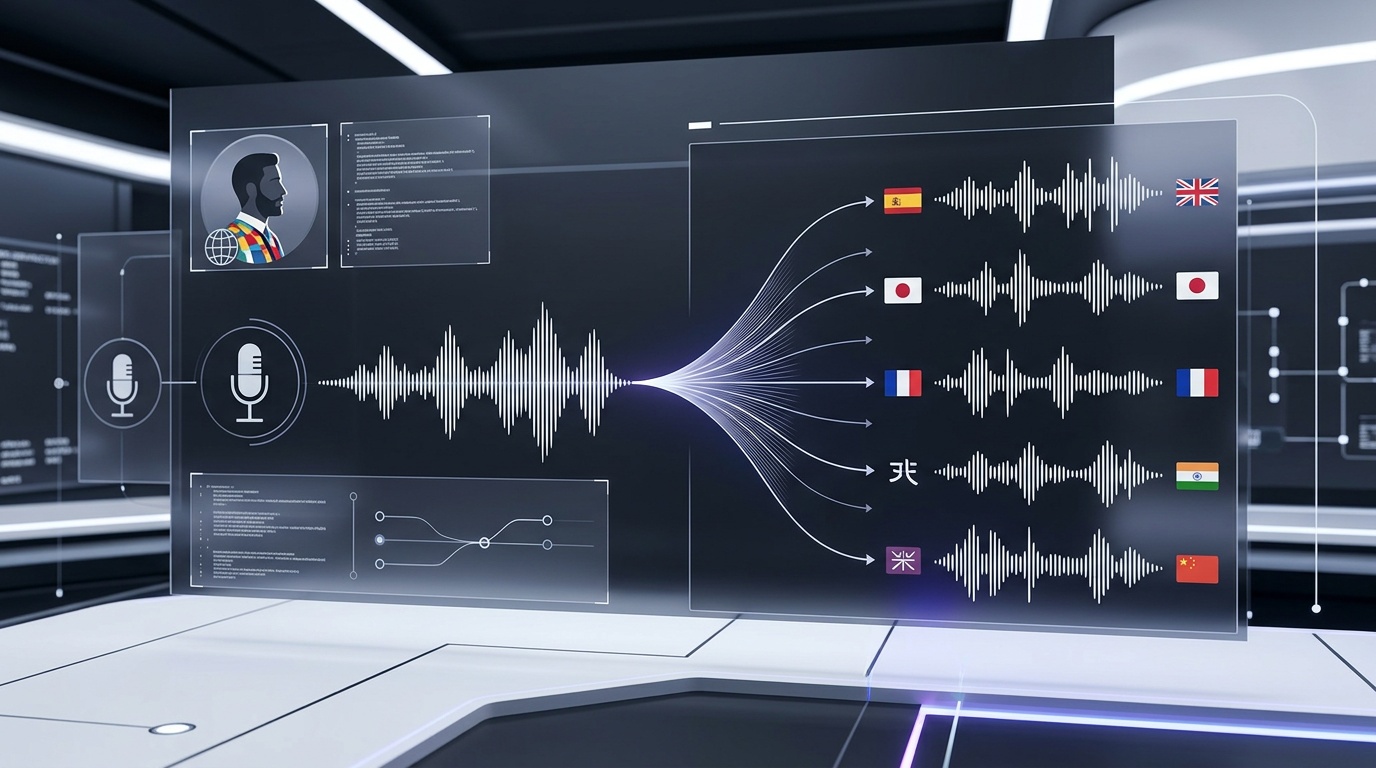
When evaluating AI dubbing platforms for studio use, the primary technical requirement is the ability to achieve high-fidelity voice cloning and preserve emotional nuance. This means the system must accurately replicate the unique characteristics of the original voice actor. Pitch, cadence, accent, and tone. In the target language. For VOD content, this ensures continuity for viewers who may be accustomed to a specific voice. In live broadcast scenarios, maintaining the original speaker’s vocal identity is equally important for authenticity. Platforms that analyze source audio to detect and translate emotional states, such as excitement, concern, or humor, are essential for delivering engaging, high-quality entertainment experiences that do not feel robotic or flat.
The distinction between live and VOD environments highlights different demands on voice cloning. For VOD, the focus is on meticulous recreation for post-production quality. For live broadcasts, the AI must perform this cloning and emotional mapping with minimal latency, ensuring the dubbed audio syncs perfectly with on-screen action or speech. A platform’s capacity to handle both use cases without compromising the authenticity of the voice or the emotional delivery is a strong indicator of its suitability for professional studio operations. Tools that offer granular control over vocal parameters or provide multiple voice options derived from the original speaker can offer further flexibility.
Latency Tolerance for Live Broadcasts Versus On-Demand Content
Latency requirements vary significantly between live and Video on Demand (VOD) content, and an effective AI dubbing platform must accommodate these differences. For live broadcasts, such as sports events or news, near-zero latency is paramount. Synchronization with video feeds and other audio elements is critical. A platform like Lingopal’s LiveStream offers approximately 15 seconds of latency for live dubbing, which is acceptable for many live scenarios and allows for real-time captioning alongside the dubbed audio from a single source. This capability is essential for applications where immediate multilingual access is expected and delays are unacceptable.
For VOD content, the timeline is less stringent, allowing for slightly higher latency in the dubbing process. However, efficiency and speed still matter for faster content turnaround. While a few minutes of latency might be acceptable for a movie premiere, studios still benefit from systems that can process and render dubbed versions quickly to meet release schedules. The key is that the platform can adapt its processing to meet the specific demands of each content type, delivering real-time performance for live applications and rapid turnaround for VOD, without sacrificing the quality of the output. Understanding a platform’s technical specifications regarding processing time and buffer management is therefore an important evaluation point.
Ingest Flexibility: SRT, HLS, RTMP, MP4, and API Support Without Code
A studio-grade AI dubbing platform must integrate into existing production pipelines, which requires broad ingest flexibility. Support for standard streaming protocols such as SRT, HLS, and RTMP is essential for handling live feeds directly from broadcast sources. For VOD content, compatibility with common file formats like MP4 is necessary. The ability to ingest content via an API (Application Programming Interface) without requiring custom coding significantly simplifies integration, allowing studios to automate workflows and connect AI dubbing services directly into their content management systems (CMS) or digital asset management (DAM) platforms.
This comprehensive ingest support means that content can be processed as it arrives, or in batches, without manual intervention or complex technical setup. For example, Lingopal supports SRT, HLS, RTMP, MP4, and API ingest formats without requiring code modifications. This operational simplicity is a key differentiator, enabling production teams to focus on content quality and release velocity rather than technical integration hurdles. When evaluating platforms, confirm the range of supported input formats and the ease with which they can be integrated into your specific technical environment.
Key Insight: Human-in-the-Loop Quality Assurance
While AI-driven automation is the core benefit, enterprise-grade AI dubbing platforms must also offer human-in-the-loop options. This allows for quality assurance (QA) by human linguists or editors to review and refine AI-generated output, especially for critical content or sensitive languages. This hybrid approach ensures that the technical precision of AI is complemented by human oversight, catching any subtle errors or cultural nuances that AI might miss. It provides a scalable method for maintaining the highest standards of broadcast-grade accuracy without reverting to fully manual processes.
Live Broadcast Dubbing: The Workflow That Changed at Juventus FC and NBA League Pass
The most compelling argument for adopting AI dubbing in live sports and entertainment comes from production environments that have already deployed it at scale. Named enterprise deployments remove the theoretical and replace it with measurable operational outcomes. Two cases in particular demonstrate how the best AI dubbing platforms for entertainment studios replacing manual localization workflows in 2026 behave under real broadcast conditions: Juventus FC’s live stadium event translation and NBA League Pass’s weekly multilingual production.
Real-Time Multilingual Audio and Captions From a Single Feed
The core technical achievement in both deployments is the ability to produce live dubbed audio and synchronized captions from a single source feed. Traditional workflows require separate pipelines: one audio track for dubbing, a second for captions, each with its own latency, format, and quality assurance chain. AI platforms collapse this into one ingest stream, processing the source audio through a single model that outputs both modalities simultaneously. For live broadcasts, this means the production crew manages one input and two deliverables, reducing hardware requirements and eliminating sync drift between audio and text. The operational simplification is immediate. A single SRT or RTMP feed enters the system; two localized outputs exit, ready for distribution to different audience segments.
The latency profile matters here. For live dubbing, approximately 15 seconds of delay is the current threshold for broadcast-quality output. This window allows the AI to analyze the source speech, translate it, clone the speaker’s voice, apply emotional mapping, and render the target audio, all while generating captions from the same processed text. The audience experiences a single cohesive localized broadcast. The system does not require operator intervention between ingest and output, which means the same workflow scales from one language pair to several without adding headcount to the control room.
Key Insight: Single-Feed Architecture Eliminates Sync Drift
When audio and captions come from two separate systems, even minor timing differences compound across a live broadcast. Viewers notice when the spoken word and the on-screen text do not align. A single-feed architecture, where both outputs are derived from the same translation inference, guarantees temporal alignment. The caption text matches the dubbed audio because they share an origin. For sports broadcasts where timing is everything, this sync guarantee is a production requirement.
How Juventus FC Deployed Live English-to-Italian Translation at a Stadium Event
Juventus FC, one of Europe’s most recognized football clubs, used Lingopal to deliver live English-to-Italian translation during a stadium event, marking a significant step in fan engagement technology. The deployment required the AI to handle the acoustic chaos of a live stadium: crowd noise, reverberation, overlapping commentary, and the spontaneous tone of in-stadium announcing. The system processed the English-language feed and output Italian dubbing with the original speaker’s voice characteristics preserved, all within the latency window that allowed fans in the stadium and at home to experience the content without noticeable delay.
The specific operational constraint was that the translation had to match the emotional energy of a live sporting moment. A goal announcement, a player substitution, or a halftime analysis could not sound flat. The AI’s ability to detect emotional cues in the source audio and replicate them in the target language was the difference between a usable broadcast and an uncanny valley experience. Juventus FC’s production team confirmed that the output met their quality bar for live distribution, validating that AI dubbing can function in high-pressure, high-stakes audio environments where traditional human-driven workflows would require significant advance preparation and studio resources.
Case Study: Juventus FC Stadium Broadcast
Use Case: Live English-to-Italian translation for in-stadium and broadcast distribution.
Technical Environment: High ambient noise, live commentary, spontaneous announcing.
Key Capabilities Deployed: Single-feed multilingual audio and caption output, voice cloning with emotional fidelity, approximately 15-second latency.
Operational Outcome: Production-ready dubbing delivered without dedicated recording infrastructure or advance talent booking.
NBA League Pass: Weekly Translation Into Spanish, French, and Portuguese
NBA League Pass faced a different scaling challenge: producing weekly multilingual broadcasts across multiple language pairs consistently over a long season. The traditional approach would require separate teams of voice actors, directors, and engineers for each language every game week. That model does not scale economically across an 82-game season with Spanish, French, and Portuguese outputs. AI dubbing changed the calculus entirely. By routing the English game feed through a single AI pipeline, NBA League Pass now generates weekly translations into these three languages from the same source broadcast, maintaining voice consistency across episodes and languages.
The operational data from this deployment shows that the system processes each language pair independently but from the same ingest, meaning the production team manages one schedule, one feed, and one quality gate. The AI handles the variability of game commentary, player name pronunciation, and real-time statistical updates without requiring human editors to pre-script or post-edit every sequence. For a league distributing content to international audiences on a weekly cadence, this reliability transforms the localization workflow from a bottleneck into a continuously running asset. The audience receives a localized experience that matches the energy of the original broadcast, with the same voice character carrying across weeks and seasons. This is the operational model that the best AI dubbing platforms for entertainment studios replacing manual localization workflows in 2026 must deliver: predictable throughput, consistent quality, and minimal human overhead at scale.
Automating Video on Demand Localization Without Sacrificing Quality
For Video on Demand (VOD) content, the challenge of localization shifts from real-time synchronization to maintaining consistent quality and emotional fidelity across vast libraries. Entertainment studios must deliver dubbed versions that capture the original performance’s essence, ensuring viewers connect with characters and narratives regardless of language. This requires AI dubbing platforms capable of sophisticated voice cloning and emotional analysis, turning large volumes of content into globally accessible assets without the prohibitive costs and delays of manual post-production.
The primary operational question for studios is the balance between full automation and human oversight. While achieving broadcast-grade accuracy with AI is the goal, the specific needs of entertainment content. Where subtle performance cues can define a character or scene. Necessitate careful consideration of quality assurance. The objective is to automate the process to scale effectively, but not at the expense of the artistic integrity that makes content compelling. This involves understanding how different AI dubbing workflows can be structured to meet these demands.
AI-Only vs. AI with Human Editor Workflows for Post-Production
The spectrum of AI-driven VOD localization ranges from fully automated systems to hybrid models incorporating human editors. An AI-only workflow leverages advanced generative models to process source audio, translate scripts, clone voices, and render final dubbed tracks with minimal human intervention. This approach offers the highest potential for speed and cost reduction, making it ideal for large volumes of content where immediate market release is prioritized and minor imperfections are acceptable or imperceptible to the average viewer. Platforms that deliver BLEU scores of 61+ and high voice fidelity can make this fully automated path viable for many applications.
Conversely, a hybrid workflow integrates human-in-the-loop (HITL) processes. Here, AI performs the initial dubbing, and human linguists or editors review and refine the output. This method is important for premium content, sensitive subject matter, or when exact voice replication and emotional nuance are paramount. It ensures that any AI misinterpretations or deviations from the original performance are corrected before final delivery. This tiered approach allows studios to deploy AI efficiently while maintaining stringent quality control, effectively creating a scalable localization pipeline that balances automation with expert human judgment for the highest fidelity outputs.
Pros
- AI-Only: Rapid turnaround times for large volumes of content, significant cost savings per hour of content, consistent output across entire libraries.
- AI with Human Editor: Highest possible quality assurance, preservation of subtle artistic nuances and emotional delivery, suitability for premium or sensitive content, ensures compliance with specific brand voice requirements.
- Scalability: Both workflows enable scaling to 100+ languages more effectively than manual processes.
Cons
- AI-Only: Potential for minor errors in translation or vocal expression, may not capture every subtle emotional cue, requires careful AI model selection for optimal results.
- AI with Human Editor: Increased time-to-market compared to AI-only, higher per-project cost due to human review, requires managing QA teams and revision cycles.
- Complexity: Designing the optimal hybrid workflow requires careful planning to maximize efficiency.
Preserving Speaker Identity and Emotional Tone Across Languages
For entertainment content, the voice is an extension of character. AI dubbing platforms must therefore prioritize preserving the unique identity and emotional tone of original performances. This involves sophisticated voice cloning that captures not just the timbre and cadence of an actor, but also their characteristic accent and speech patterns. When a viewer hears a familiar voice dubbed into another language, it fosters a deeper connection and suspension of disbelief, which is fundamental to engaging storytelling. Advanced systems analyze the source audio for prosody, pitch variation, and speech rhythm to ensure the dubbed output feels authentic.
Beyond mere vocal identity, replicating emotional tone is equally important. A character’s excitement during a triumphant moment, their sorrow during a dramatic scene, or their fear in a suspenseful sequence must be conveyed accurately in the target language. Generative AI models that can detect and translate these emotional states. Mapping them onto the cloned voice in the dubbed output. Are essential for maintaining the narrative impact. This capability moves AI dubbing beyond simple translation into nuanced performance replication, transforming how VOD content can be localized for global audiences seeking an authentic experience.
Scaling From One Language Pair to 100+ Languages in the Same Pipeline
The true power of AI dubbing for VOD libraries lies in its scalability. Traditional localization models struggle to support more than a handful of languages cost-effectively. However, AI platforms are designed to handle a vast number of language pairs within a unified workflow. Once a content ingest and processing pipeline is established, adding new languages becomes a matter of selecting the target language and applying the AI models, rather than building an entirely new production chain. This modularity is key for studios aiming for true global reach.
A single AI dubbing pipeline can be configured to manage the entire localization process for 100+ languages simultaneously. This means a studio can take a single source asset and generate dubbed versions for Spanish, French, German, Japanese, Mandarin, and dozens more, all through the same system. This operational efficiency dramatically reduces the complexity of managing multiple vendor relationships and production schedules. The ability to scale this way ensures that content can be prepared for release in virtually any market without facing the logistical or financial barriers that have historically limited global distribution strategies.
How to Evaluate ROI When Moving From Manual to AI Dubbing
Transitioning from manual localization to AI-powered dubbing requires a clear understanding of the return on investment (ROI). This evaluation extends beyond immediate cost per minute to encompass strategic benefits like increased market penetration and accelerated content release schedules. Entertainment studios must develop a financial model that accurately reflects the savings and revenue opportunities presented by AI dubbing platforms, justifying the shift for stakeholders. The goal is to quantify the value proposition of adopting these advanced technologies.
The core of the ROI calculation involves comparing the total cost of ownership for manual workflows against the projected costs and gains from AI solutions. This includes analyzing pricing structures, volume discounts, and the potential for revenue uplift derived from reaching new linguistic markets. By methodically assessing these financial aspects, studios can build a compelling business case for AI dubbing, positioning it not just as a cost-saving measure but as a strategic driver of growth and competitive advantage in the global entertainment industry.
Comparing Per-Hour Per-Language Pricing Models Against Traditional Talent Fees
Traditional dubbing costs are often calculated based on factors like talent fees, studio rental, director rates, and engineer salaries, which can result in charges ranging from $150 to $300 per minute of content, as cited by industry analyses [programminginsider.com]. These costs are inherently tied to human labor and physical resources, making them difficult to scale efficiently. In contrast, AI dubbing platforms typically operate on a per-hour or per-minute of processed audio basis, often with tiered pricing that scales down significantly with volume commitments. For instance, Lingopal’s model offers a predictable cost structure that is substantially lower than traditional talent fees when applied across extensive content libraries or numerous language requirements.
The operational difference is stark: manual dubbing pricing is a sum of many variable costs, whereas AI pricing is largely fixed per unit of processed audio, making budgeting more predictable. When a studio considers localizing a film or series into 20 languages, the cumulative cost of manual talent fees can become prohibitive. An AI platform, by contrast, can offer a per-language cost that is a fraction of the traditional rate, fundamentally changing the economics of global content distribution. This shift allows studios to allocate resources more effectively, potentially investing more in content creation or marketing rather than localization overhead.
| Financial Metric | Traditional Dubbing | AI Dubbing (e.g., Lingopal) |
|---|---|---|
| Unit Cost Metric | Per Minute of Content (inclusive of talent, studio, director) | Per Hour/Minute of Processed Audio (software/cloud service) |
| Typical Cost Range (per minute) | $150 - $300+ | $5 - $20 (scales down significantly with volume) |
| Cost Scalability (100+ languages) | Extremely High, often prohibitive | Moderate to Low, designed for scale |
| Hidden Costs | Project management, revisions, travel, talent sourcing | Integration setup (minimal with API/protocol support), potential QA oversight costs |
| Budget Predictability | Lower, prone to overruns | Higher, based on defined service tiers |
| Long-Term Investment | Ongoing operational expenses | Initial platform adoption, then per-use costs that decrease with volume |
Volume Commitments and Cost Scaling Across Multiple Language Pairs
AI dubbing platforms often offer tiered pricing that rewards higher usage. Volume commitments, where a studio commits to a certain amount of content processing over a period, can unlock substantial per-unit cost reductions. This model is particularly advantageous for studios with extensive back catalogs or those producing content at a high frequency. Unlike manual processes where costs scale linearly with each new language and each new content asset, AI costs decrease per unit as volume increases. This provides a clear incentive to consolidate localization efforts onto a single, scalable AI platform.
For example, a studio might have a base rate for processing up to 100 hours of content per month. Committing to 1,000 hours per month could reduce the per-hour rate by 30-50%, making the economics of dubbing a vast library into multiple languages far more feasible. This scaling capability is fundamental to the value proposition of the best AI dubbing platforms for entertainment studios replacing manual localization workflows in 2026. It transforms localization from a significant expenditure that limits reach into a manageable operational cost that facilitates global expansion, enabling consistent content delivery across all target markets without proportional increases in expenditure.
Revenue Upside: Subscriber Growth and Ad Inventory From Expanded Language Reach
Beyond direct cost savings, the strategic ROI of AI dubbing is realized through revenue generation. By enabling rapid and cost-effective localization into 100+ languages, studios can unlock new subscriber bases in previously inaccessible markets. This expanded reach directly contributes to subscriber growth for streaming services and increases the potential for advertising revenue by making content available to a wider global audience. The ability to deliver content simultaneously in multiple languages at launch can also create significant market buzz and competitive advantage, driving initial viewership and engagement.
Key Insight: Monetizing Global Audiences
AI dubbing provides the operational capability to turn localization into a revenue-driver. Instead of viewing dubbing as a cost center that limits content deployment, studios can see it as an investment in market expansion. By making content accessible to billions of potential viewers who do not speak the original language, AI dubbing unlocks untapped revenue streams through subscriptions, advertising, and licensing opportunities. This strategic shift from cost mitigation to revenue maximization is a primary driver for adopting these advanced platforms.
The speed at which AI allows content to be localized means studios can respond more rapidly to global demand, ensuring their titles are available in key territories from day one. This competitive edge can lead to greater market share and stronger brand recognition worldwide. Furthermore, for platforms that rely on ad revenue, expanding language availability directly increases the pool of potential ad impressions, thereby boosting overall advertising inventory value and performance. The financial upside from these revenue streams often far outweighs the investment in AI dubbing technology.
References
Frequently Asked Questions
What are the main cost differences between traditional dubbing and AI dubbing for entertainment studios?
Traditional dubbing costs between $150 to $300 per minute per language, making multi-language releases expensive. Best AI dubbing platforms for entertainment studios replacing manual localization workflows in 2026 reduce these costs dramatically by automating voice recording and editing. Studios can target dozens of languages for a fraction of the traditional budget.
How does AI dubbing ensure voice fidelity and emotional accuracy across languages?
Advanced AI dubbing platforms achieve broadcast-grade accuracy by cloning original voice characteristics and analyzing source audio for emotional cues. These systems replicate the actor’s timbre, pitch, and speaking style while preserving sentiments like excitement or sadness. This ensures the localized performance maintains its original emotional impact.
What BLEU score do AI dubbing platforms need to meet for broadcast quality?
Industry leading AI dubbing platforms achieve BLEU scores of 61 or higher, indicating strong translation accuracy. This metric measures how closely machine-translated text matches human references, ensuring the dubbed dialogue reflects the original script’s intent. A BLEU 61+ threshold is considered broadcast-grade for premium entertainment.
How quickly can AI dubbing deliver content compared to traditional workflows?
Traditional dubbing takes weeks to months per language, while AI dubbing can produce hours of localized content in hours to days. For live broadcasts, platforms like Lingopal’s LiveStream deliver dubbed audio with roughly 15 seconds of latency. This speed allows studios to release content simultaneously across global markets.
Can AI dubbing handle multiple languages from a single source feed?
Yes, best AI dubbing platforms for entertainment studios replacing manual localization workflows in 2026 generate multiple language versions from one input feed. This automates the management of separate audio tracks, simplifying post-production for large content libraries. Studios can scale to 100+ languages without additional recording sessions.
What makes AI dubbing a viable replacement for manual dubbing in 2026?
AI dubbing combines fast turnaround with broadcast-grade accuracy, including BLEU 61+ scores and voice fidelity. It eliminates the resource intensive steps of casting, studio recording, and multiple revision cycles. For entertainment studios, this shift from manual to automated systems is driven by the need to reach global audiences cost-effectively.
How does AI dubbing handle script changes and revision cycles?
Unlike traditional dubbing requiring re-recording entire segments with actors, AI systems incorporate script changes through algorithmic adjustments. This reduces revision cycles from weeks to hours, saving time and overhead. The automation lets studios move content from production to distribution much faster.