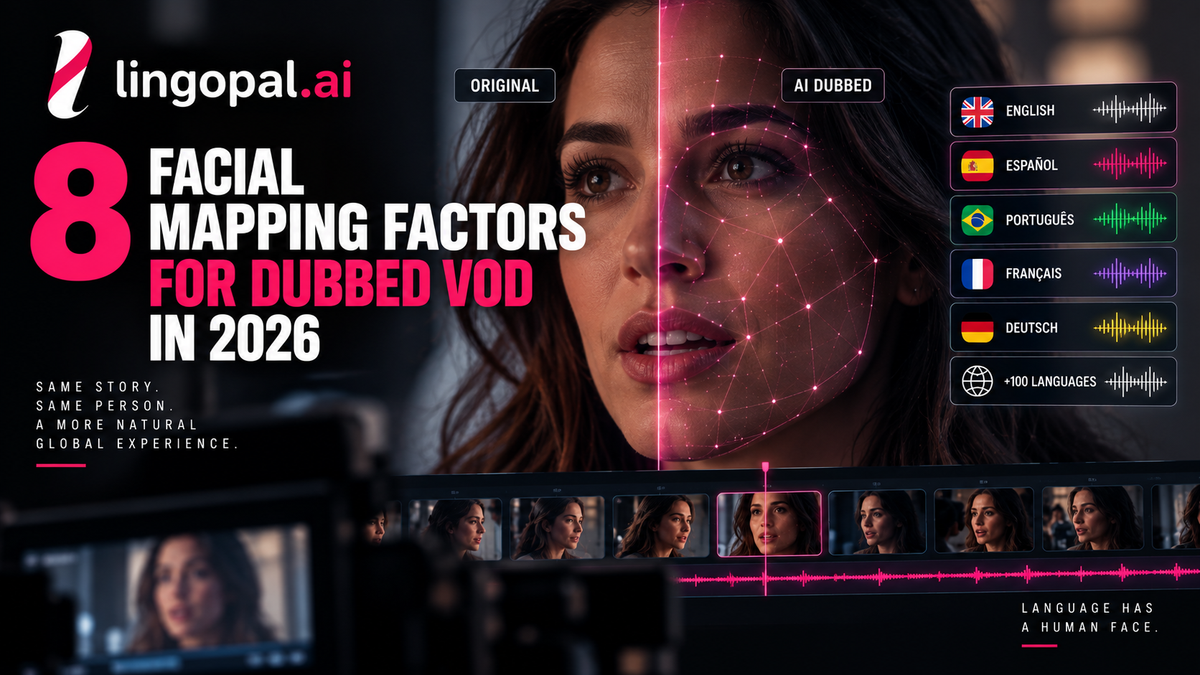
8 Facial Mapping Factors for Dubbed VOD
What Broadcast Teams Should Evaluate for More Realistic AI-Dubbed Video
Facial mapping for dubbed videos uses AI to analyze a speaker's facial movement and help align visible speech with translated audio. For broadcasters and media organizations, the goal is simple: when audiences watch localized VOD, the person on screen should look naturally connected to the words they hear.
That becomes increasingly important as AI dubbing improves.
A translated voice may sound natural. The translation may be accurate. The speaker's voice may even retain its original character and emotion.
But if the mouth clearly forms words from another language, viewers can still immediately recognize the localization.
Facial mapping and lip-sync technology attempt to reduce that disconnect.
For media teams evaluating AI video localization in 2026, however, realistic facial mapping requires much more than making lips move.
Here are the eight factors that matter most.
Quick Answer: What Makes Facial Mapping for Dubbed Videos Look Realistic?
Realistic facial mapping combines accurate lip synchronization, identity preservation, natural facial animation, expression preservation, multilingual timing, active-speaker detection, artifact control, and production-ready quality assurance.
A modern VOD localization workflow may look like:
Source Video → Transcription → Translation → AI Dubbing → Timing Alignment → Speaker Detection → Facial Mapping → Lip Sync → Quality Review → Localized VOD
The best result is not necessarily the video with the most visible AI manipulation.
It is the video where audiences stop noticing the localization technology and focus on the content.
1. Lip Synchronization Accuracy
The most obvious factor is lip synchronization.
Translated audio needs to correspond convincingly with visible mouth movement.
But evaluating lip sync is more complicated than checking whether the mouth opens when speech begins.
Broadcast teams should inspect:
- Sentence starts
- Sentence endings
- Consonants
- Vowel shapes
- Pauses
- Fast speech
- Long sentences
- Short reactions
- Mouth closures
Some sounds create especially visible mouth shapes.
If those moments consistently contradict the translated audio, the dub can feel artificial even when everything else is technically correct.
What should teams test?
Use full sentences at normal playback speed.
Do not approve a platform by freezing one impressive frame.
Dubbed video playback is continuous. Quality needs to be evaluated the same way.
2. Speaker Identity Preservation
Facial mapping should change speech-related movement without making the person look like somebody else.
This is one of the most important evaluation criteria.
Watch:
- Facial proportions
- Lips
- Jawline
- Teeth
- Skin texture
- Chin
- Cheeks
- Nose boundaries
Poor facial animation can create subtle identity changes.
The speaker may technically remain recognizable but suddenly appear visually unnatural.
This effect becomes particularly noticeable with celebrities, athletes, anchors, executives, instructors, or other people audiences already recognize.
The ideal result is:
Same person. New language.
Not:
New language. Slightly different face.
3. Natural Facial Animation
Real people do much more than open and close their mouths while speaking.
Speech creates subtle movement throughout the lower face.
The jaw moves.
The cheeks respond.
Expressions change.
The face transitions between sounds.
Strong facial animation should therefore avoid making the mouth look like an independent animated layer pasted onto otherwise static footage.
Look for:
- Smooth transitions
- Natural jaw motion
- Consistent facial geometry
- Realistic mouth opening
- Stable skin texture
The mapped region should remain visually connected to the rest of the face.
4. Expression and Emotion Preservation
Facial mapping can technically improve lip sync while making the overall performance worse.
Imagine an athlete giving an emotional post-game interview.
Or a documentary subject pausing before discussing something personal.
Or a presenter smiling during an announcement.
The original facial expression carries meaning.
Localization should preserve:
- Smiles
- Tension
- Surprise
- Sadness
- Excitement
- Hesitation
- Seriousness
This is where facial mapping connects directly with voice preservation.
The translated audio and mapped face need to communicate the same emotional moment.
A smiling voice paired with a visually flattened expression can feel just as unnatural as poor lip sync.
5. Multilingual Timing
Languages do not occupy identical amounts of time.
Consider one sentence translated from English into:
Spanish
Portuguese
French
German
Japanese
The translated versions may have different:
- Word counts
- Syllable counts
- Sentence lengths
- Rhythms
- Pause structures
That creates one of the hardest challenges in realistic video dubbing.
Facial mapping cannot simply reproduce one generic mouth animation across every target language.
The visual timing needs to respond to the actual translated performance.
A useful test
Take one source clip and localize it into several languages.
Then compare each version independently.
Ask:
Does this look like a natural performance in this language?
Not simply:
Does this look similar to the English version?
6. Active-Speaker Detection
Many VOD programs contain more than one visible person.
Consider:
Interviews
Panel discussions
Documentaries
Sports features
Reality programming
News packages
If two people appear on screen while only one speaks, the facial mapping system needs to know which person should be modified.
This is where active-speaker detection becomes important.
A production system should correctly identify:
Who is speaking?
When do they start?
When do they stop?
Who speaks next?
Incorrect speaker selection can create one of the most obvious localization failures possible: the wrong person's mouth moving with somebody else's voice.
Test difficult situations
Include:
- Two people in frame
- Reaction shots
- Interruptions
- Rapid speaker changes
- Off-camera dialogue
- Background faces
- Overlapping speech
Do not evaluate speaker detection only with one-person talking-head footage.
7. Visual Artifact Control
AI-generated facial modifications can introduce artifacts.
These may include:
- Flickering
- Blurred lips
- Warped teeth
- Unnatural mouth shapes
- Jaw distortion
- Skin inconsistencies
- Frame-to-frame instability
Artifacts become more likely under difficult conditions.
Test footage containing:
- Profile angles
- Head movement
- Facial hair
- Glasses
- Low light
- Strong shadows
- Hair crossing the face
- Hands near the mouth
- Microphones covering part of the face
- Fast camera movement
A facial mapping tool that performs beautifully on a studio presenter may behave very differently on documentary or entertainment footage.
Test your difficult footage first—not last.
8. Production Workflow Fit
The final factor is broader than facial animation itself.
The technology needs to fit the localization workflow.
Broadcast teams should evaluate whether they can:
- Upload or ingest required formats
- Preserve source timecodes
- Review translated scripts
- Correct terminology
- Regenerate individual segments
- Compare source and localized versions
- Review captions
- Approve voice tracks
- Review mapped faces
- Export required masters
A spectacular facial-mapping model that requires excessive manual reconstruction may not scale across a large VOD library.
The best tool is one that produces strong visual results inside a manageable production workflow.
BOOK A FREE DEMO
Want to see what your existing video could look and sound like in another language?
Why Facial Mapping Matters More for Some VOD Than Others
Not every piece of localized video needs facial mapping.
The value depends heavily on how visible the speaker is.
High-value use cases
Facial mapping can be particularly valuable for:
- Interviews
- Presenter-led programming
- Documentaries
- Athlete content
- Executive communications
- Training videos
- Educational courses
- Talking-head social content
Lower-value use cases
It may provide less benefit for:
- Voice-over documentaries
- Screen recordings
- Gameplay
- Animation
- Slides
- B-roll
- Off-camera narration
If viewers rarely see the speaker's mouth, spending additional processing time on facial mapping may produce little improvement.
This makes content classification an important part of scalable AI video localization.
Facial Mapping vs. Traditional Dubbing
Traditional dubbing usually adapts the translated script and performance to fit the existing picture.
The video remains unchanged.
Facial mapping introduces another option:
adapt the visible performance to the localized audio.
That does not eliminate the need for good translation or timing.
In fact, the strongest workflow combines both approaches.
First, create a translated performance that reasonably fits the scene.
Then use facial mapping to reduce the remaining visual mismatch.
Trying to solve poor timing entirely through facial manipulation can produce unnatural results.
Facial Mapping vs. Lip-Sync Technology
These terms are sometimes used interchangeably, but they can describe different scopes.
Lip-sync technology generally focuses on synchronizing visible mouth movement with speech.
Facial mapping can involve broader tracking of facial landmarks and speech-related motion.
For procurement purposes, broadcasters should avoid becoming overly focused on terminology.
Ask instead:
What exactly does the system modify?
How does it preserve identity?
How does it handle expressions?
How does it handle multiple speakers?
What happens during difficult camera angles?
The output matters more than the product label.
How Should Broadcasters Measure Facial Mapping Quality?
Create a repeatable evaluation scorecard.
Lip-Sync Quality
Do mouth movements align naturally with translated speech?
Identity Preservation
Does the speaker continue to look like themselves?
Expression Preservation
Are emotional cues retained?
Visual Stability
Are there flickers, warping, or inconsistent frames?
Multilingual Performance
Does quality remain consistent across languages?
Speaker Detection
Does the system modify the correct person?
Difficult-Shot Performance
How does it handle profiles, movement, shadows, and obstruction?
Workflow Efficiency
How much human correction is required?
These criteria make comparisons between facial mapping tools much more useful than watching vendor highlight reels.
What Does a Production-Ready Facial Mapping Test Look Like?
Select a short set of representative source clips.
Include:
Clip 1 — Clean talking head
Establish baseline quality.
Clip 2 — Emotional interview
Evaluate expression preservation.
Clip 3 — Two speakers
Test speaker detection.
Clip 4 — Profile angle
Test facial geometry.
Clip 5 — Fast dialogue
Evaluate synchronization.
Clip 6 — Difficult lighting
Look for artifacts.
Clip 7 — Facial obstruction
Use glasses, hair, microphones, or hand movement.
Clip 8 — Multiple languages
Compare timing and realism across target languages.
This test library provides a much more realistic assessment than one carefully selected demo.
Facial Mapping for Sports VOD
Sports organizations produce enormous amounts of content outside live matches.
That includes:
- Athlete interviews
- Press conferences
- Behind-the-scenes series
- Documentaries
- Training content
- Social video
- Original programming
Much of this content features recognizable people speaking directly to camera.
Facial mapping can make localized versions feel more cohesive when paired with high-quality AI dubbing.
A Brazilian fan, for example, can watch a localized athlete interview in Portuguese while the translated voice and visible speech feel more naturally connected.
Facial Mapping for News and Documentary Content
News and documentaries require additional editorial care.
Visual realism should never alter the meaning of what a person originally communicated.
Teams should maintain:
- Translation review
- Editorial approval
- Consent procedures
- Synthetic-media policies
- Clear source records
Facial mapping should improve the viewing experience without creating misleading visual implications.
For sensitive journalism, authenticity and editorial integrity remain more important than perfect lip synchronization.
Facial Mapping for Education
Educational video is another strong use case.
Universities, training providers, and educational platforms often maintain large libraries of instructor-led content.
AI localization can translate:
- Lectures
- Courses
- Tutorials
- Training programs
- Educational explainers
When instructors remain visible for long periods, facial mapping can help the localized version feel less disconnected.
This can be especially useful when the same course is distributed across many markets.
How Facial Mapping Fits With AI Dubbing
Facial mapping should be viewed as one component of a broader localization architecture.
A complete workflow might look like:
SOURCE VIDEO
↓
SPEECH RECOGNITION
↓
TRANSLATION
↓
TERMINOLOGY REVIEW
↓
AI VOICE / VOICE PRESERVATION
↓
TIMING ALIGNMENT
↓
ACTIVE-SPEAKER DETECTION
↓
FACIAL MAPPING
↓
LIP SYNCHRONIZATION
↓
CAPTIONS
↓
HUMAN QUALITY REVIEW
↓
LOCALIZED MASTER
No single component can compensate for failures everywhere else.
Realistic localization comes from the complete system.
Where Lingopal Fits
Lingopal helps broadcasters, media organizations, sports organizations, educators, enterprises, and content owners transform existing video into multilingual experiences.
For recorded content, AI-powered localization can combine:
- Translation
- AI dubbing
- Voice preservation
- Captions
- Multilingual delivery
- VOD localization workflows
Facial mapping can complement that process when visible speakers make lip synchronization important to the viewing experience.
The objective is not simply translating dialogue.
It is preserving as much of the original experience as possible across languages.
Same speaker.
Same story.
New language.
More natural playback.
Frequently Asked Questions
What is facial mapping for dubbed videos?
Facial mapping for dubbed videos uses AI to analyze and adjust speech-related facial movement so the visible speaker aligns more naturally with translated audio.
Why is facial mapping important for AI dubbing?
Without visual adaptation, translated speech may sound natural while the speaker's mouth visibly forms words from the original language. Facial mapping reduces this mismatch and can make dubbed playback feel more cohesive.
Is facial mapping the same as lip sync?
Not always. Lip synchronization generally focuses on mouth movement, while facial mapping can include broader facial landmarks, jaw motion, expressions, and other speech-related movement.
What makes facial mapping realistic?
Realistic results depend on lip synchronization, identity preservation, expression preservation, natural facial animation, correct speaker detection, multilingual timing, artifact control, and strong source video.
Can facial mapping work in different languages?
Yes, but each target language should be evaluated separately because sentence length, phonetics, rhythm, and visible speech patterns differ.
Does facial mapping work with multiple speakers?
It can, depending on the system. Multi-speaker content requires reliable active-speaker detection so facial modifications are applied to the correct person.
Does every dubbed video need facial mapping?
No. It provides the most value when speakers' faces and mouths are clearly visible. Voice-over, B-roll, animation, and screen-based content may not benefit significantly.
What should broadcasters test before choosing facial mapping software?
Test close-ups, profile angles, multiple speakers, fast speech, expressions, poor lighting, facial obstruction, multiple languages, compressed output, and real production footage.
Final Thoughts
Facial mapping for dubbed videos should make localization less noticeable—not make the AI more noticeable.
That is the most important evaluation principle.
The strongest technology does not simply generate perfectly moving lips.
It protects the complete performance:
Identity.
Expression.
Voice.
Timing.
Meaning.
Visual continuity.
For broadcast teams evaluating facial mapping in 2026, the best question is not:
"How impressive does this AI effect look?"
It is:
"Would our audience stop thinking about the dubbing and simply watch the content?"
When the answer is yes, facial mapping is doing its job.
BOOK A FREE DEMO
See how Lingopal can help transform your existing VOD content into multilingual experiences with AI dubbing, captions, voice preservation, and modern localization workflows.