Speech-to-Speech vs. Text AI: Broadcast Translation
Speech-to-Speech vs. Text AI: Broadcast Translation
Difference between speech-to-speech and speech-to-text AI translation for broadcasts?
Defining the Core Technologies: Speech-to-Text vs. Speech-to-Speech AI for Broadcast
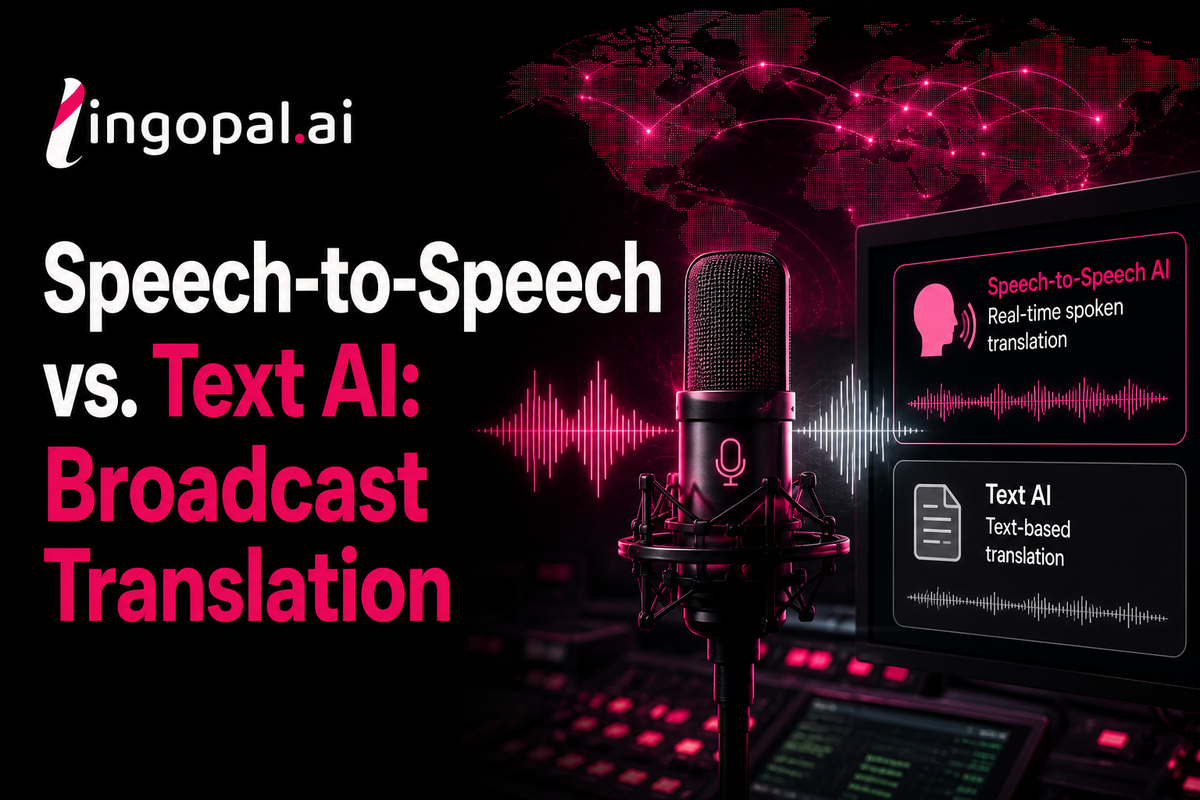
Speech-to-text converts live audio into written transcripts within the source language. Speech-to-speech generates dubbed audio in target languages while preserving the original speaker's vocal characteristics and emotional tone. This determines whether your broadcast reaches existing language markets or expands into new ones.
Speech-to-Text: Single-Language Transcription
Speech-to-text AI processes acoustic signals through neural networks, producing written transcripts with 95%+ accuracy in controlled conditions. When Spanish commentary enters the system, Spanish text comes out. No translation occurs.
Professional broadcast STT handles automated captioning, content archiving, and compliance documentation. Accuracy drops to 85-90% with crowd noise, multiple speakers, or specialized terminology.
Speech-to-Speech: Cross-Language Audio Generation
Speech-to-speech AI processes source audio and outputs spoken audio in different languages. Lingopal AI Translation processes live Spanish commentary and delivers English audio that maintains the broadcaster's vocal identity and emotional inflection.
The system performs acoustic analysis, language translation, and synthetic speech generation in one pipeline. Advanced implementations preserve speaker characteristics, emotional tone, and timing alignment with video content.
Operational Impact: Audience Reach vs. Workflow Efficiency
STT supports accessibility within existing language markets through captions and searchable archives. S2S supports expansion into new markets through dubbed audio that sounds like the original broadcaster.
Technical requirements differ significantly. STT needs text rendering systems and subtitle synchronization. S2S needs audio mixing and voice-processing infrastructure.
Lingopal's platform supports SRT, HLS, RTMP, and MP4 formats for both approaches.
Speech-to-Text AI in Broadcasting: Applications and Limitations
Automated Captioning: Accessibility Without Translation
STT technology generates synchronized text overlays with sub-second latency, meeting accessibility requirements for existing language audiences. Production-grade systems reach 98% accuracy for clear speech but struggle with sports commentary due to rapid pacing and dense vocabulary.
Content Archiving: Searchable Broadcast Libraries
Networks use automated transcription to index large archives, enabling keyword search, speaker identification, and topic categorization. This fits post-production workflows where batch processing allows higher-accuracy models and human correction.
The Language Barrier Problem
STT hits a functional limit: language boundaries. A perfectly transcribed English broadcast remains inaccessible to Spanish-speaking audiences without additional translation steps.
Traditional workflows become: speech → text → translated text → synthesized speech. Each stage adds latency and introduces potential errors. Direct speech-to-speech translation eliminates intermediate steps while better preserving timing and speaker characteristics.
Speech-to-Speech AI Translation for Broadcast: Market Expansion Technology
Direct Audio-to-Audio Processing
Speech-to-speech AI analyzes acoustic features, linguistic content, and prosody in the source language, then generates corresponding audio in target languages. This approach reduces processing time from minutes to seconds while preserving vocal characteristics that text-based workflows often lose.
The system supports real-time processing for live broadcasts and batch processing for on-demand content through the same pipeline.
Lingopal's Broadcast-Specific Implementation
Lingopal AI Translation delivers approximately 15 seconds of latency for live dubbing while producing captions from a single input feed. The platform supports SRT, HLS, RTMP, MP4, and API outputs without custom development for standard broadcast setups.
The system achieves BLEU scores of 61+ across 100+ languages. Production teams integrate through standard broadcast protocols, which reduces deployment complexity.
Voice Cloning and Emotion Preservation
Voice cloning analyzes timbre, pitch patterns, and speaking rhythm to generate translated audio that preserves the original broadcaster's recognizable traits. Audiences maintain their connection with specific personalities across language barriers.
Emotion detection models preserve affect during translation. Excitement in sports commentary or urgency in news reporting carries across languages, delivering similar viewing experiences to international audiences.
Strategic Implementation: Matching Technology to Broadcast Requirements
Technical Requirements Assessment
Live sports demand sub-15-second latency with preserved vocal intensity. News programming prioritizes accuracy and terminology control. Documentary content requires natural phrasing and cultural adaptation.
Speech-to-text fits archival workflows, compliance documentation, and post-production efficiency. Speech-to-speech fits audience expansion, real-time international distribution, and viewing experiences where voice authenticity drives engagement.
Vendor Evaluation Criteria
Enterprise broadcast translation requires confirmed technical specifications, not marketing promises. Evaluate vendors on documented latency metrics, supported ingest formats, and named client implementations.
Production-grade systems must support SRT, HLS, RTMP, and MP4 ingest without custom development. API integration must handle peak concurrent streams without degradation. BLEU scores above 60 indicate professional-grade performance, though human validation remains necessary.
Voice cloning capabilities separate basic translation from broadcast-quality output. The technology must preserve speaker identity while adapting linguistic content. Review Lingopal translation pricing for enterprise deployment cost analysis.
Proven Results in Live and VOD Content
Lingopal processes both live streams and video-on-demand content through a unified pipeline, eliminating separate translation workflows. NBA League Pass translates multiple games weekly into Spanish, French, and Portuguese using this approach.
International viewership increases when native-language audio is available beyond text-only subtitles. Speech-to-speech translation produces viewing experiences that feel closer to local production than captioned content.
Implementation Strategy
Start with pilot testing on non-critical content. Evaluate output quality against brand standards, then measure engagement metrics before and after multilingual audio deployment.
Technical integration requires API documentation review and infrastructure planning.
Schedule a demo to evaluate how the platform supports your broadcast protocols and reduces integration time for existing workflows.
Choose the technology that serves your operational requirements and audience growth goals.
Frequently Asked Questions
What is the difference between speech-to-speech and speech-to-text AI translation?
Speech-to-text AI converts spoken audio into written text within the same language, serving transcription needs. Speech-to-speech AI performs end-to-end translation, generating spoken audio in a target language from source audio. This distinction determines whether the output is text for captions or dubbed audio for new markets.
What are speech-to-text AI tools used for in broadcasting?
Speech-to-text AI tools are used in broadcasting for automated captioning and subtitling, which improves accessibility. They also facilitate content archiving and searchability by creating searchable metadata from broadcast libraries. These systems deliver high accuracy for clear speech, making them suitable for internal content management.
Is text-to-speech (TTS) considered an AI technology?
Yes, text-to-speech (TTS) is an AI technology. It uses neural networks to convert written text into spoken audio. In advanced speech-to-speech AI systems, synthetic speech generation, a form of TTS, is a key component for producing translated audio outputs.
How does text-to-speech (TTS) relate to AI translation for broadcasts?
Text-to-speech is an AI application that transforms written text into spoken audio. For broadcast AI translation, particularly with speech-to-speech systems, TTS is integrated to generate the final translated audio. This allows for the preservation of speaker identity and emotional tone, moving beyond simple text output.
What are the primary applications of speech-to-speech AI in broadcasting?
Speech-to-speech AI in broadcasting primarily supports expansion into new language markets through dubbed audio. It enables real-time translation of live commentary, preserving the original speaker's vocal identity and emotional inflection. This technology delivers multilingual audio outputs directly, reaching broader audiences.
How does speech-to-speech AI preserve a speaker's voice and emotion during translation?
Advanced speech-to-speech AI systems use voice cloning to analyze and replicate a speaker's timbre, pitch patterns, and speaking rhythm in the translated audio. Emotion detection models work to carry the original affect, such as excitement or urgency, across languages. This ensures the translated output maintains the original speaker's recognizable vocal traits and emotional tone.
What are the main limitations of speech-to-text AI for global broadcast reach?
The primary limitation of speech-to-text AI is its confinement to a single language; it does not perform translation. While it provides accurate transcripts, a broadcast transcribed in one language remains inaccessible to audiences speaking other languages without additional translation steps. This text-first approach can introduce latency and potential errors compared to direct speech-to-speech translation.