Blended LLM & NMT vs Pure LLM for Live Translation
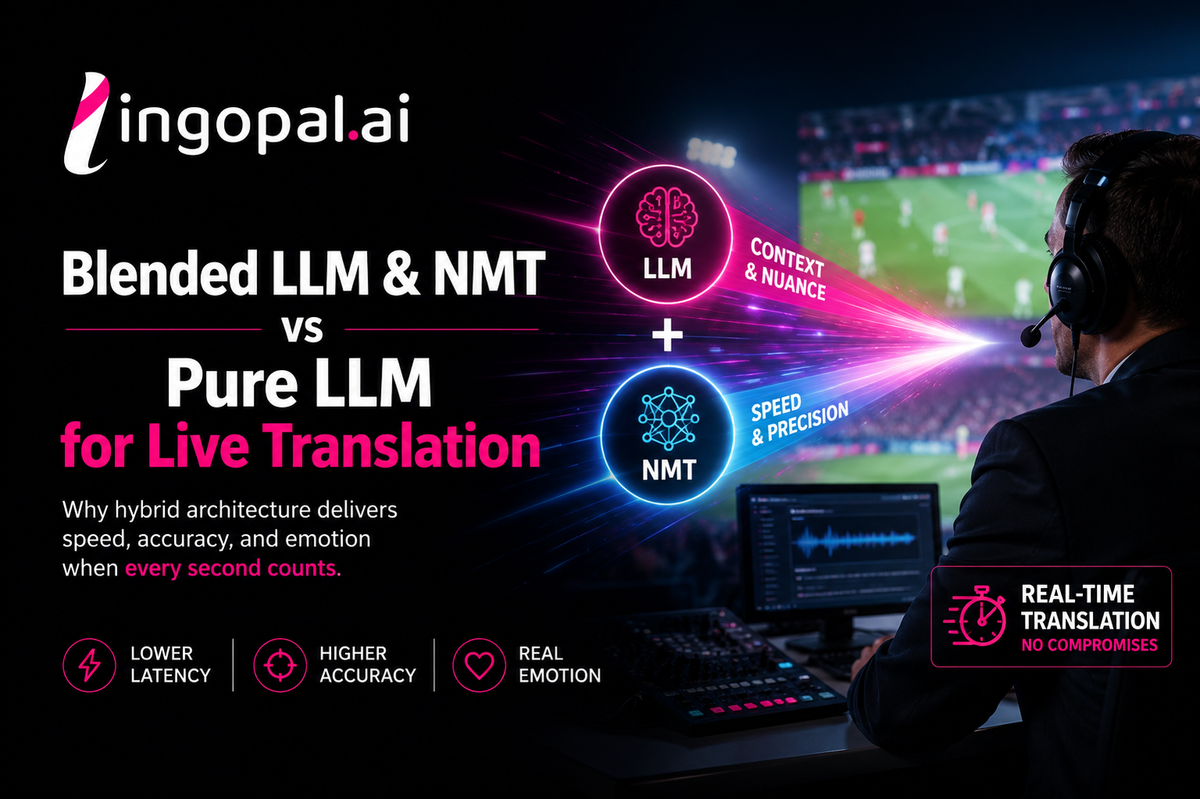
Is a blended LLM and NMT architecture actually better for live broadcast translation than a pure LLM approach?
The demands of live broadcast translation present a unique set of technical challenges. Unlike static content, live streams require immediate, accurate, and contextually aware language conversion. This necessitates architectures that can process continuous audio feeds, maintain synchronization, and deliver output with minimal delay. The question of how to best achieve this has led to a critical debate: Is a blended LLM and NMT architecture actually better for live broadcast translation than a pure LLM approach? Understanding the fundamental differences in how these models handle language processing is key to identifying the optimal solution for enterprise-grade broadcast operations.
Key Takeaways
- Live broadcast translation requires architectures that minimize delay while maintaining synchronization across continuous audio feeds.
- Blended LLM and NMT systems offer distinct advantages for enterprise operations by combining speed with contextual awareness.
- Understanding the processing differences between pure LLM and hybrid models is essential for optimizing live translation workflows.
Table of Contents
- The Core Differences Between Pure LLM and Blended NMT/LLM Architectures
- Why Latency and Ingest Protocols Dictate Live Broadcast Architecture
- Maintaining Voice Cloning and Emotion Detection in Real-Time
- Real-World Deployment: How Blended Architecture Powers Live Sports
At Lingopal, we have extensively evaluated both pure Large Language Model (LLM) and Neural Machine Translation (NMT) systems, alongside hybrid NMT/LLM configurations, within demanding live broadcast environments. Our experience shows that while LLMs offer remarkable fluency and contextual understanding, they often introduce latency that is unacceptable for real-time scenarios. Conversely, NMT excels at speed but can struggle with the idiomatic expressions and nuanced cultural references common in live commentary. This presents a clear operational bottleneck for pure LLM systems. The goal is not just translation, but translation that preserves the integrity and timing of the original broadcast.
The Core Differences Between Pure LLM and Blended NMT/LLM Architectures
How pure LLM translation processes context and nuance
Large Language Models (LLMs) operate on a principle of predicting the next token in a sequence, drawing from vast datasets encompassing virtually all forms of human text. This training methodology grants them exceptional capabilities in understanding broad context, generating fluent prose, and adapting to subtle shifts in tone or style. For translation, this means an LLM can often produce output that sounds remarkably natural and can handle complex sentence structures or idiomatic expressions that might stump traditional systems. When applied to broadcast, an LLM can grasp the overarching narrative of a sports match or a political debate, translating not just words but the implied sentiment or cultural references. This advanced contextual processing is a significant advantage, allowing for translations that feel less like literal conversions and more like natural speech.
But, this very flexibility introduces challenges for live applications. The generative nature of LLMs, while powerful for creativity, can lead to variability in output. Even with techniques like constrained decoding, repeated translations of the same source segment might yield slightly different results. This unpredictability is a risk in broadcast where consistency in terminology, names, and factual reporting is paramount. Also, the computational demands for processing long contexts and generating token by token typically result in higher latency. Industry benchmarks indicate that pure LLM translation can often exceed 2 seconds for equivalent quality output compared to NMT systems, a delay that significantly impacts the live viewing experience.
Why NMT remains relevant for low-latency requirements
Neural Machine Translation (NMT) models, particularly those built on the Transformer architecture, were originally developed with translation as their primary objective. Unlike LLMs, NMT systems are trained on massive parallel corpora. Aligned sentence pairs in source and target languages. This specialized training equips them to excel at direct, accurate translation of specific phrases and sentences. Their encoder-decoder structure is optimized for mapping source language meaning to target language output efficiently. Because of this, NMT models are inherently faster, often achieving sub-500ms latency for live translation tasks. This speed is fundamental for applications where real-time delivery is non-negotiable, such as live commentary, simultaneous interpretation, or subtitling.
The advantage of NMT in low-latency scenarios is well-established. For example, industry benchmarks show NMT achieving translation speeds significantly faster than pure LLMs. While NMT might not always capture the same level of idiomatic fluency or subtle contextual nuance as a sophisticated LLM, its reliability and speed make it indispensable for live broadcast. The ability to process continuous streams with minimal delay ensures that the translated audio or captions remain synchronized with the on-screen action. This makes NMT a foundational technology for meeting the strict performance requirements of broadcast workflows, even as LLMs advance.
Feature
Pure LLM Architecture
Blended NMT/LLM Architecture
Contextual Understanding
High; excels at broad narrative and nuance.
High; leverages LLM for context, NMT for specific segments.
Fluency & Naturalness
Very High; often sounds native.
High; balances NMT accuracy with LLM fluency.
Latency
Typically > 2 seconds; can be a bottleneck for live.
Sub-second to ~15 seconds (for dubbing); optimized for broadcast timing.
Consistency & Predictability
Moderate; output can vary across runs.
High; NMT component ensures low variability for critical terms.
Idiomatic/Cultural Handling
Excellent; strong grasp of idioms and cultural references.
Good to Excellent; LLM component addresses complex phrasing.
Computational Cost
Higher per token/inference.
Optimized; balances cost with performance needs.
Suitability for Live Broadcast
Challenging due to latency and consistency concerns.
Ideal; designed to meet strict broadcast requirements.
Why Latency and Ingest Protocols Dictate Live Broadcast Architecture
Managing continuous streams with SRT, HLS, and RTMP ingest
Live broadcast workflows depend on strong and reliable ingest protocols to handle continuous video and audio streams. Technologies like Secure Reliable Transport (SRT), High-Level Synthesis (HLS), and Real-Time Messaging Protocol (RTMP) are standard for transmitting live content from source to processing or distribution points. SRT, in particular, offers low-latency streaming with high reliability, making it suitable for challenging network conditions. HLS is widely used for adaptive bitrate streaming, allowing viewers to receive the best quality stream based on their network. RTMP, though older, remains prevalent for live streaming applications. For any AI translation solution integrated into broadcast, supporting these common ingest formats without requiring complex code integration is paramount. This ensures that the translation engine can smoothly connect to existing broadcast infrastructure, minimizing setup time and technical hurdles.
The ability of a translation system to accept streams via SRT, HLS, RTMP, or even API ingest directly addresses a core operational requirement for broadcasters. It means the AI translation pipeline can be integrated without demanding significant changes to established content delivery networks or production workflows. This flexibility is not merely a convenience; it is a critical factor in deploying AI translation at scale. When a solution, such as Lingopal AI Translation, supports these diverse ingest methods out-of-the-box, it drastically reduces the barrier to adoption and ensures compatibility across a wide spectrum of broadcast setups. This foundational support allows broadcasters to focus on the quality of the translation itself, rather than on the complexities of video stream handling.
Balancing approximately 15 seconds of latency for live dubbing with real-time captioning
Achieving precise timing is a defining characteristic of effective live translation. For live dubbing, a latency of approximately 15 seconds is often the maximum acceptable threshold to maintain synchronization with on-screen action and presenter speech. This allows for the AI to process the source audio, generate the translated script, and perform speech synthesis, all while remaining closely aligned with the visual feed. Simultaneously, delivering real-time captions. Which typically require even lower latency, often under 1 second. From the same single input feed presents a complex engineering challenge. A system must manage two distinct output streams with different timing requirements. This dual-output capability from a single source stream is where architectural design proves its worth, ensuring that both high-quality dubbed audio and instantaneous captions are produced without compromising each other.
The architecture must support both high-fidelity dubbing with controlled latency and instantaneous captioning. Lingopal AI Translation achieves this by employing a blended approach that optimizes each output independently, all managed from a single source feed. This capability is essential for broadcasters needing to serve diverse audience preferences without duplicating processing pipelines.
This balance is not easily achieved. Pure LLM approaches often struggle to meet the sub-second latency required for real-time captions while simultaneously producing dubbed audio within the 15-second window. A blended architecture, but, can strategically assign tasks. For example, an NMT component might handle the initial rapid transcription and translation for captions, while an LLM refines the dubbed output for naturalness and nuance, all within the stipulated latency budgets. The ability to generate both outputs from a single input feed, supporting formats like SRT, HLS, RTMP, MP4, and API ingest without code, is a testament to the sophisticated engineering behind such systems. This integration simplifies broadcast operations, allowing for wider reach and engagement across different language markets.
Maintaining Voice Cloning and Emotion Detection in Real-Time
Preserving speaker identity across multiple languages
For broadcast professionals, maintaining the unique vocal characteristics and emotional tone of a speaker across translated languages is not a secondary concern; it is fundamental to authentic communication. Pure Large Language Models (LLMs), while adept at generating fluent text, can sometimes homogenize vocal output, leading to a generic synthesized voice that loses the speaker's original identity. This is particularly problematic in contexts where the presenter's charisma or authority is intrinsically linked to their voice. A blended architecture addresses this by allowing for sophisticated voice cloning models to be precisely applied. These models can capture and replicate the nuances of pitch, cadence, and timbre, ensuring that the translated voice remains recognizably the original speaker, even when speaking a different language. This capability moves beyond simple translation to deliver a faithful audio representation.
Neural Machine Translation (NMT) models, in their standard form, do not typically incorporate voice cloning or emotional fidelity. Their focus is strictly on linguistic accuracy and speed. This is where a hybrid approach offers a distinct advantage. By integrating specialized NMT components for rapid, accurate text translation with advanced LLM-driven or dedicated voice synthesis modules, a blended system can achieve superior results. For example, the NMT can handle the core translation task, feeding into an LLM-enhanced voice cloning engine that then reconstructs the speech, preserving the speaker's identity. This architecture allows for the translation of over 100 languages while maintaining the speaker's unique vocal signature, a capability that is often overlooked in comparisons focusing solely on word-for-word accuracy.
How architecture choices impact emotional fidelity preserved in live commentary
The emotional resonance of live commentary is often what connects most deeply with an audience. A flat, toneless translation can strip away the excitement of a game-winning goal or the gravity of a significant announcement. While LLMs demonstrate a strong capacity for understanding and generating text with emotional coloring, their application in real-time, high-volume broadcast scenarios can be hampered by latency and consistency issues. NMT, on the other hand, prioritizes speed over emotional nuance. A blended architecture offers a pathway to bridge this gap. It can use NMT for the rapid, accurate translation of factual statements and calls, while employing LLM capabilities to interpret and convey the emotional context of the source audio. This allows the translated output to reflect the original speaker's enthusiasm, urgency, or solemnity.
The technical implementation of emotional fidelity in live translation is complex. It requires the system to analyze not just the words spoken, but also the prosody, intonation, and pacing of the original delivery. A blended NMT/LLM system can be architected to perform this multi-layered analysis. The NMT component ensures that the core message is translated quickly and accurately, meeting the stringent latency requirements for live broadcasts. Subsequently, LLM-based processing can inject the appropriate emotional tone and delivery style into the synthesized speech, ensuring that the translated commentary carries the same impact as the original. This sophisticated approach is critical for maintaining audience engagement and delivering a broadcast experience that feels authentic and alive, rather than merely functional. This is a capability that pure LLM approaches often struggle to deliver consistently at broadcast scale due to computational overhead and potential variability.
Pros and
Real-World Deployment: How Blended Architecture Powers Live Sports
Juventus FC: Live English-to-Italian translation at scale
The demands of live sports broadcasting require a translation solution that is not only accurate but also exceptionally fast and consistent. When Juventus FC sought to deliver their match commentary to a global Italian-speaking audience in English, the challenge was to replicate the energy and insight of live commentary without introducing delays that would disconnect viewers from the action. A pure LLM approach would struggle to meet the sub-second latency needed for real-time commentary, potentially leading to a disjointed viewing experience. Instead, a blended architecture proved to be the optimal solution, capable of processing the continuous stream of English audio, translating it into Italian, and synthesizing it with minimal delay.
This implementation focused on maintaining the authenticity of the original broadcast. The blended architecture ensured that specific football terminology, player names, and tactical discussions were translated with high fidelity, leveraging the strengths of NMT for precision. Simultaneously, the LLM component refined the output for natural cadence and idiomatic expression, preserving the commentator's original tone and enthusiasm. This allowed Juventus FC to offer a high-quality, localized viewing experience for their international fans, demonstrating that a hybrid model can effectively scale to meet the rigorous demands of major sporting events. The core question of whether a blended LLM and NMT architecture is actually better for live broadcast translation than a pure LLM approach finds a clear answer in such deployments.
NBA League Pass: Delivering multi-language broadcasts weekly
For a service like NBA League Pass, providing multiple language options for every game is a significant operational undertaking. The need to offer diverse commentary streams for fans worldwide necessitates a system that can handle a high volume of concurrent translations reliably. A pure LLM strategy would likely incur prohibitive costs and latency penalties when scaled to cover dozens of games each week across numerous language pairs. The architecture must support continuous, real-time audio streams, translating them into various target languages with consistent quality and acceptable latency. This is precisely where the efficiency and targeted performance of a blended NMT/LLM system shine.
Lingopal AI Translation offers a proven solution for these complex requirements. By integrating NMT for rapid, accurate text translation and LLM capabilities for contextual richness and natural speech synthesis, the system ensures that each language feed is delivered without compromising the viewer's experience. This approach allows for the preservation of speaker identity and emotional nuance, critical for engaging sports commentary. The ability to ingest streams via standard protocols like SRT, HLS, and RTMP, and to support over 100 languages, means that platforms like NBA League Pass can expand their global reach effectively. This validated approach demonstrates clear advantages over relying solely on LLMs for such extensive, real-time multilingual broadcast needs.
Lingopal AI Translation in Action: Enterprise-Grade Broadcast Solutions
The deployment of Lingopal AI Translation for major sports leagues and clubs underscores the practical superiority of a blended LLM and NMT architecture for live broadcast. These deployments are not theoretical exercises; they represent enterprise-grade solutions delivering tangible results. By handling complex ingest protocols like SRT, HLS, and RTMP without code, Lingopal AI Translation simplifies integration into existing broadcast workflows. The system's ability to manage approximately 15 seconds of latency for live dubbing while simultaneously generating real-time captions from a single input feed showcases its advanced engineering. This dual capability, combined with unparalleled voice cloning and emotion detection, ensures that broadcasts are not just translated, but authentically reproduced for global audiences, validating the effectiveness of the blended approach in real-world, high-stakes environments.
References
Frequently Asked Questions
What is the difference between LLM and NMT translation?
LLM translation predicts the next token in a sequence to generate natural output, while NMT (Neural Machine Translation) uses an encoder-decoder structure trained on aligned sentence pairs for direct, accurate translation. NMT achieves sub-500ms latency, making it significantly faster for live applications, whereas pure LLM systems often exceed 2 seconds but handle idiomatic expressions and broad contextual nuance better.
Which LLM is the best for translation?
No single LLM is universally best for translation because the optimal choice depends on specific requirements like latency tolerance, domain vocabulary, and output consistency. Pure LLM architectures, while exceptional at capturing broad narrative context and cultural references, introduce latency exceeding 2 seconds per segment, making them problematic for live broadcast scenarios where timing is non-negotiable.
What are the disadvantages of NMT?
NMT systems struggle with idiomatic expressions, nuanced cultural references, and the complex contextual understanding that live commentary frequently demands. NMT models also require specialized parallel corpora for training, which limits their adaptability to new domains or less common language pairs compared to the vast text datasets that power modern LLMs.
What is one significant difference between NMT models and LLMs in terms of their training data?
NMT models are trained on massive parallel corpora consisting of aligned sentence pairs in source and target languages, while LLMs draw from vast datasets covering virtually all forms of human text. This specialized training makes NMT faster and more predictable for direct phrase translation, while LLMs excel at understanding broad narrative context and generating fluent, natural speech.
What is the best LLM for video translation?
For live video translation, a blended NMT/LLM architecture outperforms any pure LLM approach because it balances the sub-second speed of NMT with the contextual fluency of LLMs. Pure LLM systems introduce latency exceeding 2 seconds, which disrupts the viewing experience and makes real-time broadcast operations like subtitling and simultaneous interpretation challenging to execute reliably.
Why does latency matter in live broadcast translation?
Latency directly impacts viewer experience in live broadcast translation because delays exceeding 500 milliseconds cause translated audio or captions to fall out of sync with on-screen action. Pure LLM translation typically exceeds 2 seconds per segment, which is unacceptable for real-time scenarios like live commentary, where NMT systems consistently achieve sub-500ms performance and maintain broadcast synchronization.