The Real-Time Translation Dilemma: AI-Driven vs. Human Interpretation
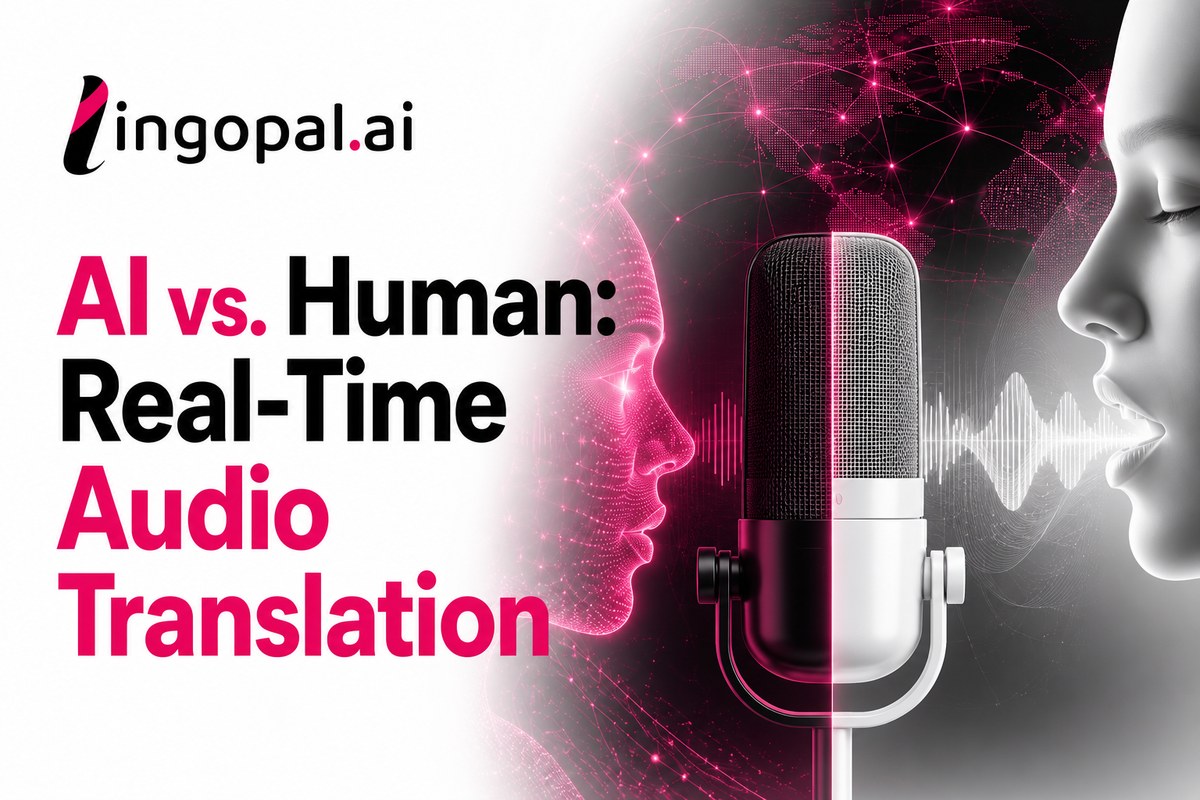
The Real-Time Translation Dilemma: AI-Driven vs. Human Interpretation
Defining Real-Time Audio Translation in Broadcast
Real-time audio translation platforms: Which is better, AI-driven or human interpretation? The answer depends on your operational requirements. Real-time audio translation converts spoken language into target languages within seconds of delivery, letting global audiences access live content simultaneously. In broadcast environments, this means processing audio feeds through SRT, HLS, RTMP, or MP4 streams while maintaining synchronization with video content.
Two distinct approaches dominate this space: AI-driven systems that use neural networks for near-instant processing, and human interpreters who provide contextual understanding. Each serves different broadcast scenarios with measurable tradeoffs in latency, accuracy, and scalability.
Why Accurate Real-Time Translation Matters
Translation errors in live broadcasts create immediate consequences. Mistranslated sports commentary loses emotional impact. Incorrect news translation spreads misinformation. Financial broadcasts with poor translation accuracy can affect market decisions across time zones.
Operational Reality: A single mistranslation during a live earnings call can trigger unintended market reactions. Broadcast teams need systems that deliver consistent accuracy under pressure, not just theoretical performance metrics.
Lingopal's Thesis: Bridging Global Audiences Through Generative AI
Lingopal AI Translation addresses this challenge through generative AI models trained specifically for broadcast content. The platform delivers approximately 15 seconds of latency for live dubbing while producing real-time captions simultaneously. Both outputs generate from a single input feed, eliminating separate translation workflows.
The system supports over 100 languages with BLEU scores of 61+, indicating translation quality that meets professional broadcast standards.
How Lingopal works involves direct integration with existing broadcast infrastructure through API connections and standard streaming protocols.
AI-Driven Audio Translation: Precision, Speed, and Scalability at Enterprise Grade
How Generative AI Delivers Linguistic Fidelity
Generative AI processes audio translation through neural networks trained on millions of parallel text pairs and speech patterns. These models understand context beyond word-for-word substitution, analyzing sentence structure, idiomatic expressions, and domain-specific terminology. The result? Translation that preserves meaning while adapting to target language conventions.
Modern AI systems combine multiple neural architectures: speech recognition models convert audio to text, translation models handle the language conversion, and text-to-speech synthesis generates natural-sounding output. This multi-stage pipeline operates in parallel, reducing processing time while maintaining translation quality across technical, conversational, and specialized content.
Confirmed Performance: Latency, Accuracy, and Language Support
Lingopal AI Translation achieves BLEU scores of 61+ across its supported language pairs, indicating professional-grade translation quality. The platform processes live audio with approximately 15 seconds of latency for dubbed output while generating real-time captions simultaneously.
Technical Specifications: The system supports over 100 languages through SRT, HLS, RTMP, MP4, and API formats. Integration requires no custom coding, allowing broadcast teams to implement translation workflows within existing infrastructure without technical restructuring.
Voice Cloning and Emotion Preservation: Beyond Literal Translation
Advanced AI translation preserves vocal characteristics and emotional tone through voice synthesis technology. The system analyzes pitch patterns, speaking pace, and emotional markers in the original audio, then reproduces these qualities in the target language. This capability maintains speaker identity and content atmosphere across linguistic boundaries.
Voice cloning technology creates consistent audio experiences for recurring speakers, particularly valuable for sports commentators, news anchors, or corporate executives who appear regularly in translated content. The AI learns individual vocal signatures, supporting brand consistency across multiple broadcast sessions.
Addressing Data Security and Privacy in AI Translation Workflows
Enterprise AI translation systems process sensitive audio content that requires strict data protection protocols. Cloud-based platforms implement encryption during transmission and storage, while on-premises deployments keep audio data within controlled environments. Compliance with GDPR, HIPAA, and industry-specific regulations often determines the deployment architecture for different broadcast organizations.
Data retention policies vary significantly between providers. Some systems process audio in real time without persistent storage, while others retain training data to improve model performance. Broadcast teams must evaluate these policies against their content sensitivity requirements and regulatory obligations.
AI Translation Advantages
- Consistent 15-second latency with simultaneous captioning output
- 100+ language support with BLEU scores exceeding 61
- No-code integration with SRT, HLS, RTMP, and MP4 formats
- Scalable processing without human resource constraints
- Voice cloning maintains speaker identity across languages
AI Translation Limitations
- Cultural context requires extensive training data
- Spontaneous slang may challenge real-time processing
- Initial setup costs for enterprise-grade systems
- Dependency on stable internet connectivity for cloud solutions
Human Interpretation: The Nuance and Contextual Understanding Advantage
The Unmatched Human Grasp of Cultural Nuance and Idiomatic Expression
Professional interpreters understand cultural subtext that extends beyond linguistic conversion. They recognize when humor requires cultural adaptation, when formal register shifts are necessary, and how regional dialects affect meaning interpretation. This contextual awareness proves particularly valuable in diplomatic broadcasts, cultural programming, and content with significant local references.
Experienced interpreters adapt their translation approach based on audience demographics and content purpose. They make real-time decisions about preserving original phrasing versus localizing concepts for target audiences, balancing fidelity with comprehension.
When Spontaneity Demands Human Agility: The "Heat of the Moment" Challenge
Live sports commentary, breaking news, and unscripted interviews create linguistic challenges that favor human adaptability. Interpreters process emotional intensity, speaker interruptions, and rapid topic changes while maintaining translation flow. They understand when to prioritize speed over perfection and when accuracy warrants brief delays.
Human interpreters excel in situations requiring immediate cultural judgment calls. When speakers use unexpected references, controversial language, or time-sensitive information, experienced interpreters make contextual decisions that automated systems can't replicate.
The Limitations: Cost, Scalability, and Availability of Human Interpreters
Professional interpretation services require significant budget allocation for multi-language broadcasts. Skilled interpreters command premium rates, particularly for specialized domains like financial reporting, technical presentations, or legal proceedings. Scaling human interpretation across multiple simultaneous language pairs multiplies these costs quickly. Organizations evaluating translation pricing models often find AI solutions provide more predictable cost structures for large-scale operations.
Geographic and time zone constraints limit interpreter availability for global broadcasts. Finding qualified professionals for less common language pairs or emergency coverage can create operational bottlenecks that delay or cancel international programming.
Frequently Asked Questions
What is the best real-time AI interpreter for broadcast content?
For broadcast environments, specialized AI platforms like Lingopal AI Translation offer consistent performance. These systems deliver approximately 15 seconds of latency for live dubbing and simultaneous captions. They integrate directly with existing broadcast infrastructure, supporting over 100 languages with professional-grade BLEU scores.
Which AI platform provides the most accurate real-time translation?
Accuracy in real-time AI translation is measured by metrics like BLEU scores. Platforms like Lingopal AI Translation achieve BLEU scores of 61+ across supported language pairs, indicating professional-grade quality for broadcast content. Generative AI models, trained on extensive parallel text and speech, process context beyond word-for-word substitution, preserving meaning.
Will AI translation replace human interpreters entirely?
AI translation serves different operational requirements than human interpretation. While AI offers speed, scalability, and consistent latency, human interpreters excel in handling spontaneous slang or highly nuanced cultural contexts. The choice depends on specific broadcast scenarios and content sensitivity, with each approach having distinct tradeoffs.
Can general AI tools like ChatGPT perform live audio translation for broadcast?
General AI tools like ChatGPT are not designed for the specific demands of real-time broadcast audio translation. Specialized enterprise AI systems, such as Lingopal, are trained on broadcast content and integrate with streaming protocols. These platforms deliver the precision, speed, and synchronization required for live media.
How does AI ensure linguistic fidelity in real-time audio translation?
Generative AI achieves linguistic fidelity by using neural networks trained on millions of parallel text pairs and speech patterns. These models analyze sentence structure, idiomatic expressions, and domain-specific terminology. This approach ensures the translation preserves original meaning while adapting to target language conventions.
What are the main advantages of AI-driven real-time translation for broadcasters?
AI-driven systems offer consistent 15-second latency with simultaneous captioning, supporting over 100 languages with high accuracy. They provide scalable processing without human resource constraints and integrate with existing broadcast formats like SRT, HLS, RTMP. Voice cloning also maintains speaker identity across languages, which is valuable for recurring speakers.