7 Facial Mapping Questions for VOD Dubbing Teams
A Practical Guide to Evaluating Facial Mapping Tools for Scalable AI Video Localization
Primary Keyword: facial mapping tools
Table of Contents
- What are facial mapping tools?
- Why facial mapping matters for VOD dubbing
- The seven questions every dubbing team should ask
- How facial mapping fits into AI localization workflows
- Common mistakes when evaluating solutions
- Frequently Asked Questions
- Final Thoughts
What Are Facial Mapping Tools?
As AI-powered dubbing becomes standard across streaming platforms, broadcasters and media organizations are looking beyond translation quality.
Viewers don't just listen—they watch.
Even perfectly translated dialogue can feel unnatural when a speaker's lips, facial expressions, and mouth movements no longer match the dubbed audio.
That's where facial mapping tools come in.
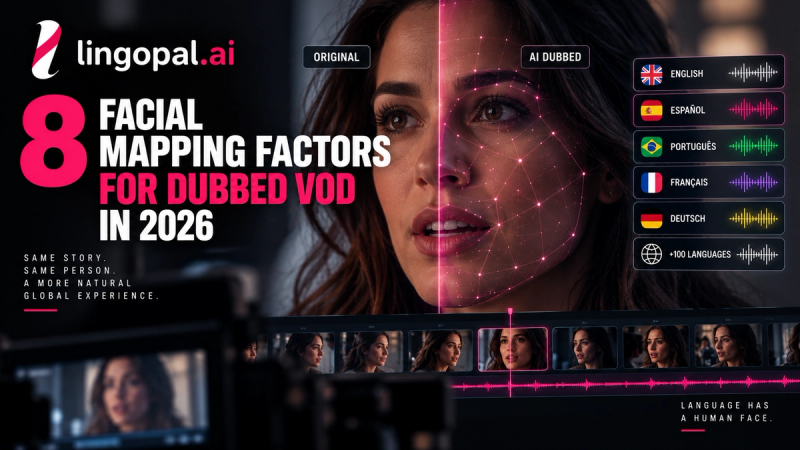
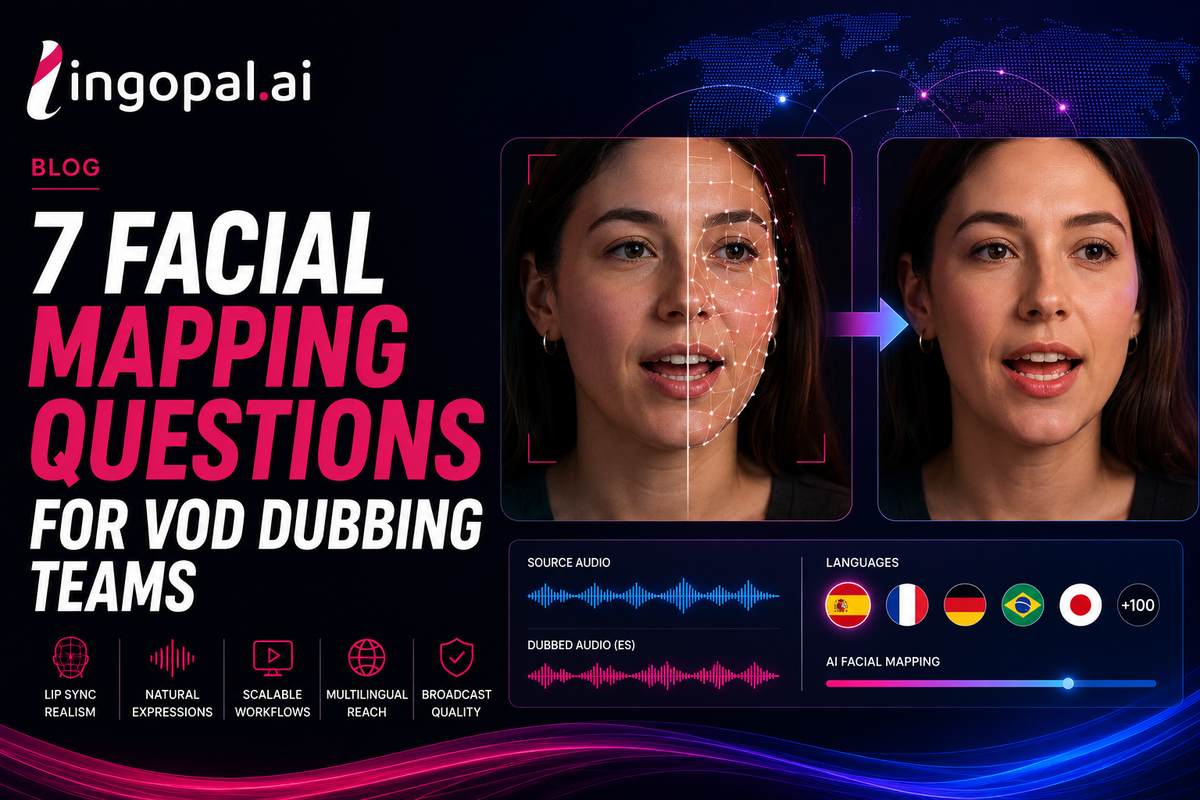
Facial mapping technology analyzes facial landmarks, lip movement, jaw position, and expressions, then adjusts video playback to better synchronize with translated speech. Combined with AI dubbing, it creates a far more natural multilingual viewing experience.
For VOD (Video on Demand) content, facial mapping is becoming an increasingly important part of professional localization workflows.
Why Facial Mapping Matters for VOD Dubbing
Global audiences expect localized content to feel native—not translated.
Whether watching documentaries, interviews, sports highlights, entertainment programming, educational videos, or corporate communications, viewers immediately notice when lip movements don't align with speech.
Modern facial mapping helps solve this challenge by improving:
- Lip synchronization
- Viewer immersion
- Voice authenticity
- Overall production quality
- Audience retention
- Global accessibility
Instead of creating distracting mismatches, AI can now produce localized content that feels significantly more natural.
1. Does the Tool Produce Natural Lip Synchronization?
The first question is the most obvious.
Does the speaker actually appear to be saying the translated words?
Basic systems simply replace audio.
Advanced facial mapping platforms dynamically adjust mouth movement so speech aligns more closely with translated dialogue.
The goal isn't perfect animation.
The goal is reducing visual distraction while maintaining realism.
2. Can It Preserve Natural Facial Expressions?
Facial expressions communicate emotion just as much as speech.
Smiles.
Surprise.
Concern.
Excitement.
Confidence.
Good facial mapping preserves these expressions while modifying only the mouth movements necessary for synchronization.
If expressions become artificial, audiences quickly lose trust.
3. Does It Scale Across Large Content Libraries?
Media organizations rarely localize one video.
They localize thousands.
A practical facial mapping solution should support:
- Large VOD libraries
- Automated processing
- Batch localization
- Cloud workflows
- Multiple simultaneous languages
Scalability is often more valuable than manual perfection.
4. Does It Integrate with Existing Video Localization Workflows?
Facial mapping should not introduce unnecessary production complexity.
Look for solutions that integrate with existing workflows for:
- AI translation
- AI dubbing
- Subtitle generation
- Caption editing
- Video asset management
- Cloud production
- API automation
The fewer manual steps required, the easier it becomes to scale multilingual production.
5. Can It Maintain Speaker Identity?
Viewers connect with people—not just voices.
Modern localization platforms increasingly focus on preserving:
- Voice characteristics
- Facial identity
- Emotional delivery
- Speaking rhythm
- Natural pacing
Facial mapping should enhance these qualities rather than replacing them with artificial-looking animations.
6. How Realistic Is the Final Playback?
The ultimate test is simple:
Would the average viewer notice that the content was localized?
Professional broadcasters should evaluate:
- Mouth synchronization
- Eye movement consistency
- Lighting preservation
- Frame stability
- Visual artifacts
- Overall realism
Natural playback increases audience trust and watch time.
7. Does the Technology Support Enterprise Production?
Enterprise localization involves much more than generating AI video.
Broadcast teams should evaluate whether facial mapping technology supports:
- Secure cloud deployment
- API integrations
- Workflow automation
- High-volume rendering
- Multiple output formats
- Version control
- Quality review processes
The strongest platforms become part of the production pipeline—not a separate editing tool.
Facial Mapping Is Only One Piece of AI Localization
Facial mapping is powerful, but it delivers the best results when combined with a complete localization workflow.
A professional AI localization pipeline typically includes:
- Speech recognition
- Machine translation
- Voice cloning
- AI dubbing
- Facial mapping
- Subtitle generation
- Caption synchronization
- Human quality review
When these components work together, organizations can localize content at scale while preserving the authenticity of the original production.
Common Evaluation Mistakes
Many organizations focus only on visual demonstrations.
Instead, broadcasters should evaluate how facial mapping performs under real production conditions.
Ask questions like:
- Can it process long-form content?
- Does it support multiple speakers?
- How does it handle interviews?
- Does it preserve branding?
- Can it integrate into existing media workflows?
- How much manual review is still required?
A short technology demo rarely reflects real-world deployment.
Industries Using Facial Mapping
Facial mapping technology is increasingly used across:
Broadcast Television
Localizing interviews, documentaries, and studio programming.
Streaming Platforms
Delivering multilingual VOD libraries to global audiences.
Sports
Localizing athlete interviews, documentaries, and feature content.
Entertainment
Enhancing dubbed films, series, and creator content.
Education
Making lectures feel more natural for international students.
Corporate Communications
Localizing executive messages, training videos, and product announcements.
Frequently Asked Questions
What are facial mapping tools?
Facial mapping tools analyze facial movements and adjust mouth animations to better synchronize dubbed speech with translated audio, creating a more natural multilingual viewing experience.
Do facial mapping tools replace dubbing?
No.
They complement AI dubbing by improving visual synchronization between speech and mouth movement.
Is facial mapping the same as face swapping?
No.
Face swapping replaces one person's face with another.
Facial mapping modifies facial movement while preserving the speaker's identity and appearance.
Why is lip synchronization important?
Poor lip synchronization reduces immersion and makes localized content feel artificial.
Better synchronization improves viewer engagement and perceived quality.
Can facial mapping be automated?
Yes.
Modern enterprise platforms increasingly automate facial mapping as part of AI-powered localization workflows.
Final Thoughts
As AI localization becomes more sophisticated, viewers expect multilingual content to feel as authentic as the original production.
Facial mapping helps bridge one of the last remaining gaps between translated audio and believable on-screen performance.
For broadcasters, streaming platforms, sports organizations, and media companies managing large VOD libraries, evaluating facial mapping tools should go beyond visual demos. The right solution must deliver realistic lip synchronization, preserve speaker identity, integrate with existing production workflows, and scale across thousands of videos without compromising quality.
When combined with AI translation, voice preservation, and professional dubbing workflows, facial mapping becomes a key component of modern global content distribution.
Why Media Organizations Choose Lingopal
Lingopal helps broadcasters, sports organizations, streaming platforms, and enterprises deliver multilingual video experiences that feel natural from start to finish.
With AI translation, voice preservation, multilingual dubbing, live and VOD localization, support for 100+ languages, and enterprise-ready media workflows, Lingopal enables teams to scale global content without sacrificing authenticity.
Ready to modernize your localization workflow?
Book a personalized demo and discover how Lingopal helps organizations deliver broadcast-quality multilingual content worldwide.