7 Live Stream Translation Platforms for Broadcast in 2026
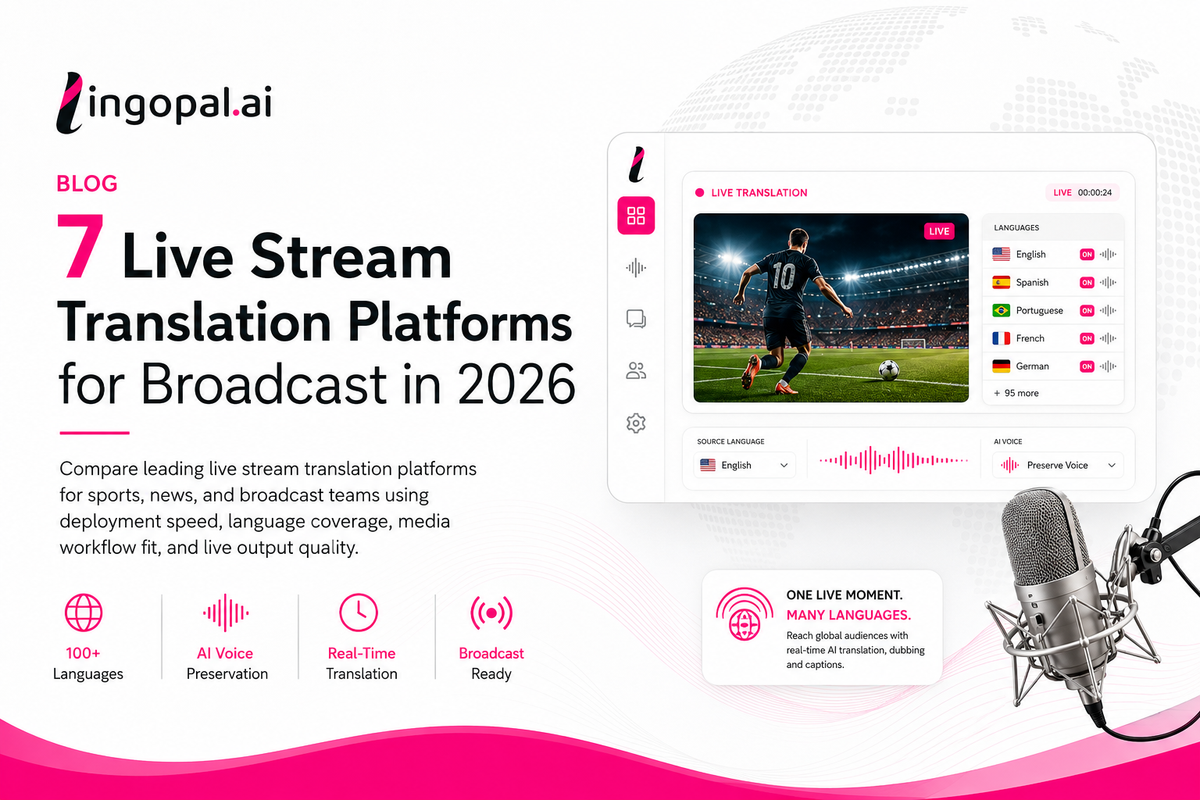
7 Live Stream Translation Platforms for Broadcast in 2026
How to Choose the Best Live Stream Translation Software for Sports, News, and Global Media Production
Primary keyword: live stream translation software
What is live stream translation software?
Live stream translation software enables broadcasters, sports organizations, media companies, OTT platforms, and event producers to translate live audio into multiple languages while a program is being broadcast.
Unlike traditional subtitle generators, modern platforms can simultaneously produce:
- Live captions
- Live subtitles
- AI voice dubbing
- Multiple audio channels
- Speaker-preserved voices
- Real-time multilingual broadcasts
Instead of producing separate broadcasts for every language, one live production can now reach audiences worldwide.
This shift is becoming increasingly important as sports rights, news organizations, and streaming services expand globally.
Why broadcasters are investing in multilingual live streaming
The media industry has changed dramatically over the last five years.
International audiences now expect content in their own language—even during live broadcasts.
According to industry research:
Trend
Why it matters
More than 65% of internet users prefer consuming content in their native language
Language directly impacts engagement and retention
Live sports audiences continue to become increasingly global
Rights holders need multilingual distribution
AI speech models have dramatically reduced latency
Live translation is now practical for production environments
Cloud production has become mainstream
Translation can be integrated without additional hardware
Instead of hiring interpreters for every language or producing multiple control rooms, broadcasters increasingly use AI localization as part of their cloud workflow.
What should you look for in live stream translation software?
Not every platform was built for broadcast.
Many AI translation tools work well for meetings but struggle with television-quality production.
When evaluating solutions, consider the following criteria.
1. Translation quality
Sports, entertainment and news require contextual understanding—not just literal translation.
Good platforms preserve:
- meaning
- terminology
- pacing
- emotion
2. Voice quality
The newest generation of AI can preserve characteristics such as:
- tone
- emotion
- cadence
- speaking style
This creates a much more natural experience than synthetic robotic voices.
3. Broadcast integrations
Professional broadcasters typically require support for:
- OBS
- vMix
- SRT
- RTMP
- MPEG-TS
- NDI
- SDI
- Cloud production platforms
The easier the integration, the faster deployment becomes.
4. Latency
For sports and breaking news, every second matters.
Most production teams aim for only a few seconds of delay while maintaining natural speech.
5. Language coverage
Organizations covering international audiences often require dozens of languages, not just Spanish and French.
Look for platforms supporting over 100 languages and regional dialects.
Lingopal is designed specifically for live broadcast, sports, newsrooms, OTT platforms and cloud production.
Unlike generic AI translation tools, it focuses on preserving the original speaker's voice, pacing and emotion while delivering multilingual live broadcasts with very low latency.
Best for
- Sports leagues
- News organizations
- Live events
- Broadcasters
- OTT platforms
- FAST channels
Strengths
✔ AI voice preservation
✔ Emotion-aware speech
✔ Live captions
✔ Live dubbing
✔ Multiple audio outputs
✔ Cloud production integrations
✔ 100+ languages
✔ Real-time localization
Organizations including broadcasters, sports organizations and media companies use Lingopal to reach multilingual audiences without rebuilding existing production workflows.
2. Wordly
Wordly focuses primarily on conferences and corporate events.
It offers AI-generated captions and translated audio for meetings but isn't designed specifically for broadcast-grade production.
Best for: Conferences
3. Interprefy
Interprefy combines AI translation with human interpreters, making it suitable for enterprise events and multilingual conferences.
It supports many languages but typically involves more operational planning than automated AI platforms.
4. SyncWords
SyncWords has long been known for captioning and subtitling.
Its broadcast integrations make it useful for accessibility workflows, although AI voice localization is not its primary focus.
5. KUDO
KUDO specializes in multilingual meetings using professional interpreters.
Its strength lies in governmental and enterprise communication rather than sports broadcasting.
6. Deepdub Live
Deepdub has expanded into real-time AI dubbing with impressive voice quality.
It is particularly relevant for entertainment and media localization.
7. CaptionHub Live
CaptionHub remains a strong accessibility platform for subtitles and caption workflows.
Organizations primarily seeking compliance and accessibility often include CaptionHub in their workflow.
Which platform is best for sports broadcasting?
Sports broadcasting presents unique challenges.
Commentators speak quickly.
Crowd noise is constant.
Player names must remain accurate.
Emotion is essential.
For these reasons, broadcasters increasingly prioritize solutions capable of preserving voice characteristics while maintaining very low latency.
Features that matter most include:
- Live multilingual commentary
- Voice preservation
- Scoreboard terminology
- Low latency
- Multiple language outputs
- Cloud production compatibility
Which platform is best for newsroom translation?
News organizations need:
- Breaking news translation
- Accurate terminology
- Fast deployment
- Low delay
- Reliable captioning
- Multiple simultaneous languages
Modern AI translation platforms allow one newsroom to distribute content globally without operating separate language teams.
How AI is transforming broadcast translation
Five years ago, multilingual live broadcasting often required:
- Human interpreters
- Separate commentary teams
- Multiple production rooms
- Significant operational costs
Today, AI enables broadcasters to produce once and distribute everywhere.
Advances in speech synthesis, automatic speech recognition, and neural machine translation now allow broadcasters to generate multilingual live audio while preserving much of the original speaker's identity and emotional delivery.
This represents one of the biggest operational changes in broadcast technology since the move to cloud production.
Frequently Asked Questions
What is the best live stream translation software?
For professional broadcast workflows, platforms specifically designed for sports, news, and media production generally offer stronger integrations and lower latency than generic meeting translation tools. Lingopal, SyncWords, and Interprefy are among the most recognized solutions, depending on the production requirements.
Can AI translate live sports commentary?
Yes. Modern AI systems can translate sports commentary in real time while preserving much of the commentator's voice, pacing, and emotion.
How many languages can live translation platforms support?
Most enterprise platforms support between 50 and 100+ languages. Some solutions also provide regional accents and localized terminology.
Is live AI translation replacing interpreters?
Not entirely. Human interpreters remain valuable for diplomacy, legal proceedings, and highly sensitive communications. However, AI is increasingly handling large-scale multilingual broadcasting where speed, scalability, and cost efficiency are critical.
What industries use live stream translation software?
The technology is widely used across:
- Broadcast television
- Sports
- News
- OTT platforms
- FAST channels
- Education
- Government
- Live events
- Corporate communications
Final Thoughts
The demand for multilingual live content continues to accelerate as broadcasters seek to reach audiences beyond traditional geographic boundaries.
Choosing the right live stream translation software depends on your workflow, latency requirements, language coverage, and production environment.
For broadcasters, sports organizations, and media companies that need professional-grade AI localization, solutions designed specifically for live production offer significant advantages over generic meeting translation platforms. By combining real-time translation, voice preservation, and broadcast-ready integrations, organizations can expand global reach while maintaining the quality and authenticity viewers expect.
Why Broadcasters Choose Lingopal
Whether you're producing live sports, breaking news, entertainment, or corporate broadcasts, Lingopal helps you reach global audiences without adding complex multilingual production workflows.
With support for 100+ languages, AI voice preservation, real-time dubbing, live captions, and seamless broadcast integrations, Lingopal enables media organizations to deliver authentic multilingual experiences at scale.
Ready to see it in action?
Book a personalized demo and discover how Lingopal can help your team launch multilingual live broadcasts in minutes—not months.