7 Subtitle Essentials for Multilingual Livestreams
How Broadcast Teams Can Choose AI Livestream Translation Platforms That Deliver Accurate, Real-Time Multilingual Captions
Primary Keyword: AI livestream translation
Table of Contents
- Why subtitles matter in multilingual livestreams
- What makes broadcast subtitles different?
- The 7 subtitle essentials every broadcaster should evaluate
- Common mistakes in AI subtitle workflows
- AI subtitles vs traditional captioning
- Frequently Asked Questions
- Final thoughts
Why Subtitles Matter More Than Ever
Live streaming has become one of the primary ways organizations communicate with global audiences.
From sports broadcasts and breaking news to conferences, corporate events, worship services, and live entertainment, viewers increasingly expect content in their preferred language.
While AI voice dubbing continues to evolve, subtitles remain the fastest, most scalable, and most accessible localization method for live content.
Modern AI livestream translation platforms can automatically generate multilingual captions within seconds, allowing broadcasters to reach international audiences without building separate production workflows.
However, subtitle quality varies significantly between platforms.
For broadcast organizations, choosing the right AI subtitle workflow involves much more than simple speech recognition.
What Makes Broadcast Subtitles Different?
Generating subtitles for live media is fundamentally different from producing captions for recorded content.
Live broadcasts introduce challenges such as:
- Rapid speech
- Crowd noise
- Multiple speakers
- Breaking news
- Sports commentary
- Last-minute script changes
- Live interviews
- Technical terminology
The subtitle engine must continuously process speech while maintaining synchronization with the live event.
Poor subtitles quickly reduce viewer confidence.
Professional subtitle workflows must balance:
- Speed
- Accuracy
- Readability
- Synchronization
- Scalability
1. Are the Subtitles Truly Real-Time?
The first question every broadcaster should ask is simple:
How quickly do subtitles appear?
Even highly accurate captions become distracting if they appear several seconds after the speaker.
Broadcast-grade AI livestream translation platforms prioritize low latency while maintaining readability.
The objective is synchronized viewing—not simply fast transcription.
2. Does the Platform Understand Context?
Words change meaning depending on context.
Consider examples such as:
- "Pitch"
- "Match"
- "Charge"
- "Strike"
- "Cell"
Sports, finance, medicine, education, and politics all use identical words differently.
Context-aware AI translation significantly improves subtitle quality by understanding the surrounding conversation instead of translating word by word.
3. Can It Handle Proper Names Correctly?
Nothing damages viewer trust faster than incorrect names.
Professional subtitle systems should accurately recognize:
- Athletes
- Teams
- Companies
- Presenters
- Cities
- Products
- Sponsors
- Organizations
The strongest platforms also support terminology glossaries, allowing broadcasters to standardize names and technical vocabulary across every event.
4. Are Captions Easy to Read?
Subtitle quality is not determined by translation alone.
Good captions should also maintain:
- Natural line breaks
- Comfortable reading speed
- Proper punctuation
- Clear speaker changes
- Consistent formatting
Crowded captions create unnecessary cognitive load for viewers.
Professional platforms optimize subtitles for human reading—not simply machine output.
5. Can One Livestream Produce Multiple Languages Simultaneously?
Modern broadcasters increasingly distribute content globally.
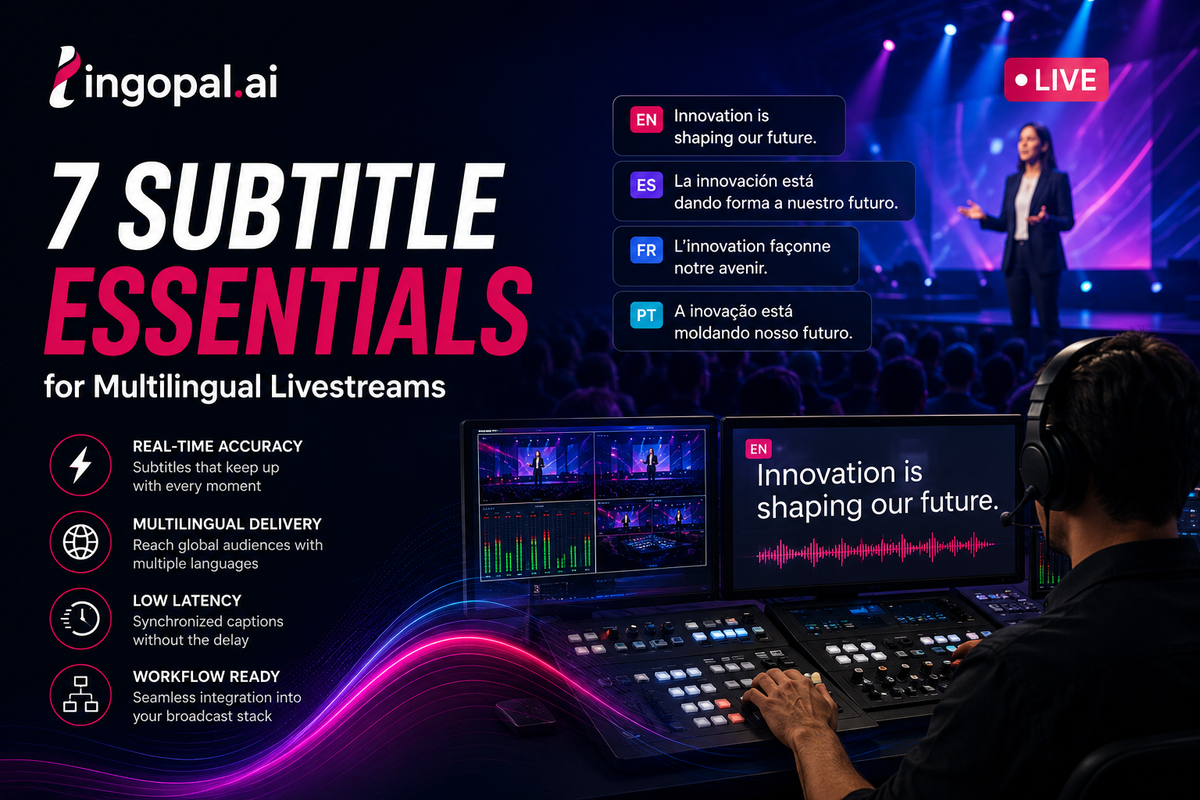
Instead of creating separate productions, AI livestream translation platforms should generate:
- English captions
- Spanish captions
- Portuguese captions
- French captions
- German captions
- Additional language outputs simultaneously
Scalable multilingual workflows dramatically reduce operational costs while expanding audience reach.
6. Does the Subtitle Workflow Fit Existing Broadcast Operations?
The best subtitle engine is useless if it requires rebuilding production infrastructure.
Broadcasters should evaluate compatibility with existing workflows, including:
- SRT
- RTMP
- HLS
- MP4
- API integrations
- OBS
- vMix
- Cloud production
Integration reduces operational complexity and accelerates deployment.
7. Can the Platform Scale During Major Live Events?
Small demonstrations rarely reveal real-world performance.
Professional broadcasts may require:
- Thousands of concurrent viewers
- Multiple language feeds
- Several commentators
- Live interviews
- Simultaneous sporting events
- Breaking news updates
A production-ready subtitle platform must maintain consistent quality under broadcast-scale demand.
Reliability matters just as much as translation accuracy.
Common Subtitle Workflow Mistakes
Many organizations evaluate subtitle platforms using short product demos.
Instead, test real production scenarios.
Questions worth asking include:
- How does the platform handle noisy environments?
- Can it identify multiple speakers?
- Does latency remain stable?
- Can terminology be customized?
- How much manual review is required?
- Does subtitle timing remain synchronized throughout long broadcasts?
These answers often matter more than raw translation accuracy.
AI Subtitles vs Traditional Captioning
Traditional captioning relies heavily on manual workflows and human operators.
While human captioners remain valuable for highly sensitive content, AI dramatically improves scalability.
Modern AI livestream translation allows broadcasters to:
- Produce multilingual captions automatically
- Reduce production costs
- Expand global distribution
- Improve accessibility
- Deliver localized content in real time
Many organizations now adopt hybrid workflows where AI generates captions while editors oversee terminology and quality assurance.
Industries Benefiting from AI Livestream Translation
Subtitle generation has become essential across multiple sectors:
Broadcast Television
Breaking news, studio programming, and international events.
Sports
Live commentary, athlete interviews, press conferences, and highlights.
Corporate Events
Global product launches, earnings calls, and investor presentations.
Education
University lectures, webinars, and online learning.
Faith-Based Organizations
Livestreamed worship services and international ministry.
Government
Public announcements and multilingual communication.
Frequently Asked Questions
What is AI livestream translation?
AI livestream translation automatically converts live speech into multilingual subtitles, captions, and translated audio using speech recognition, machine translation, and AI voice technologies.
Why are subtitles important during live broadcasts?
Subtitles improve accessibility, increase audience reach, support multilingual viewers, and allow organizations to distribute live content globally without creating separate productions.
Can AI subtitles be generated in multiple languages simultaneously?
Yes.
Modern enterprise platforms can generate multiple subtitle streams simultaneously from a single live broadcast.
Are AI subtitles replacing human captioners?
Not entirely.
Many organizations use AI to automate caption generation while human editors review terminology, formatting, and quality.
Which industries benefit most from AI subtitle generation?
Broadcast television, sports, education, corporate communications, faith-based organizations, government, and live events all benefit from AI-powered multilingual subtitle workflows.
Final Thoughts
Subtitles have evolved from an accessibility feature into a strategic component of multilingual broadcasting.
As organizations expand into global markets, AI livestream translation enables broadcasters to deliver synchronized, multilingual captions that improve accessibility, audience engagement, and operational efficiency.
The strongest subtitle platforms are those that combine low latency, contextual translation, terminology management, seamless broadcast integrations, and enterprise scalability. By evaluating these seven essentials, broadcast teams can build localization workflows that are ready for today's live productions and tomorrow's global audiences.
Why Broadcasters Choose Lingopal
Lingopal helps broadcasters, sports organizations, media companies, and enterprises deliver broadcast-grade AI livestream translation with multilingual subtitles, live dubbing, and voice preservation—all from a single production workflow.
With support for 100+ languages, real-time caption generation, low-latency delivery, and seamless integration with SRT, HLS, RTMP, MP4, and API workflows, Lingopal empowers organizations to reach global audiences without increasing production complexity.
Ready to modernize your multilingual livestream strategy?
Book a personalized demo and discover how Lingopal can help your team deliver accurate, scalable, and accessible live broadcasts worldwide.