AI Dubbing: Worth It for News Localization?
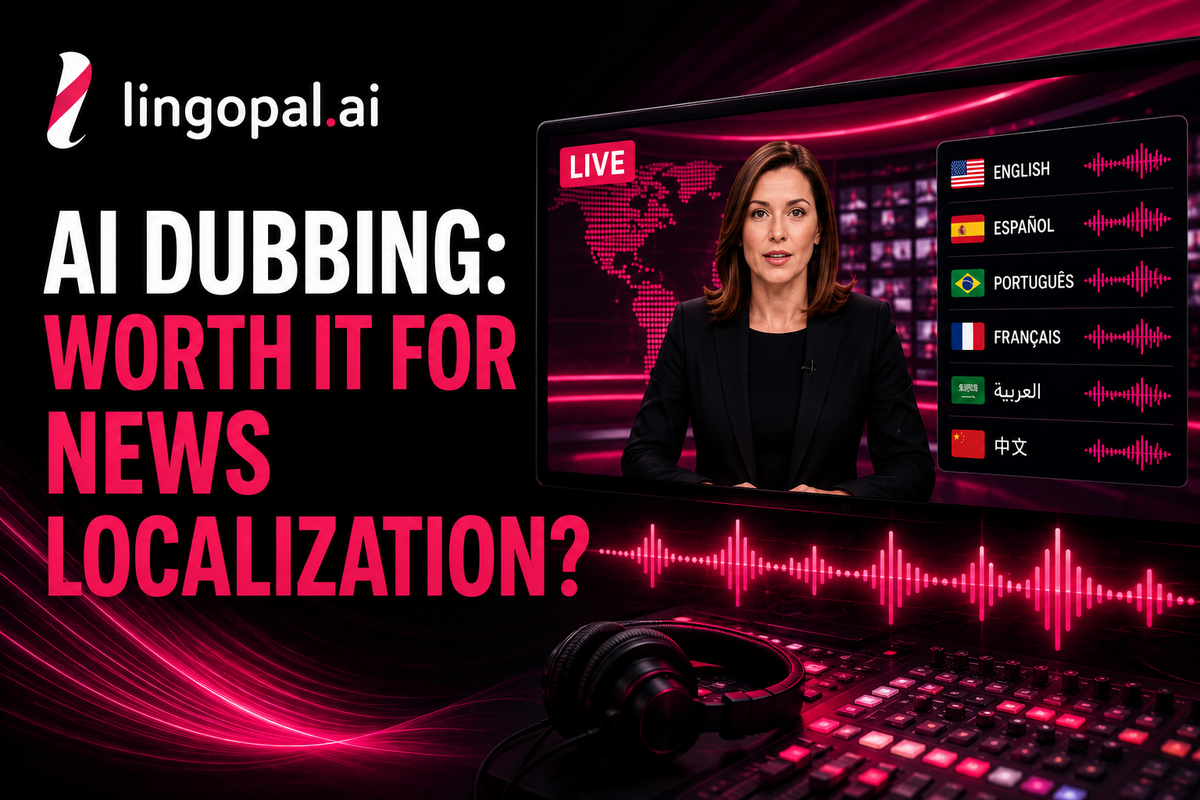
AI Dubbing: Worth It for News Localization?
Is AI dubbing worth it for a news network that currently relies on post-production localization workflows?
Quality and Accuracy Benchmarks for News Content
Pros
- Near real-time delivery for breaking news scenarios.
- Scalable multilingual content generation.
- Significant cost reduction compared to traditional methods for extensive language coverage.
- Preservation of original anchor voice characteristics.
- High accuracy metrics for translated terminology.
Cons
- Potential for AI-generated errors in highly nuanced or idiomatic language.
- Ethical considerations regarding voice cloning and consent require careful management.
- Requires rigorous quality assurance processes to ensure journalistic integrity.
- Audience perception may initially be a barrier to adoption.
For any news network, the integrity of information is non-negotiable. This extends directly to the localization process. When adopting AI dubbing, the primary concern is maintaining accuracy for critical elements such as names, places, and specialized terminology. Traditional post-production localization, while methodical, can introduce delays that compromise the timeliness of news. AI dubbing systems must demonstrate a capacity to translate technical jargon, proper nouns, and place names with a precision that rivals human translators. The ability to correctly pronounce foreign names or complex political terms is a direct measure of a system's readiness for broadcast news, where a single mispronunciation can undermine credibility.
Key Takeaways
- News networks evaluating AI dubbing must prioritize precision over speed, as a single mispronounced name or mistranslated term can damage editorial credibility.
- Traditional post-production workflows guarantee accuracy but introduce latency that undermines breaking news coverage, making AI a viable alternative only if it matches human-level terminology handling.
- An AI system's readiness for broadcast hinges on its ability to correctly render foreign proper nouns, place names, and political jargon without human oversight.
- Adopting AI dubbing in news should not be a cost decision but a reliability decision, measured by error rates on high-stakes content like international court rulings or election results.
Table of Contents
- Quality and Accuracy Benchmarks for News Content
- Navigating the Risks: Trust, Ethics, and Compliance in AI-Generated News
- Strategic Integration: Implementing AI Dubbing into News Workflows
Beyond factual accuracy, the authentic delivery of news is paramount. Audiences connect with anchors not just for their words, but for the tone, cadence, and emotional nuance they convey. AI dubbing technology must move beyond robotic recitation to capture these subtleties. Advanced generative AI models, particularly those trained on extensive voice data, can achieve remarkable voice fidelity. This means cloning an anchor's unique vocal characteristics. Their pitch, intonation, and even subtle emotional inflections. To create a dubbed version that sounds genuinely like the original reporter. This preservation of authenticity is key to maintaining viewer engagement and trust, especially in sensitive reporting where emotional delivery plays a significant role.
The dynamic nature of news production presents unique challenges for localization. Breaking news often requires rapid script adjustments, sometimes mid-broadcast. An AI dubbing solution must be adaptable enough to handle these changes without significant delays. This involves not only translating new script segments but also ensuring consistency with previously broadcast material. Lingopal's generative AI platform is engineered for this adaptability. It supports real-time captioning alongside dubbing, allowing for immediate updates to multilingual content. This capability is a direct answer to the need for timely global distribution of breaking news, transforming turnaround times from hours to minutes and enabling news organizations to reach international audiences faster than ever before.
Quantifiable performance metrics are essential for evaluating AI dubbing solutions. Lingopal achieves high accuracy, demonstrated by BLEU scores of 61+, indicating a strong command of translation quality. This is complemented by proprietary voice cloning technology that ensures a natural, authentic vocal presence. These technical specifications translate directly into operational benefits: news networks can expect their content to be localized with both linguistic precision and vocal fidelity. Is AI dubbing worth it for a news network that currently relies on post-production localization workflows? The benchmarks for accuracy and authentic voice cloning provided by advanced systems like Lingopal's suggest a compelling affirmative, particularly when speed and scale are critical factors in global news dissemination.
Navigating the Risks: Trust, Ethics, and Compliance in AI-Generated News
Mitigating AI Risks in Broadcast
Implementing AI dubbing requires a proactive approach to audience trust, ethical considerations, and regulatory compliance. News organizations must establish clear guidelines for AI use, ensure transparency with viewers, and maintain rigorous quality control. By addressing these areas, the potential risks associated with AI-generated content can be effectively managed, allowing networks to capitalize on the benefits of faster, wider global reach.
Building and maintaining audience trust is the bedrock of any news organization. Introducing AI-generated voices into broadcasts necessitates a transparent approach. Viewers must understand that the content they are consuming has been localized using advanced technology. Clear disclaimers, visible on screen or in program notes, can help manage audience expectations. Additionally, the AI's output must consistently meet high standards of accuracy and naturalness. Any perceived degradation in quality or factual errors, regardless of the source, can erode trust. A strategy that prioritizes viewer perception and consistently delivers high-fidelity, accurate content is essential for the successful integration of AI dubbing.
The ethical dimensions of AI dubbing, particularly concerning voice cloning, require careful consideration. Obtaining explicit consent from on-air talent for the use of their voice by AI systems is a fundamental requirement. This consent should clearly define the scope and duration of AI voice usage. For public figures or individuals appearing in news segments, ethical guidelines must be established regarding the creation and deployment of their AI-generated voices. Responsible AI deployment means respecting individual rights and avoiding misrepresentation. Lingopal's approach emphasizes ethical AI practices, ensuring that voice cloning technology is used with the full understanding and agreement of the individuals involved, thereby safeguarding both the talent and the network's reputation.
Compliance with broadcast standards and evolving regulatory frameworks is another critical aspect. Different regions and countries have specific regulations concerning synthetic media, voice replication, and content authenticity. News organizations must stay abreast of these developments and ensure their AI dubbing workflows adhere to all applicable laws. This includes potential requirements for labeling AI-generated content. Establishing a comprehensive internal compliance checklist for AI implementation can help news networks navigate this complex legal terrain. By prioritizing adherence to broadcast standards and legal requirements, organizations can deploy AI dubbing solutions with confidence, minimizing legal exposure and maintaining operational legitimacy across diverse markets.
Effectively mitigating the inherent risks of AI-generated content requires a multi-faceted strategy. This involves implementing rigorous quality assurance processes that include human oversight for critical content. Developing fallback protocols for AI system failures or unexpected output is also prudent. For news networks, the question of whether AI dubbing is worth it for a news network that currently relies on post-production localization workflows hinges on the ability to manage these risks effectively. By investing in transparent communication, obtaining necessary consents, ensuring regulatory adherence, and maintaining rigorous quality control, the benefits of speed, scale, and cost efficiency offered by AI dubbing can be realized without compromising journalistic integrity or audience trust.
Strategic Integration: Implementing AI Dubbing into News Workflows
The decision to adopt AI dubbing requires a strategic approach to integration rather than a simple replacement of existing systems. For a news network currently reliant on post-production localization workflows, the question of Is AI dubbing worth it for a news network that currently relies on post-production localization workflows? shifts to how best to implement this technology. This involves a careful assessment of specific content needs, technical infrastructure, and the potential for a hybrid model that combines AI efficiency with human expertise. Successful integration is not just about adopting new tools; it is about re-architecting workflows to maximize speed, scale, and accuracy while maintaining journalistic integrity.
Assessing Workflow Compatibility: Live vs. VOD Dubbing Needs
News operations differ significantly in their content delivery requirements. Live broadcasts demand near-instantaneous localization, a challenge that traditional post-production struggles to meet. AI dubbing, with its minimal latency, is uniquely positioned to address this. For instance, Lingopal's platform offers approximately 15 seconds of latency for live dubbing, enabling real-time translation of breaking news segments. Conversely, Video On Demand (VOD) content allows for a more measured approach. While speed is still a benefit, the tolerance for slightly longer turnaround times means that AI can be applied without the same extreme pressure. Understanding whether the primary need is for immediate live translation or for scaling a library of VOD content dictates the implementation strategy and the specific AI capabilities that should be prioritized. A network that broadcasts live events globally will find AI dubbing's real-time capabilities indispensable, transforming its ability to serve international audiences instantaneously.
Technical Integration: Ingest Formats and Infrastructure Alignment
Integrating AI dubbing into an existing broadcast infrastructure requires compatibility with current media formats and ingest pipelines. Advanced AI localization platforms must support a range of standard protocols to ensure a smooth transition. Lingopal's system is designed for broad compatibility, supporting common ingest formats such as SRT, HLS, RTMP, and MP4. Furthermore, it offers API ingest capabilities, allowing for programmatic integration into existing content management systems or broadcast workflows. This flexibility means that news organizations do not need to overhaul their entire infrastructure. The focus should be on how the AI system can ingest source feeds and deliver localized output in formats that can be immediately utilized by broadcast playout systems or digital distribution platforms. Aligning technical requirements ensures that the AI dubbing solution becomes an additive component rather than a disruptive force within the newsroom.
Developing a Hybrid Approach: When to Use AI vs. Human Localization
The most effective strategy for many news networks is not an absolute shift to AI, but the development of a hybrid localization model. This approach acknowledges the distinct strengths of both AI and human translators. For content requiring absolute linguistic precision, complex legal or political terminology, or where subtle cultural nuances are paramount, human localization remains invaluable. However, for the vast majority of daily news content, especially breaking news, general updates, or recurring segments, AI dubbing offers unparalleled speed and cost-efficiency. For example, a news clip reporting on a political event might benefit from AI for rapid translation of standard commentary, while a deep-dive investigative piece might still require human oversight for specialized terms. This hybrid model allows news organizations to allocate human resources to the most critical tasks, while AI handles high-volume, time-sensitive content, thereby optimizing both quality and operational efficiency. This balances the need for accuracy with the demand for rapid global reach.
A Practical Evaluation Framework for AI Dubbing Vendors
Selecting the right AI dubbing vendor is critical for successful implementation. A structured evaluation framework ensures that all essential aspects are considered. This framework should begin with a clear definition of the network's specific localization needs, including volume, language requirements, and desired turnaround times. Key technical criteria include the range of supported ingest and output formats, integration capabilities via API, and demonstrated latency figures for live content. Quality benchmarks, such as BLEU scores (Lingopal achieves 61+) and the fidelity of voice cloning, are paramount. Ethical considerations, including data privacy and consent for voice cloning, must also be assessed. Furthermore, the vendor's capacity for ongoing support, updates, and customization is important. A comprehensive checklist can guide this evaluation, ensuring that the chosen solution aligns with the network's operational goals and technological readiness. This systematic process helps answer the question, Is AI dubbing worth it for a news network that currently relies on post-production localization workflows? by providing a clear methodology for assessing value and suitability.
AI Dubbing Vendor Evaluation Checklist
- Content & Workflow Assessment:
- Define primary use cases (Live News, VOD, Social Media, etc.)
- Quantify volume of content to be localized (hours/day, clips/week)
- Identify target languages and priority markets
- Assess required turnaround times (real-time, hours, days)
- Technical Capabilities:
- Supported ingest formats (SRT, HLS, RTMP, MP4, API)
- Supported output formats and delivery methods
- Demonstrated latency for live dubbing (target: ~15 seconds)
- API integration capabilities for workflow automation
- Scalability to handle peak demand
- Quality & Accuracy:
- Accuracy metrics (e.g., BLEU scores of 61+)
- Voice cloning fidelity and naturalness (preservation of emotion/inflection)
- Handling of proper nouns, technical terms, and regional dialects
- Real-time captioning synchronization capabilities
- Ethics & Compliance:
- Clear policies on voice cloning consent for talent
- Adherence to broadcast standards and regulatory requirements
- Transparency protocols for AI-generated content
- Data security and privacy measures
- Support & Partnership:
- Onboarding and training process
- Ongoing technical support and maintenance
- Roadmap for future feature development
- Case studies and client references in broadcast/news
Frequently Asked Questions
How good is AI dubbing for news content compared to post-production localization?
AI dubbing is highly effective for news content when measured by translation accuracy and voice fidelity. Systems like Lingopal achieve BLEU scores of 61+ while preserving an anchor's original pitch, intonation, and emotional inflection. This combination of linguistic precision and authentic vocal cloning addresses the core requirement for news localization with faster turnaround times than manual methods.
Will AI dubbing replace human journalists and translators in news production?
AI dubbing will not replace journalists but will change how localization workflows operate. Human oversight remains necessary for quality assurance, ethical consent management, and handling nuanced language that AI may misinterpret. News networks adopting AI dubbing should view it as a tool that scales multilingual output while allowing journalists to focus on reporting and editorial integrity.
What is the future of AI dubbing in broadcast news?
The future of AI dubbing in broadcast news points toward near real-time multilingual delivery for breaking stories. Advanced generative models will continue improving accuracy with proper nouns and technical terminology. Expect wider adoption as systems demonstrate consistent performance metrics and networks establish transparent labeling practices to maintain viewer trust.
How does AI dubbing handle breaking news scenarios where scripts change during a broadcast?
AI dubbing systems designed for news adaptability support real-time captioning alongside dubbing to handle rapid script changes. Lingopal's platform processes new segments while maintaining consistency with previously broadcast material. This transforms localization turnaround from hours to minutes, allowing networks to update multilingual content as stories develop without interrupting the broadcast flow.
What ethical concerns exist with voice cloning technology in news AI dubbing?
The primary ethical concern is obtaining explicit consent from on-air talent before cloning their voice for AI dubbing. News organizations must define the scope and duration of AI voice usage in clear agreements. Ethical deployment also requires transparent viewer disclaimers and guidelines preventing misrepresentation of public figures or individuals appearing in news segments.
Is AI dubbing accurate enough for names and specialized terminology in global news coverage?
AI dubbing systems must demonstrate precision with proper nouns, places, and technical jargon to meet broadcast standards. High accuracy metrics like BLEU scores of 61+ indicate strong translation quality for these critical elements. A single mispronunciation of a foreign name can undermine credibility, so rigorous quality assurance processes are essential before any AI output reaches air.
What measurable performance benchmarks should news networks evaluate in AI dubbing solutions?
News networks should evaluate BLEU scores for translation quality and proprietary voice cloning metrics for vocal fidelity. Lingopal achieves BLEU scores of 61+ alongside voice technology that preserves natural pitch, intonation, and emotional delivery. These quantifiable metrics directly indicate whether a system can deliver the linguistic accuracy and authentic vocal presence required for broadcast news.
About the Author
This article was crafted by the expert team at Lingopal, an AI-powered platform built for real-time translation and transcription in live broadcast environments. From sports and news to education and global events, Lingopal helps professional teams deliver multilingual audio and captions with voice cloning, emotion preservation, and enterprise-grade accuracy.