AI Speech-to-Speech Translation for Arabic Live News Streams
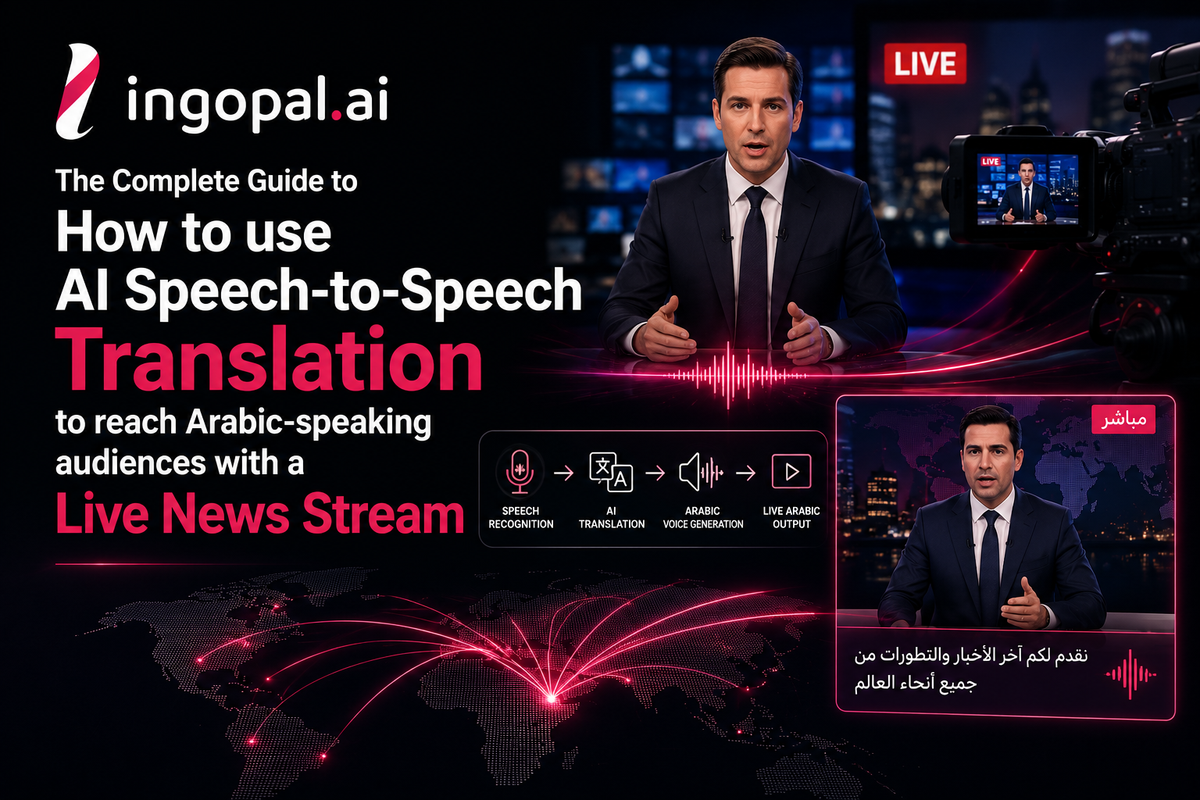
The Complete Guide to How to use AI speech-to-speech translation to reach Arabic-speaking audiences with a live news stream
How to use AI speech-to-speech translation to reach Arabic-speaking audiences with a live news stream
How to use AI speech-to-speech translation to reach Arabic-speaking audiences with a live news stream starts with treating translation as part of the broadcast chain, not as a separate postproduction task. The system receives an English audio feed, transcribes speech, translates the transcript, generates Arabic speech, and returns the localized audio while the news program continues. That workflow must account for anchor cadence, interview interruptions, proper names, regional terminology, audio mixing, captions, and transmission timing.
Key Takeaways
- How to use AI speech-to-speech translation to reach Arabic-speaking audiences with a live news stream starts with treating translation as part of the broadcast chain, not as a separate postproduction task.
- The system receives an English audio feed, transcribes speech, translates the transcript, generates Arabic speech, and returns the localized audio while the news program continues.
- That workflow must account for anchor cadence, interview interruptions, proper names, regional terminology, audio mixing, captions, and transmission timing.
For a newsroom, the practical question is not whether machine translation can produce Arabic text. It is whether the complete pipeline can deliver understandable, natural speech without losing the timing, authority, or urgency of the original report. Translation workflows may be assessed for broadcast and live event use, where speech recognition, machine translation, voice synthesis, speaker identification, and distribution may need to operate together.
What is How to use AI speech-to-speech translation to reach Arabic-speaking audiences with a live news stream?
AI speech-to-speech translation converts a live source-language voice into spoken Arabic through a cascaded process: automatic speech recognition, translation, and text-to-speech generation. A production-grade implementation also uses speaker diarization to determine who is speaking, terminology controls for names and organizations, punctuation and sentence segmentation for timing, and an audio mixer that places the Arabic track beside or over the original feed. The output may be delivered as a dubbed program, a secondary audio channel, or a localized stream for a separate audience.
Arabic news requires a language strategy before the first transmission. Modern Standard Arabic is generally appropriate for headlines, scripted anchor links, official statements, and national coverage because it provides a formal register understood across Arabic-speaking markets. Field interviews may contain Egyptian, Gulf, Levantine, Iraqi, or Maghrebi dialect features. A system trained only on formal written Arabic can mistranscribe colloquial speech, flatten meaning, or produce an unnatural voice. Native-trained Arabic speech models, regional language settings, a newsroom glossary, and human review for sensitive segments reduce those failures.
Timing is a separate engineering constraint. Research from Palabra’s live stream translation solution identifies a vendor-reported two-to-five-second latency budget for keeping dubbed speech aligned with video feeds; this figure is not universal. The acceptable point depends on the program: a delayed Arabic audio track may be acceptable for a panel discussion, while a long pause during breaking news can make viewers question whether the translation is current. Teams may use live dubbing and real-time captioning as distinct options for accessibility and spoken localization.
Benefits of How to use AI speech-to-speech translation to reach Arabic-speaking audiences with a live news stream
The primary benefit is direct access to viewers who prefer Arabic audio rather than subtitles. Spoken translation allows audiences to follow a report while watching maps, footage, lower thirds, interviews, and live action. It also supports viewers who have limited reading time, visual impairments, or difficulty processing fast captions. For broadcasters, one source feed can support multiple language outputs without requiring a separate Arabic studio for every bulletin, press conference, or special report.
Cost and production capacity improve when the workflow is automated. Clevercast reports that AI-dubbed audio can run at roughly $2 to $2.50 per speaker-hour. Palabra reports localization overhead reductions of up to 79 percent through AI voice cloning and native-trained text-to-speech models. These vendor-reported figures are not independently verified here, do not remove editorial review, audio mastering, or compliance work, and should not be treated as universal results. They show why continuous multilingual coverage becomes more practical when every segment does not require a full external language-services production.
Voice quality determines whether the Arabic service sounds like a news product or an automated utility. American accent bleed can occur when a model transfers English pronunciation patterns into Arabic phonemes, stress, or rhythm. Native-trained models, Arabic-specific pronunciation dictionaries, phonetic testing, and careful voice selection address this problem. Voice cloning can preserve a recognizable anchor timbre, while emotion detection helps distinguish a routine update from a warning, live interruption, or eyewitness account. The goal is not theatrical performance. It is controlled delivery that preserves urgency without adding emotion absent from the source.
Operational test: evaluate the Arabic feed with scripted headlines, names, numbers, acronyms, overlapping speakers, code-switching, dialect interviews, and sudden anchor interruptions. Measure transcription accuracy, terminology consistency, audio intelligibility, speaker changes, and end-to-end delay. A successful pilot should also test SRT, HLS, RTMP, MP4, or API ingest according to the station’s distribution architecture, rather than testing only a clean studio recording.
For broadcasters implementing How to use AI speech-to-speech translation to reach Arabic-speaking audiences with a live news stream, the strongest setup connects language quality to transmission engineering. A broadcast workflow should account for captioning, dubbing, voice characteristics, and live-feed requirements. That reduces the risk of treating Arabic translation as an isolated audio experiment instead of a service that must remain accurate, intelligible, and synchronized throughout a live broadcast.
How to Choose How to use AI speech-to-speech translation to reach Arabic-speaking audiences with a live news stream
Choosing a system for How to use AI speech-to-speech translation to reach Arabic-speaking audiences with a live news stream requires testing the full broadcast chain, not just the quality of an Arabic voice demo. Begin with the input and output architecture. Confirm that the platform can ingest the newsroom’s actual feed through SRT, HLS, RTMP, MP4, or an API, then return a usable audio, caption, or localized stream without a custom integration project. Translation workflows may be assessed for live broadcast and event use, including speech recognition, machine translation, voice synthesis, speaker identification, and multilingual distribution.
Latency should be measured from the source microphone to the Arabic output heard by the viewer. Research from Palabra’s live stream translation solution identifies a vendor-reported two-to-five-second budget for keeping dubbed speech aligned with video; this figure is not universal. A breaking-news bulletin may need a short delay to preserve immediacy, while a long interview can tolerate more processing time if the audio remains coherent. A newsroom should select live dubbing or real-time captioning according to its editorial and transmission requirements. Ask for a timed test using interruptions, speaker changes, overlapping speech, and a live return feed.
Arabic language coverage needs separate evaluation. A vendor should demonstrate Modern Standard Arabic for headlines, financial reports, official statements, and scripted anchor copy, then show how the system handles Egyptian, Gulf, Levantine, Iraqi, or Maghrebi speech in field interviews. Review pronunciation of names, locations, ministries, companies, numbers, abbreviations, and foreign terms. Require a glossary or terminology control that prevents a proper noun from changing between segments. Native-trained Arabic speech models can help limit American accent bleed, misplaced stress, English phoneme transfer, and robotic pacing. Listen for consonant accuracy, vowel quality, pauses, sentence-final cadence, and whether the generated voice remains intelligible over music and location noise.
Ask how the platform controls errors before they reach air. The pipeline should expose automatic speech recognition, translation, and text-to-speech stages for quality review, with confidence signals or logs that help operators identify uncertain passages. Speaker diarization should separate an anchor, correspondent, guest, and translator, while voice cloning should preserve approved speaker timbre only when the newsroom has documented consent and usage rights. Emotion detection can help retain the difference between a routine update and an urgent interruption, but it should not manufacture alarm. Test code-switching, incomplete sentences, crosstalk, background noise, and rapidly changing names because clean studio audio does not represent a live news feed.
Buying test: request a pilot built from real newsroom material. Include a scripted headline, a press conference, a regional-dialect interview, a financial figure, an unfamiliar place name, an anchor interruption, and a two-speaker exchange. Score Arabic intelligibility, translation fidelity, terminology consistency, pronunciation, speaker assignment, emotional control, caption timing, audio mixing, and recovery after an input interruption. The pilot should also document operator controls, escalation procedures, data handling, consent for voice cloning, and the steps required to switch from dubbing to captions during a transmission problem.
Finally, examine operating economics without judging a price in isolation. Clevercast reports AI-dubbed audio at roughly $2 to $2.50 per speaker-hour, while Palabra reports localization overhead reductions of up to 79 percent through AI voice cloning and native-trained text-to-speech models. These vendor-reported figures are not independently verified here and do not replace editorial oversight, compliance review, monitoring, or audio engineering. A suitable platform should show how usage is metered, how many simultaneous language channels the workflow supports, which staff permissions exist, and how the Arabic service scales from a daily bulletin to continuous live coverage.
Frequently Asked Questions
How does AI speech-to-speech translation work for a live news stream?
The system processes the program through several connected stages. Automatic speech recognition converts the source audio into text. A machine translation engine renders that text in Arabic, while terminology controls help preserve names, locations, political terms, organizations, and numerical information. Text-to-speech then generates the Arabic audio. Speaker diarization identifies whether the current voice belongs to an anchor, correspondent, guest, or interview subject. Audio mixing places the translated track alongside the original video, captions, music, and ambient sound.
Translation workflows may be assessed for broadcast use rather than ordinary meeting transcription. The implementation should be tested with live interruptions, cross-talk, changing speakers, background noise, incomplete sentences, and fast delivery. A clean studio sample can conceal problems that appear immediately during a press conference or field report.
What is the difference between Modern Standard Arabic and regional dialects?
Modern Standard Arabic, often called MSA, is the usual register for headlines, scripted anchor copy, official statements, public announcements, and formal reporting. It provides broad comprehension across Arabic-speaking markets. Regional dialects are more common in spontaneous interviews and on-the-ground reporting. Egyptian, Gulf, Levantine, Iraqi, and Maghrebi speech can differ in vocabulary, pronunciation, grammar, and sentence rhythm.
A newsroom should not force every source into one language setting. MSA may be the correct output for a formal bulletin, while a dialect-aware speech recognition model can better interpret an interview recorded in a local community. The output policy should determine whether the translated audio retains a regional character or converts the content into formal Arabic. That decision belongs to editorial leadership, not only to the engineering team.
How can a newsroom prevent American accent bleeding through on Arabic AI voices?
Accent bleed usually reflects a mismatch between the speech model and the target language. Test native-trained Arabic voices rather than judging a model from English voice quality. Review Arabic phonemes, stress, vowel length, pauses, sentence endings, and the pronunciation of proper names. A pronunciation dictionary should include ministries, cities, political parties, athletes, organizations, and recurring sources. The team should also test Arabic audio over music, crowd noise, satellite delay, and compressed transmission because intelligibility can change after broadcast processing.
Voice selection matters as much as translation accuracy. A voice that preserves timbre but uses English prosody will still sound artificial. Approved voice profiles, terminology rules, and representative newsroom clips should be included in evaluation. The acceptance test should include native Arabic listeners who can identify unnatural pronunciation and register shifts that may not appear in an automated score.
What is an acceptable latency window for translated news?
There is no single delay suitable for every program. Research from Palabra’s live stream translation solution identifies a vendor-reported two-to-five-second latency budget for keeping dubbed audio aligned with video feeds; this figure is not universal. A newsroom should measure the complete path, including capture, transcription, translation, voice generation, encoding, distribution, and playback.
Breaking news generally requires the shortest practical delay because viewers expect the Arabic audio to track the current picture. A panel discussion or extended interview may tolerate a longer buffer if the speech remains coherent and the program clearly communicates any delay. Live dubbing and real-time captioning can be selected according to editorial priorities.
Can AI voice cloning preserve the urgency and emotion of a live news anchor?
It can preserve selected characteristics, but it should not be treated as a perfect copy of a live performance. Voice cloning can retain aspects of speaker timbre, pitch range, and delivery style. Emotion detection can help classify whether the source is calm, urgent, explanatory, or interrupted. The output must still be governed by editorial controls so the Arabic voice does not add alarm, sarcasm, or emphasis that the original anchor did not convey.
Test emotion preservation with several editorial conditions: a routine headline, a developing emergency, a correction, an eyewitness interview, and a transition to a correspondent. Native Arabic reviewers should assess whether urgency is audible without becoming theatrical. Consent, identity protection, access permissions, and a clear disclosure policy should accompany any cloned voice used in public news coverage. A technically convincing voice is not sufficient without responsible newsroom governance.
How should broadcasters handle hallucinations or mixed-language output?
Use constrained terminology, source-audio monitoring, confidence review, and escalation procedures. Proper nouns and numbers deserve special treatment because one mistranslated figure or name can change the meaning of a report. The workflow should preserve the original audio for rapid comparison and allow an operator to switch to captions or the source track when the Arabic output becomes uncertain. Prebroadcast testing should include code-switching, acronyms, incomplete phrases, and noisy interviews.
About the Author
This article was crafted by the expert team at Lingopal, an AI-powered platform built for real-time translation and transcription in live broadcast environments. From sports and news to education and global events, Lingopal helps professional teams deliver multilingual audio and captions with voice cloning, emotion preservation, and enterprise-grade accuracy.