AI Translation for Sports: Is It Worth It?
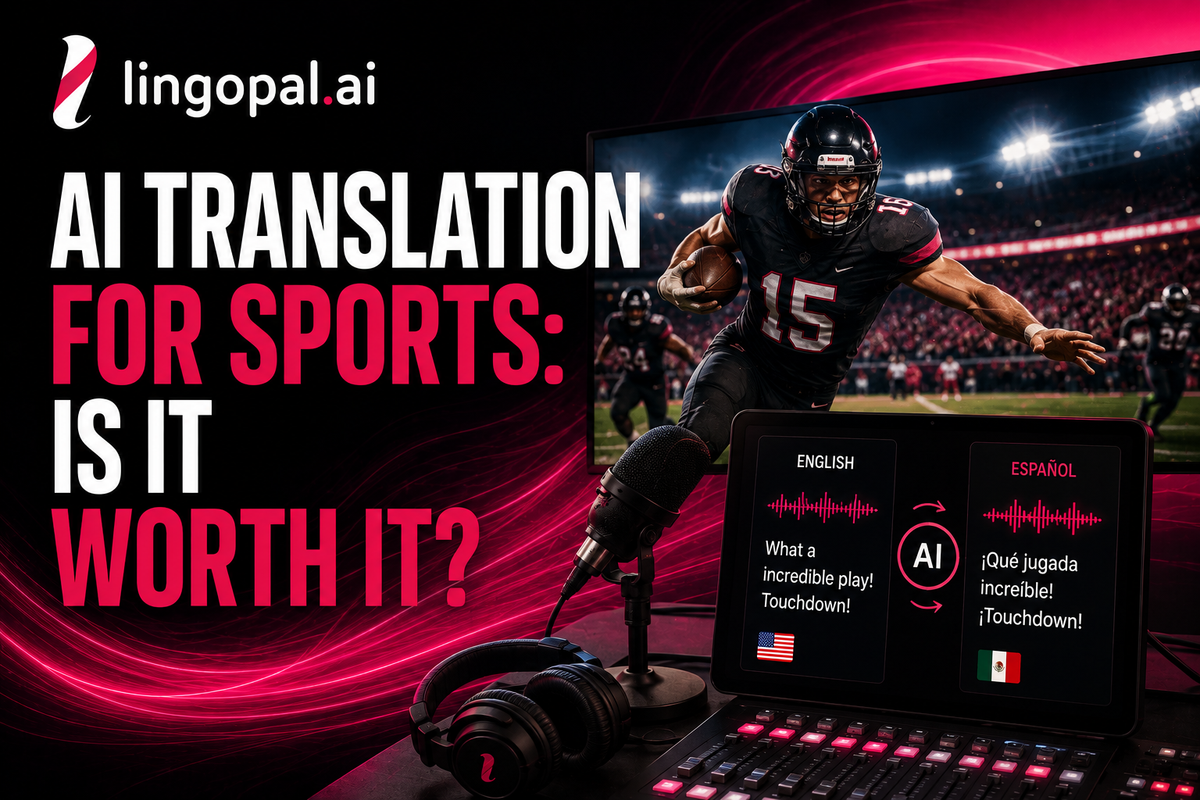
Is real-time AI translation worth it for a regional sports network trying to grow its Spanish-language audience?
Assessing the Cost of Live Spanish Commentary vs. AI Translation for Regional Networks
The operational question for any regional sports network comes down to a single financial reality: what does it actually cost to deliver live Spanish commentary for a full season? Human Spanish commentary requires hiring broadcast-ready talent, often multiple commentators to cover different dialects, plus interpreters for post-game interviews. For a network airing 100+ games per season, the line item for human Spanish commentary can exceed $200,000 annually before factoring in travel, rehearsal time, and production overhead. IBM reports that 33% of sports fans believe real-time translation will most impact their viewing experience in the next two to three years. That statistic represents a sizable audience segment that regional networks currently leave unserved when they skip Spanish commentary entirely.
Key Takeaways
- Hiring broadcast-ready human commentators for a full season of Spanish coverage can cost a regional network over $200,000 annually once you add travel, rehearsal, and production overhead.
- One in three sports fans expects real-time translation to change how they watch games within a few years, yet most regional networks ignore that audience when they skip Spanish commentary.
- The operational decision to provide live Spanish commentary is not just about talent salaries but also about covering multiple dialects and post-game interpretation, which drives costs higher.
- Real-time AI translation offers a path to serve the underserved Spanish-speaking fan base without the recurring six-figure expense of human commentators.
The hidden cost is not simply the talent fee. It is the operational friction of scheduling commentators who speak the right dialect for each broadcast, managing separate audio feeds, and absorbing the risk of a commentator missing a game due to illness or scheduling conflicts. Regional networks with limited budgets often default to English-only broadcasts because the logistics of live Spanish commentary feel unmanageable at their scale.
The Hidden Cost of Human Spanish Commentary for Regional Broadcasts
Hiring a single Spanish-language commentator for a regional sports network carries a per-game cost ranging from $2,000 to $5,000 depending on market size and experience. For a network covering baseball or basketball seasons, that translates to $200,000 to $500,000 per season for one voice. Most networks require a rotation of at least two commentators to manage fatigue and scheduling gaps, doubling the expense. Additional costs include interpretation services for pre-game and post-game segments, equipment for separate audio channels, and the studio time needed for rehearsals. Sportico estimates that sports commentary translation represents a $56 billion market globally, underscoring the scale of the opportunity and the corresponding investment required to address it through traditional means.
How AI Translation Changes the Cost Structure Without Sacrificing Quality
Lingopal AI Translation replaces the per-game talent model with a per-stream licensing structure that eliminates the need for multiple human commentators. The platform ingests the English broadcast feed and generates Spanish commentary using neural machine translation, voice cloning, and real-time dubbing. The Tennis Channel deployed Lingopal for English-to-Spanish dubbing during the Guadalajara Open Akron in 2024, demonstrating that the technology performs at tournament-grade standards. For regional networks, the cost shift is dramatic: instead of paying per commentator per game, the network pays a fixed fee per stream hour with no talent scheduling overhead, no travel costs, and no dialect availability risk. The question "Is real-time AI translation worth it for a regional sports network trying to grow its Spanish-language audience?" becomes a straightforward calculation when the variable cost of human talent is replaced by a predictable technology license.
Cost Factor
Human Spanish Commentary
Lingopal AI Translation
Per-game talent cost
$2,000 to $5,000+
Fixed per-stream fee
Seasonal cost (100 games)
$200,000 to $500,000+
Fraction of that cost
Scheduling overhead
High (multiple commentators, travel)
None (single feed ingest)
Dialect coverage per broadcast
One dialect per commentator
Multiple dialect outputs available
Setup time
Weeks for hiring and rehearsals
Days for integration
What Regional Networks Need to Know About AI Translation Latency, Accuracy, and Dialects
Broadcast engineers evaluating AI translation need to verify three specific technical parameters before committing to a platform: latency during live play, accuracy under game conditions, and dialect handling for the specific Hispanic communities the network serves. These are not abstract quality metrics. They determine whether a Spanish-language viewer hears a timely call, a correctly translated player name, and a voice that sounds appropriate for the broadcast context.
Latency Requirements for Live Sports: What 15 Seconds Means in Practice
Lingopal delivers approximately 15 seconds of latency for live dubbing while producing real-time captions simultaneously from a single input feed. For a live sports broadcast, 15 seconds means the Spanish commentary arrives slightly behind the English broadcast, a gap that viewers quickly adjust to because the audio remains synced to the game action they are watching. The platform supports SRT, HLS, RTMP, MP4, and API ingest formats, allowing regional networks to integrate the translation pipeline into their existing production workflow without reconfiguring encoders or switching hardware. The key operational insight is that 15 seconds of latency does not affect the viewer experience negatively. It allows the AI to complete its processing pipeline.
Accuracy Benchmarks: BLEU 61+ and Handling Regional Spanish Dialects
Lingopal’s neural machine translation models achieve BLEU scores of 61+, a benchmark that indicates strong alignment between the AI-produced translation and a professional human reference translation. The firm reports 97% accuracy under live conditions. For regional networks serving US Hispanic audiences, dialect handling is the more operationally relevant metric. Mexican, Puerto Rican, Dominican, and Castilian Spanish differ in vocabulary, pace, and idiomatic expression. A translation model trained primarily on Castilian Spanish will produce commentary that sounds foreign to a Mexican-American audience in the Southwest or a Puerto Rican audience in the Northeast. Lingopal’s models are trained on dialect-specific corpora to match the target audience’s linguistic norms.
Voice Cloning and Emotional Fidelity in Game-Critical Moments
Voice cloning in Lingopal preserves the timbre, pacing, and emotional range of the original English commentator. When a game reaches a critical moment, such as a buzzer-beater or a walk-off home run, the Spanish commentary must carry the same intensity as the English call. The AI model maintains emotional fidelity across languages, so the rise in pitch and faster cadence that signals excitement in English transfers naturally to the Spanish output. For regional networks, this eliminates the flat, robotic quality that has historically made AI translation unacceptable for live sports. The platform does not simply translate words. It translates the performance of the call.
Key technical threshold for evaluation: Any AI translation platform your network evaluates must demonstrate dialect-specific model training, BLEU scores above 60, and voice cloning that preserves emotional range across game-critical moments. If a vendor cannot confirm these three parameters with test data from your specific audience region, the technology is not ready for live sports deployment.
Building the Business Case: A Step-by-Step ROI Framework for Your Spanish-Language Audience
Regional network executives face a decision that blends audience strategy with operational finance. The question "Is real-time AI translation worth it for a regional sports network trying to grow its Spanish-language audience?" can be answered through a structured ROI framework that uses your existing data points to produce a defensible financial case. These four steps move from audience sizing through revenue projection and cost comparison to long-term brand value.
- Calculate your potential Spanish-language viewership within your broadcast territory.
- Estimate the watch time lift and ad revenue impact per viewer.
- Compare the cost of AI translation against traditional human commentary.
- Factor in sponsor interest and long-term brand loyalty effects.
Step 1: Calculate Your Potential Spanish-Language Viewership
Start with US Census Bureau American Community Survey data for your designated market area. Identify the percentage of households that identify as Hispanic or Latino and the share of those households where Spanish is the primary language. For a regional network covering a market like Los Angeles, Houston, or Miami, Spanish-primary households can represent 30% to 50% of the population. Cross-reference this data against your existing streaming analytics to determine how many of these households currently watch your English broadcast. The gap between total Spanish-primary households in your DMA and your current English-language reach represents your addressable growth opportunity. A network serving a DMA with 200,000 Spanish-primary households that currently reaches only 20,000 of them has a potential audience expansion of 180,000 viewers.
Step 2: Estimate Watch Time Lift and Ad Revenue per Viewer
Lingopal AI Translation reports that regional broadcasters using the platform saw measurable increases in average watch time within Spanish and Portuguese language markets. For a network with 50,000 English-language viewers per game, even a 10% audience lift through Spanish commentary adds 5,000 viewers per broadcast. Multiply that number by your average CPM and the length of your season. A network airing 100 games with a $15 CPM and 5,000 additional Spanish-language viewers per game generates $7,500 in incremental ad revenue per broadcast, or $750,000 per season. This estimate remains conservative because it does not account for the higher engagement rates that language-specific content typically produces. Viewers who watch in their primary language stay through commercial breaks at higher rates than casual English-language viewers.
Step 3: Compare AI Translation Cost vs. Traditional Approaches
The cost structure for human Spanish commentary runs $2,000 to $5,000 per game for a single commentator, with most networks needing at least two voices for a full season to manage scheduling gaps and dialect coverage. Lingopal AI Translation replaces that per-game talent cost with a fixed per-stream license fee that eliminates scheduling overhead, travel expenses, and dialect availability risk. For a 100-game season, the human commentary budget of $200,000 to $500,000 stands against an AI translation cost that represents a fraction of that figure. The savings flow directly to the bottom line while the network gains the ability to offer Spanish commentary for every game, not just select matchups. The financial comparison favors AI translation decisively when the network commits to covering its entire broadcast schedule rather than a partial slate.
Step 4: Factor in Sponsor Interest and Long-Term Brand Loyalty
Sponsors targeting Hispanic demographics pay premiums for media placements that reach Spanish-language audiences authentically. A regional network offering Spanish-language ad inventory alongside its commentary opens a new revenue stream at CPMs often 20% to 40% higher than English-only inventory. Beyond direct ad revenue, the loyalty effect compounds across seasons. Viewers who consume sports in their primary language show higher retention rates and stronger brand affiliation with the network that provides that service. Sportico estimates that sports commentary translation represents a $56 billion market globally. Regional networks that capture even a small fraction of that value within their DMA build audience equity that competitors cannot easily replicate. The brand loyalty metric alone justifies the investment when measured across a three to five year planning horizon.
ROI threshold for go/no-go decision: If your network can identify at least 10,000 Spanish-primary households in its DMA and generate $5 or more CPM premium on Spanish-language ad inventory, the ROI case for Lingopal AI Translation closes within a single season. Watch time increases and sponsor interest follow the availability of language-specific content, as confirmed by real deployment data.
Frequently Asked Questions
How good is AI at translating languages?
AI translation, particularly neural machine translation models like those used by Lingopal, achieves high accuracy with BLEU scores of 61+ and 97% accuracy under live conditions. This technology handles regional dialects effectively, producing commentary that matches the linguistic norms of specific Hispanic audiences.
Will AI hurt or help sports broadcasting?
AI translation helps sports broadcasting by enabling regional networks to offer Spanish-language commentary at a fraction of the cost of human talent. It removes scheduling overhead, travel costs, and dialect availability risks, allowing networks to grow their audience without the logistical friction of traditional commentary.
What language is most in demand for interpreters?
Spanish is the most in-demand language for interpreters in US sports broadcasting, driven by the large Hispanic audience that regional networks currently leave unserved. The market for sports commentary translation is estimated at $56 billion globally, with Spanish representing a significant portion of that demand.
What are the cons of AI translation?
AI translation introduces a latency of approximately 15 seconds for live dubbing, which viewers adjust to but may notice initially. Accuracy can vary with complex game terminology or rapid play, and models must be trained on specific dialects to avoid sounding foreign to the target audience.
What are the disadvantages of AI translation?
Disadvantages of AI translation include the need for dialect-specific training to avoid mismatches with audience expectations, and the latency gap that requires viewer adaptation. The technology also depends on consistent audio feed quality and may not capture the emotional nuance of human commentators in high-stakes moments.
How much does human Spanish commentary cost per season for a regional sports network?
Human Spanish commentary for a regional sports network covering 100 games per season costs between $200,000 and $500,000 or more. This includes talent fees of $2,000 to $5,000 per game, plus additional costs for interpretation services, equipment, and scheduling overhead.
What technical parameters should networks verify before adopting AI translation?
Networks should verify latency during live play, accuracy under game conditions, and dialect handling for their specific Hispanic communities. Lingopal delivers 15 seconds of latency with 97% accuracy and supports multiple dialect outputs, ensuring the commentary matches the audience's linguistic norms.
About the Author
This article was crafted by the expert team at Lingopal, an AI-powered platform built for real-time translation and transcription in live broadcast environments. From sports and news to education and global events, Lingopal helps professional teams deliver multilingual audio and captions with voice cloning, emotion preservation, and enterprise-grade accuracy.