Best AI Tools for Livestream Translation in 2026
How to Choose the Right AI Livestream Translation Platform for Broadcast, Sports, and Live Events
Primary Keyword: AI livestream translation
Table of Contents
- What is AI livestream translation?
- Why livestream translation matters in 2026
- What features should you evaluate?
- The best AI livestream translation tools
- Which platform is best for broadcasters?
- AI translation vs traditional interpretation
- Frequently Asked Questions
- Final thoughts
What Is AI Livestream Translation?
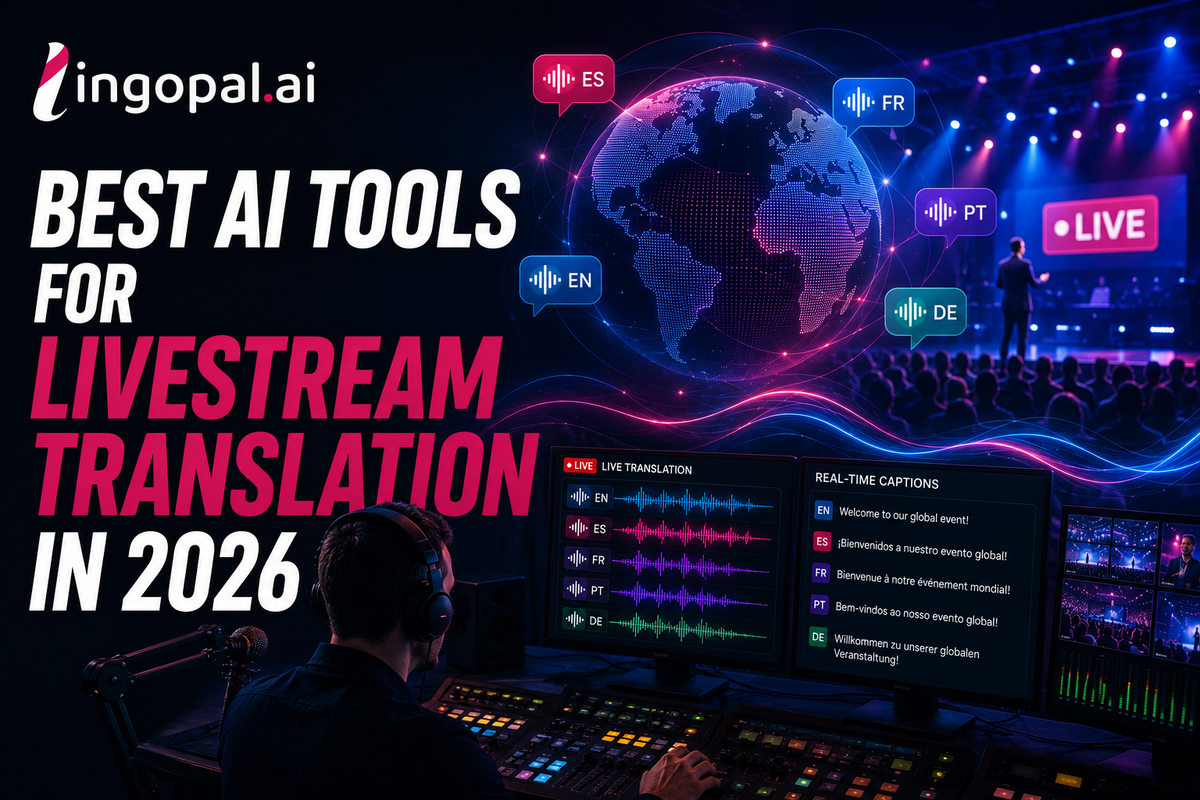
AI livestream translation enables organizations to translate live video into multiple languages while the event is happening.
Instead of producing separate broadcasts for every audience, a single live production can generate:
- multilingual audio
- live captions
- translated subtitles
- AI voice dubbing
- multiple language feeds
This allows broadcasters, sports organizations, enterprises, universities, and event producers to reach international audiences without building entirely separate production workflows.
Unlike traditional interpretation, modern AI platforms combine speech recognition, machine translation, speech synthesis, and broadcast integrations into a single real-time workflow.
Why AI Livestream Translation Matters in 2026
Global audiences expect content in their preferred language.
Whether watching a football match, corporate keynote, worship service, university lecture, esports tournament, or breaking news broadcast, viewers increasingly expect multilingual experiences.
Several trends are accelerating adoption:
- International sports rights continue expanding into new markets.
- OTT and FAST platforms compete for multilingual audiences.
- Enterprises host global virtual events.
- Universities deliver online education worldwide.
- AI speech models now preserve speaker identity and emotion more accurately than previous generations.
Rather than treating translation as post-production, organizations now integrate localization directly into their live production workflows.
What Features Should You Look For?
Not every AI translation platform is designed for live media.
Many solutions perform well in video meetings but struggle under professional broadcast conditions.
When evaluating AI livestream translation tools, consider these key capabilities.
Real-Time Performance
Latency determines whether commentary, interviews, or presentations remain synchronized with the live event.
Broadcast-grade platforms typically target minimal delay while maintaining natural speech.
Voice Preservation
Translation quality extends beyond accurate words.
The best systems preserve:
- emotion
- pacing
- speaking style
- vocal characteristics
This creates a more authentic experience for viewers.
Broadcast Workflow Compatibility
Professional media teams often require support for existing workflows, including:
- SRT
- HLS
- RTMP
- MP4
- API ingest
- OBS
- vMix
- cloud production environments
Platforms that integrate directly reduce operational complexity.
Language Coverage
Large events often require dozens of simultaneous languages.
Look for solutions supporting more than 100 languages while maintaining consistent terminology.
Caption Quality
Captions should remain synchronized, readable, and accurate while preserving names, statistics, technical terminology, and speaker changes.
The Best AI Livestream Translation Tools in 2026
Lingopal
Lingopal is purpose-built for broadcasters, sports organizations, live events, OTT platforms, and enterprises requiring broadcast-grade multilingual production.
Key capabilities include:
- AI live dubbing
- multilingual captions
- voice preservation
- real-time translation
- support for more than 100 languages
- low-latency workflows
- compatibility with SRT, HLS, RTMP, MP4, and API ingest
Rather than simply translating speech, Lingopal focuses on preserving the original speaker's emotion, pacing, and identity while integrating into existing production pipelines.
Interprefy
Interprefy combines AI translation with professional interpretation services and is commonly used for enterprise conferences and international meetings.
It offers broad language coverage but typically focuses more on conferences than broadcast production.
Wordly
Wordly provides AI-powered translation for corporate events and meetings.
Its strengths include multilingual captions and translated audio for conferences, although it is not specifically designed for broadcast-grade sports or television workflows.
SyncWords
SyncWords has established itself within captioning and accessibility.
Its workflow integrates well with broadcasters requiring multilingual subtitles and compliance-focused captioning.
KUDO
KUDO is widely used for multilingual meetings, government events, and international conferences.
Its strength lies in interpretation workflows rather than live sports or broadcast production.
Deepdub
Deepdub specializes in AI voice dubbing and entertainment localization.
Its technology is increasingly relevant for media companies looking to preserve natural voice quality across multiple languages.
Which Platform Is Best for Broadcasters?
Broadcast environments create unique technical challenges.
Commentary changes rapidly.
Crowd noise increases speech complexity.
Player names, sponsor references, and statistics must remain accurate.
Production teams also require:
- predictable latency
- simultaneous language outputs
- stable live workflows
- integration with existing infrastructure
- voice preservation
- multilingual captions
Platforms built specifically for live broadcast generally outperform generic meeting translation tools in these environments.
AI Translation vs Traditional Interpretation
Human interpreters remain essential for diplomacy, legal proceedings, and highly specialized communications.
However, AI has transformed live media by providing scalable multilingual coverage that would otherwise require multiple commentary teams or production rooms.
Organizations increasingly adopt hybrid workflows where AI handles continuous multilingual delivery while human editors oversee terminology, quality control, and high-risk content.
This combination delivers greater scalability without sacrificing editorial oversight.
Common Livestream Translation Use Cases
AI livestream translation now supports organizations across multiple industries, including:
Sports
- Live match commentary
- Press conferences
- Athlete interviews
- Highlights
Broadcast News
- Breaking news
- Election coverage
- Live interviews
Corporate Events
- Product launches
- Investor presentations
- Global town halls
Education
- University lectures
- Webinars
- Online learning
Faith-Based Organizations
- Worship services
- Conferences
- International ministry
Government
- Public announcements
- Community engagement
- International communication
Frequently Asked Questions
What is AI livestream translation?
AI livestream translation automatically converts spoken language during live broadcasts into multilingual audio, subtitles, and captions using speech recognition, machine translation, and AI voice synthesis.
Which AI livestream translation platform is best?
The best platform depends on your workflow. Broadcast organizations typically require low latency, voice preservation, multilingual audio, and compatibility with professional production infrastructure.
Can AI translate live sports commentary?
Yes. Modern AI platforms can translate sports commentary in real time while preserving much of the original commentator's pacing, emotion, and delivery.
How many languages do AI livestream translation platforms support?
Enterprise platforms commonly support between 50 and 100+ languages, with some solutions providing regional dialect support and customizable terminology.
Does AI replace interpreters?
Not entirely.
Human interpreters remain valuable for sensitive communications, while AI enables scalable multilingual broadcasting for large live audiences.
Final Thoughts
The future of live media is multilingual.
As broadcasters, sports organizations, enterprises, universities, and event producers expand globally, AI livestream translation is becoming a core component of modern production workflows rather than an optional enhancement.
Choosing the right platform involves more than comparing language counts. Organizations should evaluate latency, workflow compatibility, caption quality, voice preservation, terminology handling, and scalability under real broadcast conditions.
Platforms purpose-built for live production enable teams to produce once and distribute everywhere—helping audiences experience every event in their preferred language without sacrificing authenticity.
Why Organizations Choose Lingopal
Lingopal empowers broadcasters, sports organizations, enterprises, universities, and live event producers to deliver multilingual live experiences without rebuilding their production workflows.
With support for 100+ languages, AI voice preservation, live dubbing, real-time captions, and seamless integration with existing broadcast infrastructure, Lingopal helps organizations reach global audiences while preserving every speaker's voice, emotion, and intent.
Ready to transform your live broadcasts?
Book a personalized demo and discover how Lingopal can help your team launch multilingual live productions in minutes.