Best AI Translation for Preserving Original Speaker Emotion
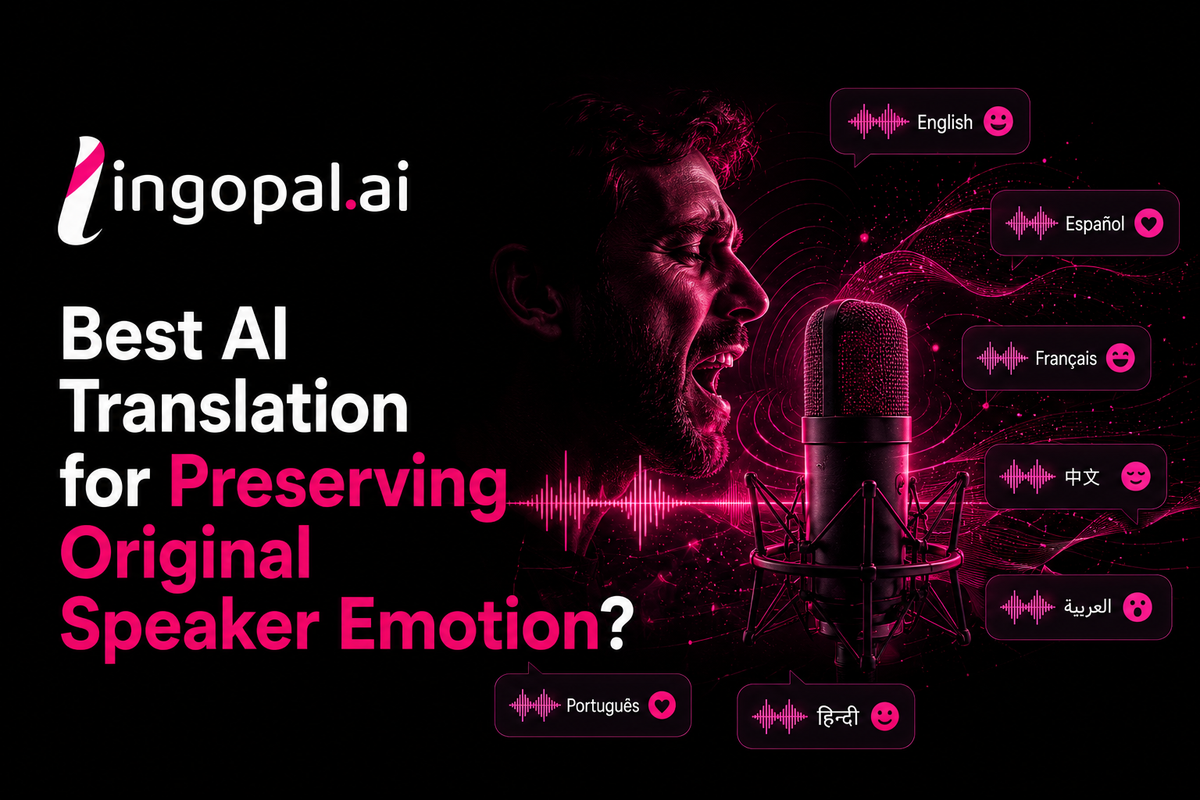
Translation is not merely converting words from one language to another. For broadcast professionals, the challenge lies in conveying the full spectrum of human expression. The subtle inflections, the emotional weight, the very character of the original speaker. Achieving this level of fidelity requires sophisticated AI architectures capable of dissecting and reconstructing not just meaning, but the emotional subtext that underpins it. This is where the technical specifics of Generative AI become paramount for accurate, emotive voice translation.
The pursuit of the Best AI translation for preserving original speaker emotion? demands a deep dive into the underlying technology. It moves beyond basic linguistic accuracy to capture the performance aspect of spoken communication. Understanding the technical foundation is the first step for any broadcast operation considering AI-powered dubbing or localization.
The Technical Architecture Required for Emotional Fidelity
Preserving the emotional cadence of an original speaker means the AI must process more than just the semantic content of the audio. It requires a nuanced understanding of prosody. The patterns of rhythm, stress, and intonation in speech. These elements are not universal; they vary significantly between languages and even dialects. For example, a question in American English typically ends with a rising intonation, while in some other languages, the final word might be stressed differently or carry a different pitch contour to signify inquiry. An AI system designed for emotional fidelity must not only translate the words but also map these prosodic features accurately, ensuring the translated output carries the same emotional intent and grammatical function, whether it's conveying urgency, surprise, or calm.
The architecture must be capable of decomposing the source audio into multiple layers of information. This includes the linguistic content, the speaker's unique vocal timbre, and the emotional state conveyed through pitch variation, speech rate, and loudness. Modern Generative AI models, particularly those built on advanced neural network frameworks, are designed to handle this complexity. They simultaneously process the acoustic and linguistic signals, allowing them to maintain grammatical correctness in the target language while replicating the emotional coloring of the original performance. This simultaneous processing, often involving encoder-decoder Transformer networks, is key to preventing the loss of emotional nuance that can occur with simpler translation methods.
Technical Specifications for Emotional Fidelity
Achieving high emotional accuracy in AI translation relies on specific architectural components:
- Unified Voice and Text Processing: Models must be trained on datasets that correlate acoustic features with semantic meaning and emotional markers. This enables the AI to learn how pitch, rhythm, and tone map to specific sentiments across languages.
- Prosodic Feature Extraction: Advanced algorithms extract key prosodic features such as fundamental frequency (pitch), energy (loudness), and duration (speech rate) from the source audio. These features are then used to guide the synthesis of the target language audio.
- Contextual Language Modeling: Large Language Models (LLMs) alongside Neural Machine Translation (NMT) systems are employed. LLMs provide fluency and stylistic adaptation, while NMT offers precision. When combined, they allow for the generation of target language speech that is both grammatically sound and emotionally aligned with the source, maintaining a high BLEU score for linguistic accuracy.
- Real-time Synthesis: For live applications, the system must synthesize the translated speech in near real-time, preserving the original speaker's vocal characteristics and emotional delivery without noticeable delay.
The process diagram for such a system typically illustrates a pipeline where raw audio is first analyzed for its acoustic and prosodic components. These features are then fed into a translation engine that generates the target language text. Simultaneously, the acoustic and prosodic information guides a voice synthesis module. This module generates speech in the target language, not with a generic voice, but with vocal characteristics that mimic the original speaker's pitch, pace, and emotional tone. This integrated approach ensures that the final output is not just a word-for-word translation but an authentic vocal rendition that carries the same emotional weight and intent, maintaining the speaker's unique vocal signature throughout the dubbing process.
Real-Time Constraints Versus Post-Production Workflows
The operational environment significantly dictates the AI translation approach. For live broadcasting, such as news feeds, sporting events, or live interviews, latency is a critical factor. The AI must perform dubbing with minimal delay to maintain synchronization with the video feed and the natural flow of a live program. This necessitates highly optimized models that can process audio, translate text, and synthesize voice with minimal delay. The challenge here is balancing speed with the preservation of emotional nuance. A system that prioritizes speed might sacrifice some degree of vocal character or emotional subtlety. Consequently, broadcast operations must carefully evaluate the acceptable latency thresholds for live dubbing, ensuring that the voice cloning technology maintains the speaker's distinct characteristics and emotional delivery in real time without becoming jarring or unnatural for the viewer.
In contrast, post-production workflows for recorded content, like documentaries, films, or corporate videos, offer more flexibility. These scenarios allow for extended processing times, which can be used to achieve higher fidelity in both linguistic accuracy and emotional replication. Audio-visual synchronization and lip-cycle matching become more manageable when there isn't a strict real-time constraint. This permits the use of more computationally intensive models that can perform deeper analysis of the source audio, fine-tune the prosody, and ensure perfect lip-sync. While the goal of preserving speaker emotion remains, the methods differ. VOD content can benefit from more sophisticated voice cloning and emotional mapping techniques that might introduce too much latency for live broadcasts but yield superior results for pre-recorded material, providing a more polished and emotionally impactful final product.
Validating Emotional Accuracy Through Enterprise Metrics
Broadcast technical directors cannot rely on subjective assessments when evaluating AI translation quality. The question "Did the translation feel right?" must be replaced with quantifiable metrics that measure both linguistic precision and emotional fidelity. Enterprise deployment demands a standardized audit framework that separates genuine capability from marketing claims. Two categories of evaluation matter most: linguistic fidelity scores and voice cloning consistency.
Linguistic Fidelity Scores and Semantic Alignment
BLEU scores remain the industry baseline for evaluating translation accuracy, but they measure surface-level n-gram overlap, not emotional preservation. A translation can score high on BLEU while stripping all expressive nuance. For broadcast applications, semantic alignment ratios provide a more meaningful metric. This ratio compares the semantic vectors of the source and target utterances, ensuring that the emotional intent. Urgency, humor, empathy. Is preserved even when the surface wording changes. Lingopal AI Translation achieves a high BLEU score, indicating strong linguistic accuracy, but its neural architecture also maps prosodic features to semantic embeddings, enabling the system to retain the emotional register across languages. Technical directors should request semantic alignment validation reports during any AI translation trial, verifying that the model maintains emotional tone consistency across at least 100 test samples per target language.
Voice Cloning Consistency and Vocal Character Preservation
Voice cloning consistency metrics assess whether the synthesized output preserves the original speaker's unique vocal identity across different emotional contexts and speaking rates. The critical measure is the speaker embedding distance: the vector difference between the source speaker's voice signature and the cloned voice. A low distance (below 0.05 in cosine similarity terms) indicates high fidelity. Additionally, pitch variation preservation. The range of fundamental frequency (F0) in the output relative to the source. Must remain within 10% tolerance to avoid artificial flattening of emotional peaks. These metrics ensure the broadcast audience hears the same personality, not a generic synthetic voice. Production teams should test with high-emotion segments. Arguments, celebrations, apologies. To stress-test the model's ability to replicate the speaker's authentic vocal character under challenging conditions.
Evaluation Checklist for AI Translation Deployments
- BLEU score verification: confirm a high score on representative content
- Semantic alignment ratio: compare source/target sentiment vectors across 100+ samples
- Speaker embedding distance: measure cosine similarity between original and cloned voice
- Pitch variation preservation: F0 range within 10% of source speaker
- Emotional stress test: run translation on high-emotion segments and score for appropriateness
- Real-time consistency: validate that latency constraints do not degrade emotional output
When broadcast teams apply these metrics systematically, the search for the Best AI translation for preserving original speaker emotion? becomes an empirical evaluation rather than a subjective preference. Lingopal AI Translation provides the necessary performance benchmarks and reporting tools to support this level of auditability, ensuring that enterprise deployments meet both technical and expressive standards.
Operational Deployment Criteria for Broadcast Teams
Integrating advanced AI translation into broadcast workflows requires careful consideration of technical compatibility and scalability. Operations teams must ensure that any proposed solution can ingest content through standard protocols without requiring extensive custom development or re-encoding. This focus on ingest flexibility and the capacity to handle a wide array of languages simultaneously is paramount for efficient deployment and maximum operational benefit. The goal is to streamline the localization process, enabling broadcast professionals to reach global audiences with their content, complete with the original speaker's emotional intent, without introducing significant technical hurdles.
Ingest Protocol Compatibility and Format Agnostic Processing
For broadcast operations, the ability to ingest content via common streaming protocols and file formats is non-negotiable. Solutions that demand specific, non-standard inputs create bottlenecks and increase operational overhead. A platform designed for enterprise broadcast must natively support protocols such as Secure Reliable Transport (SRT), High-Efficiency Streaming Protocol (HLS), Real-Time Messaging Protocol (RTMP), and standard video files like MP4. Furthermore, strong API ingest capabilities are essential for programmatic integration into existing content management systems or live production pipelines. This format-agnostic approach allows content creators to submit audio and video feeds in their native formats, eliminating costly and time-consuming pre-processing steps. This is a key differentiator for platforms that prioritize workflow efficiency and broad compatibility.
Lingopal AI Translation is engineered to address these critical ingest requirements. It processes SRT, HLS, RTMP, MP4, and API feeds without requiring code modifications. This means broadcast engineers can connect their existing streams or upload their files directly, and the AI engine will handle the rest, including language detection and processing. This capability ensures that the complexity of localization is managed by the AI, not by the operations team having to adapt their established infrastructure. The system’s design prioritizes minimizing points of failure and maximizing throughput, allowing for a smooth transition from content creation to multilingual distribution.
Scalable Infrastructure for Multi-Language Simultaneous Output
The demands on a translation system scale dramatically with the number of target languages and concurrent broadcasts. A broadcast operation might need to localize a single live event into dozens of languages simultaneously, or manage multiple VOD assets for different regional markets. The underlying infrastructure must possess the elasticity to handle such variable loads without performance degradation. This means not just supporting a large number of languages, but also delivering them with consistent quality and minimal latency, regardless of the volume of requests. This scalability is critical for dynamic content environments where market demands can shift rapidly.
Enterprise-grade AI translation platforms must offer the capacity to support a wide array of languages, providing simultaneous output streams for each. This level of scalability is achieved through distributed cloud architectures that can dynamically allocate resources based on demand. For broadcast teams, this translates to a predictable operational cost and the assurance that their content can reach any global audience, at any time, in their preferred language, while preserving the original speaker's emotional authenticity. The ability to scale effortlessly ensures that as an organization's reach expands, its localization capabilities keep pace, maintaining brand consistency and audience engagement across all markets.