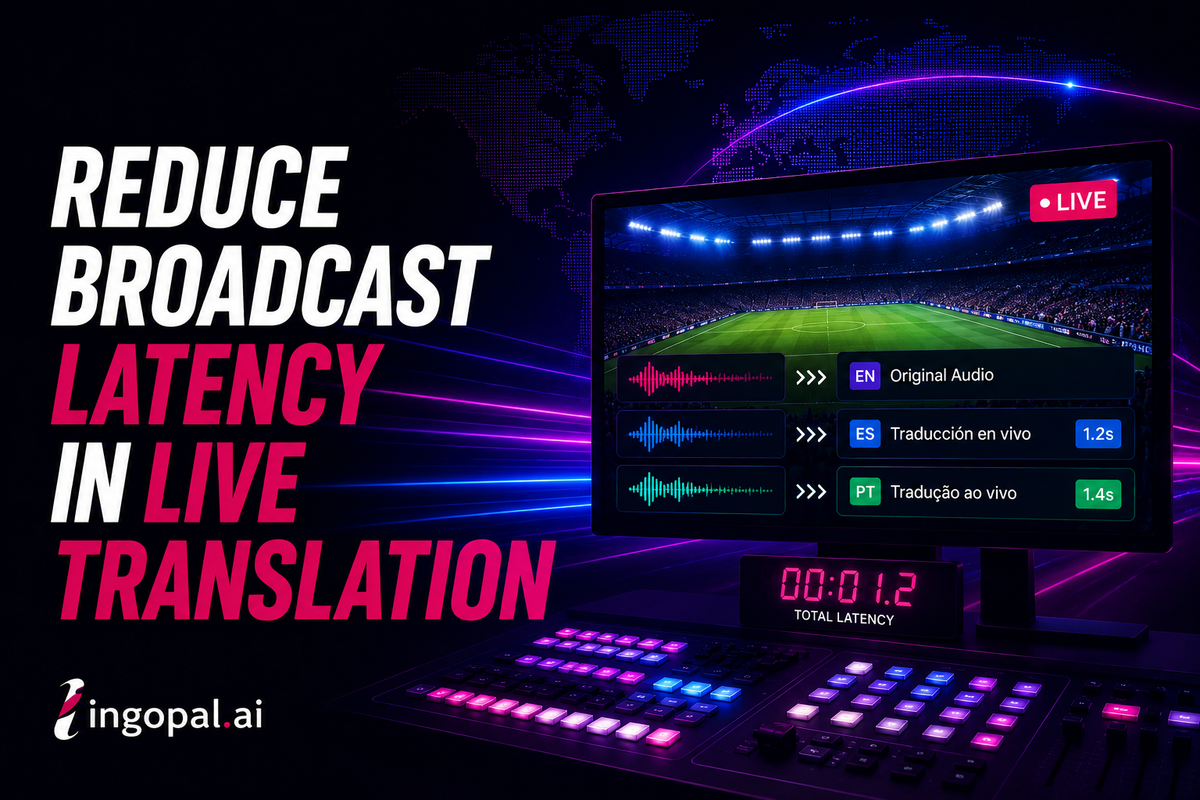
How to Reduce Broadcast Latency in Live Translation
A Complete Guide to Building Low-Latency Multilingual Broadcast Workflows
Primary Keyword: live stream translation
Table of Contents
- What causes latency in live stream translation?
- Why low latency matters in broadcasting
- The broadcast translation workflow explained
- 8 ways to reduce broadcast latency
- Common mistakes that increase delay
- Frequently Asked Questions
- Final Thoughts
Why Broadcast Latency Matters More Than Ever
Viewers expect live broadcasts to feel immediate.
Whether they're watching a Champions League match, breaking news, an earnings call, a worship service, or a global product launch, even a few seconds of unnecessary delay can negatively impact the viewing experience.
When multilingual broadcasting is introduced, maintaining synchronization becomes even more challenging.
A live stream translation workflow isn't simply translating speech. It involves multiple systems working together simultaneously:
- Audio capture
- Speech recognition
- AI translation
- Voice synthesis
- Caption generation
- Encoding
- Streaming
- Distribution
Every additional process introduces potential latency.
The challenge isn't eliminating delay completely—it's minimizing it while maintaining translation quality and broadcast reliability.
What Is Broadcast Latency?
Broadcast latency refers to the total delay between someone speaking and viewers hearing or reading the translated content.
That delay includes every stage of the production pipeline.
A simplified workflow looks like this:
Speaker
↓
Audio Processing
↓
Speech Recognition
↓
AI Translation
↓
Voice Generation
↓
Caption Rendering
↓
Encoder
↓
CDN
↓
Viewer
The goal is to optimize every stage instead of focusing only on the translation engine.
Why Low Latency Is Critical
Different types of live content have different latency requirements.
For example:
Sports
Commentary should remain synchronized with goals, plays, interviews, and celebrations.
News
Breaking events lose value if translated coverage significantly lags behind competitors.
Corporate Events
Executives speaking to global audiences need translated audio that feels immediate.
Faith-Based Streaming
Natural timing helps maintain emotional connection during worship and sermons.
Live Entertainment
Audience engagement depends on conversations feeling authentic and synchronized.
What Actually Creates Delay?
Many organizations assume AI translation is responsible for most latency.
In reality, translation often represents only one part of the overall delay.
Typical contributors include:
- Audio buffering
- Network transmission
- Speech recognition
- Translation processing
- Voice synthesis
- Caption rendering
- Video encoding
- CDN distribution
- Player buffering
Optimizing only one stage rarely produces meaningful improvements.
Instead, broadcast teams should evaluate the complete workflow.
1. Improve Source Audio Quality
Everything begins with clean audio.
Poor microphones, crowd noise, overlapping speakers, and inconsistent levels force speech recognition systems to work harder.
Better source audio produces:
- Faster transcription
- Higher translation accuracy
- Better captions
- Lower overall latency
Translation quality starts before AI is even involved.
2. Minimize Buffering Throughout the Workflow
Every production component introduces buffering.
Examples include:
- Audio buffers
- Video buffers
- Streaming protocols
- CDN caching
- Playback buffers
Small buffers improve responsiveness but reduce tolerance for unstable networks.
Finding the right balance is essential.
3. Optimize Speech Recognition
Accurate speech recognition reduces downstream corrections.
Professional workflows should recognize:
- Speaker changes
- Proper names
- Technical terminology
- Sports vocabulary
- Company names
Errors here increase processing time later in the workflow.
4. Use Translation Engines Built for Live Media
Not every AI model is optimized for live production.
Meeting software often prioritizes conversational accuracy over speed.
Broadcast environments require:
- Low latency
- Continuous processing
- Context awareness
- Terminology consistency
- Stable throughput
Platforms designed specifically for live media generally deliver better real-time performance.
5. Separate Audio Tracks
Using isolated program audio significantly improves translation quality.
Separate tracks allow independent handling of:
- Commentary
- Crowd noise
- Music
- Interpreters
- AI translation
OBS multi-track audio and professional broadcast routing make multilingual workflows much easier to manage.
6. Optimize Voice Generation
AI voice synthesis should balance quality with speed.
Natural voices improve viewer engagement, but excessively complex synthesis can increase latency.
Modern systems increasingly preserve:
- Voice identity
- Emotion
- Speaking rhythm
- Natural pacing
while maintaining production-ready performance.
7. Validate Infrastructure Before Major Events
Translation performance depends heavily on infrastructure.
Broadcast teams should evaluate:
- SRT
- RTMP
- HLS
- MP4
- API ingest
- Cloud production
- CDN routing
- Network redundancy
A fast translation engine cannot compensate for poor network architecture.
8. Continuously Monitor End-to-End Latency
The most successful broadcasters monitor latency throughout every event.
Rather than measuring only AI performance, monitor:
- Source audio
- Speech recognition
- Translation
- Captions
- Voice generation
- Distribution
- Viewer playback
Continuous monitoring identifies bottlenecks before audiences notice them.
Workflow Reliability Matters as Much as Speed
Reducing latency should never compromise reliability.
The most successful multilingual broadcasters prioritize:
- Consistent synchronization
- Stable language outputs
- Accurate terminology
- Broadcast resilience
- Operational visibility
A reliable 8-second workflow often provides a better viewer experience than an unstable 3-second workflow.
Common Broadcast Latency Mistakes
Many organizations unknowingly increase latency by:
- Mixing all audio together
- Using poor microphones
- Ignoring glossary management
- Over-buffering streams
- Skipping infrastructure testing
- Measuring only translation speed
- Not testing under live conditions
Latency optimization requires operational discipline—not simply faster AI.
How AI Is Changing Live Translation
Only a few years ago, multilingual live broadcasting required:
- Multiple commentary teams
- Human interpreters
- Separate control rooms
- Significant operational overhead
Today, AI enables broadcasters to produce once and distribute everywhere.
Combined with professional infrastructure, AI translation makes multilingual live production faster, more scalable, and significantly more cost-effective than traditional workflows.
Industries Benefiting from Low-Latency Translation
Organizations increasingly optimizing broadcast latency include:
Sports Broadcasters
Live commentary, press conferences, interviews, highlights.
News Organizations
Breaking news and international reporting.
OTT & FAST Platforms
Global streaming services.
Corporate Communications
Town halls, investor events, product launches.
Education
University lectures and webinars.
Faith-Based Organizations
Live worship services and international conferences.
Frequently Asked Questions
What causes latency in live stream translation?
Latency results from the combined delay introduced by audio capture, speech recognition, translation, voice synthesis, caption generation, encoding, network transmission, and viewer playback.
How much latency is acceptable?
The acceptable delay depends on the production type, but professional broadcasters generally aim for the lowest practical latency while maintaining reliability and synchronization.
Is AI translation responsible for most latency?
Not usually.
Translation represents only one stage in a much larger broadcast workflow.
Infrastructure, buffering, encoding, and distribution often contribute equally—or more—to overall delay.
Can OBS reduce translation latency?
OBS itself doesn't reduce AI processing time, but proper audio routing, multi-track workflows, and optimized configurations can significantly improve multilingual production efficiency.
How can broadcasters improve reliability?
Organizations should optimize source audio, monitor end-to-end workflows, validate infrastructure, maintain terminology glossaries, and continuously test under live conditions.
Final Thoughts
As multilingual broadcasting becomes standard across sports, news, entertainment, education, and corporate media, reducing latency is no longer just a technical challenge—it is a competitive advantage.
Broadcast teams that optimize their entire production pipeline, rather than focusing solely on translation speed, deliver smoother viewer experiences, higher-quality localization, and more reliable global broadcasts.
By improving source audio, infrastructure, workflow integration, and continuous monitoring, organizations can build multilingual streaming operations that remain fast, scalable, and resilient under real broadcast conditions.
Why Broadcasters Choose Lingopal
Lingopal helps broadcasters, sports organizations, streaming platforms, and enterprises deliver low-latency live stream translation with AI-powered multilingual audio, real-time captions, and voice preservation.
Supporting 100+ languages, SRT, HLS, RTMP, MP4, API ingest, and cloud-native workflows, Lingopal integrates directly into professional broadcast environments—helping teams reduce operational complexity while reaching audiences worldwide.
Ready to optimize your multilingual broadcast workflow?
Book a personalized demo and discover how Lingopal helps organizations deliver faster, more reliable live translations at scale.