Best Live Stream Translation Tools for Newsrooms in 2026
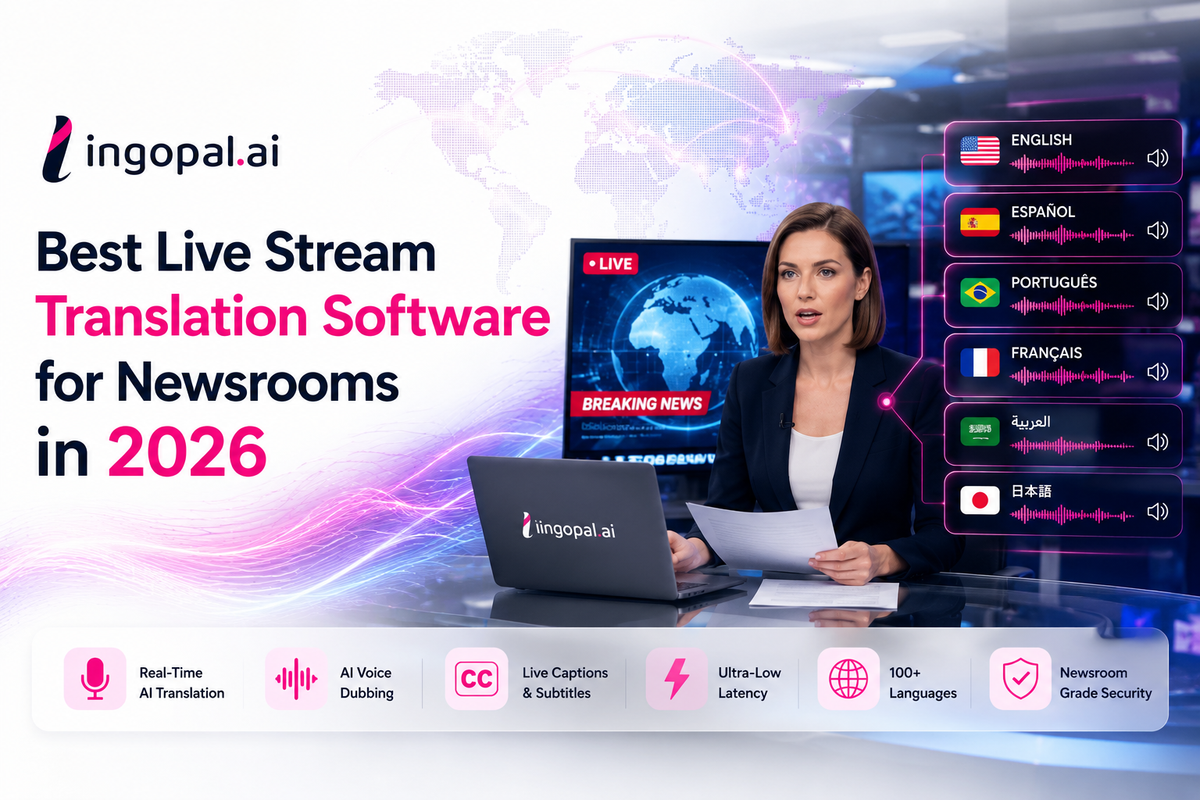
The complete comparison of broadcast-ready AI translation platforms for modern media organizations
News no longer stops at national borders.
A press conference in Brussels is watched in São Paulo.
A breaking news event in Tokyo trends globally within minutes.
An election debate is clipped, shared, translated, and discussed before the broadcast even ends.
For today's newsrooms, speed isn't enough.
Audiences increasingly expect live news in their own language.
According to Reuters Institute's Digital News Report, over 70% of online news consumers access news through digital platforms, while video continues to become one of the fastest-growing formats for news consumption.
At the same time, CSA Research found that 76% of consumers prefer content in their native language, making multilingual news no longer just an accessibility feature—it's becoming a competitive advantage.
This has fueled rapid growth in live stream translation software designed specifically for media organizations.
But which platforms are actually built for newsroom workflows?
In this guide, we compare the leading solutions based on what matters most to broadcasters:
- Language coverage
- Deployment speed
- Integration complexity
- Broadcast readiness
- Real-time audio translation
- Scalability
What Should Newsrooms Look for in Live Stream Translation Software?
Unlike conference translation or meeting software, newsroom translation requires:
- continuous live operation
- low latency
- speaker changes
- breaking news terminology
- multiple destinations
- reliable automation
The best newsroom translation solutions minimize operational complexity while fitting into existing broadcast workflows.
Comparison at a Glance
Platform
Languages
Broadcast Focus
Deployment
AI Voice
Live Captions
Best For
Lingopal
100+
⭐⭐⭐⭐⭐
No-code
✅
✅
Broadcast, sports, news, OTT
Wordly
60+
⭐⭐
Fast
Limited
✅
Conferences & events
Interprefy
80+
⭐⭐⭐
Medium
Hybrid
✅
Enterprise meetings
Palabra
Broadcast-focused
⭐⭐⭐⭐
Medium
Limited
✅
Accessibility & captions
SyncWords
100+
⭐⭐⭐⭐
Medium
Limited
✅
Captioning & subtitles
Deepdub
130+
⭐⭐
Slower
⭐⭐⭐⭐⭐
Limited
Post-production dubbing
1. Lingopal
Best for Broadcast-First Newsrooms
If your newsroom produces:
- live news
- sports
- OTT
- FAST channels
- breaking news
Lingopal is designed specifically for broadcast environments.
Rather than focusing only on translation, the platform combines:
- live dubbing
- multilingual audio
- real-time captions
- AI voice cloning
- speaker detection
- broadcast integrations
It supports standard media workflows including:
- SRT
- RTMP
- HLS
- MP4
- API integrations
Deployment is designed to fit existing production pipelines instead of requiring broadcasters to redesign their infrastructure.
Strengths
✅ 100+ languages
✅ Broadcast-ready
✅ AI voice preservation
✅ Low integration complexity
✅ Simultaneous captions and translated audio
Best for:
- Newsrooms
- Broadcasters
- Sports
- OTT
- FAST Channels
2. Wordly
Best for Conferences
Wordly has become a popular AI translation platform for conferences and corporate events.
Its strength lies in quickly translating presentations into multiple languages without requiring human interpreters.
However, newsroom production introduces challenges that conference environments typically don't.
Breaking news, multiple speakers, rapid topic changes, and continuous broadcasting demand workflows optimized for live media rather than scheduled presentations.
Strengths
- Fast deployment
- Easy setup
- Live captions
- Good language coverage
Best for:
Corporate events and conferences.
3. Interprefy
Best for Enterprise Events
Interprefy combines AI with optional human interpretation.
Organizations that require interpreter-assisted workflows often choose this model for:
- government events
- enterprise meetings
- international conferences
For broadcasters, however, hybrid workflows may increase operational complexity compared to fully automated broadcast solutions.
Strengths
- Hybrid AI + human
- Enterprise support
- Large language portfolio
Best for:
High-touch enterprise communication.
4. Palabra
Best for Accessibility
Palabra focuses heavily on live captioning and accessibility.
Many broadcasters use captioning platforms to improve compliance and viewer accessibility.
While caption quality is excellent, organizations looking for multilingual AI audio may require additional technologies alongside caption generation.
Strengths
- Live captions
- Accessibility
- Broadcast experience
Best for:
Accessibility-focused media organizations.
5. SyncWords
Best for Caption-Centric Workflows
SyncWords has built strong capabilities around:
- subtitles
- captioning
- multilingual text
It integrates with several streaming platforms and broadcast environments.
Organizations prioritizing multilingual subtitles often consider SyncWords, while those requiring AI-generated multilingual commentary may evaluate broader speech-to-speech solutions.
Strengths
- Caption generation
- Subtitle workflows
- Broadcast integrations
Best for:
Subtitle-heavy productions.
6. Deepdub
Best for Video-on-Demand Localization
Deepdub specializes in AI dubbing for pre-recorded content.
Its technology has been adopted by entertainment companies seeking high-quality localized video.
Because it primarily targets VOD workflows, organizations requiring continuous live broadcasting should carefully evaluate whether its workflow matches live newsroom requirements.
Strengths
- Voice quality
- AI dubbing
- Entertainment localization
Best for:
Movies, TV, and post-production.
Which Platform Is Easiest to Deploy?
One of the biggest differences between platforms isn't translation quality.
It's deployment.
Many newsroom teams simply don't have months to redesign infrastructure.
Generally speaking:
Lower integration complexity
- Lingopal
- Wordly
Medium complexity
- SyncWords
- Palabra
- Interprefy
Higher implementation effort
- Deepdub (depending on workflow)
Organizations increasingly favor platforms that integrate with existing streaming infrastructure rather than replacing it.
What Makes Broadcast Translation Different?
News isn't predictable.
Translation software must handle:
- breaking stories
- multiple anchors
- interviews
- field reporters
- political terminology
- changing speakers
- live audience reactions
Unlike corporate meetings, newsrooms rarely follow scripts.
This makes real-time audio translation significantly more demanding.
Questions Every Newsroom Should Ask
Before selecting live stream translation software, ask:
- How many languages are supported?
- Is deployment no-code?
- Can it generate multilingual audio?
- Does it support live captions?
- Does it integrate with our streaming technology?
- Can it handle breaking news?
- Does it support cloud production?
- How much latency should we expect?
- Can it scale during major news events?
Frequently Asked Questions
What is live stream translation software?
Live stream translation software automatically translates spoken audio during live broadcasts into multiple languages while generating captions and, in some platforms, multilingual audio.
Which platform is best for news broadcasters?
Broadcasters typically look for solutions designed specifically for live media workflows, offering low latency, multilingual audio, broadcast integrations, and scalable deployment.
What is the difference between conference translation and newsroom translation?
Conference platforms usually focus on scheduled presentations with predictable speakers, while newsroom solutions must handle breaking news, rapid speaker changes, live interviews, and continuous broadcasting.
Can AI translate live news broadcasts?
Yes. Modern AI platforms can translate live broadcasts into multiple languages while simultaneously generating captions and multilingual audio streams.
Do these platforms require new production workflows?
Many enterprise platforms are designed to integrate into existing broadcast infrastructure, reducing the need for major workflow changes.
Final Thoughts
The market for live stream translation software has evolved rapidly.
While many platforms can translate speech, relatively few are designed specifically for the realities of live news production.
The right solution depends on your newsroom's priorities.
If your focus is conferences, accessibility, or post-production, several excellent platforms exist.
If your goal is real-time multilingual streaming, low operational complexity, and broadcast-ready deployment, platforms purpose-built for media workflows can significantly simplify expansion into global audiences.
As multilingual news consumption continues to grow, investing in the right translation infrastructure today can help news organizations reach new markets, improve accessibility, and deliver breaking stories to audiences everywhere without multiplying production resources.
References
- Reuters Institute – Digital News Report 2025: https://reutersinstitute.politics.ox.ac.uk/digital-news-report
- CSA Research – Can't Read, Won't Buy: https://csa-research.com/
- International Telecommunication Union (ITU): https://www.itu.int/