Best Speech-to-Speech AI Translation Platforms by BLEU Score
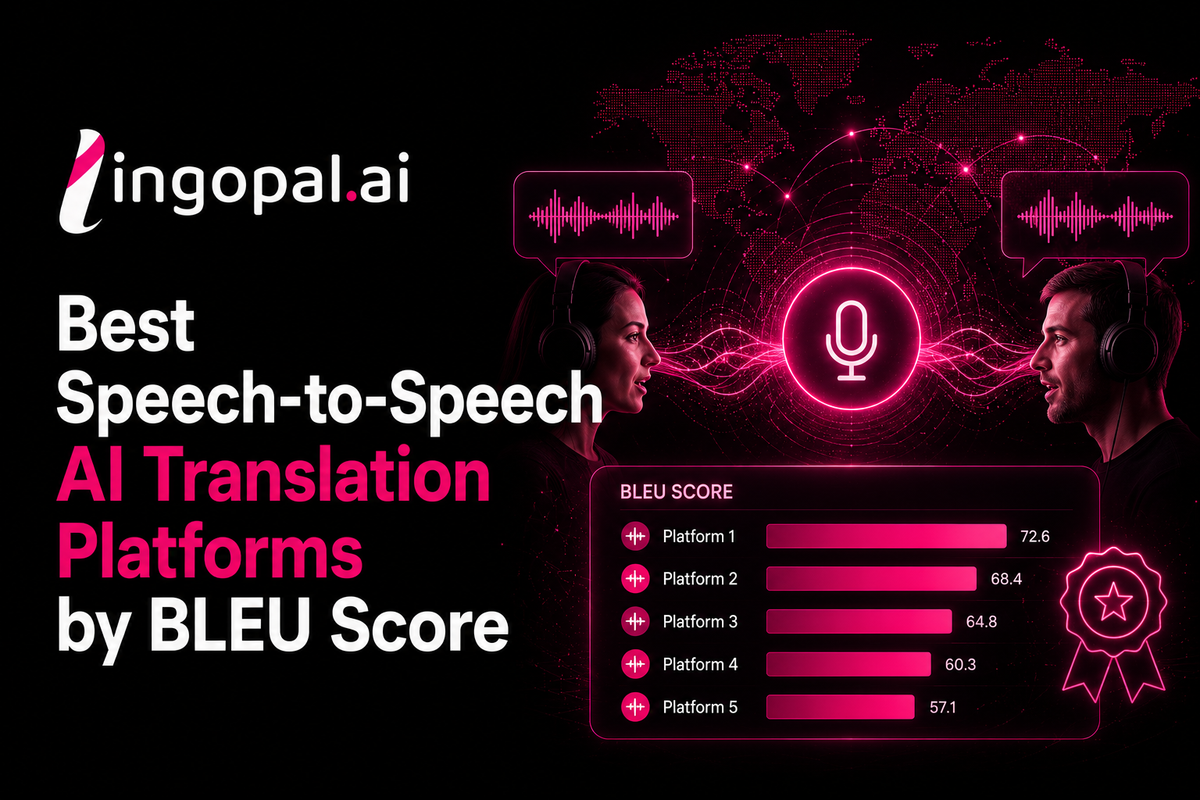
Evaluating the performance of AI translation platforms requires a precise understanding of the metrics used and the operational context in which they function. Simply looking at raw benchmark numbers can be misleading, especially when transitioning from text-based translation to the complex demands of live speech-to-speech conversion for broadcast. The "Best speech-to-speech AI translation platforms with BLEU-score accuracy benchmarks in 2026" are not defined solely by theoretical scores but by their practical application in real-world scenarios where accuracy, speed, and fidelity are paramount.
This analysis delves into the core technical evaluations that matter for broadcast professionals. We will dissect the nuances of accuracy metrics, explore the essential role of latency in live environments, and establish a framework for assessing platforms that goes beyond superficial claims. Understanding these factors is essential for any organization looking to implement AI translation effectively.
Interpreting Accuracy Metrics: BLEU, ASR-BLEU, and Broadcast Fidelity
The primary keyword, "Best speech-to-speech AI translation platforms with BLEU-score accuracy benchmarks in 2026," often leads evaluators to focus on BLEU scores. However, the standard BLEU (Bilingual Evaluation Understudy) score, originally designed for text-to-text machine translation, offers an incomplete picture when applied to speech-to-speech systems. Text BLEU evaluates the statistical similarity between machine-generated text and one or more human reference translations. It measures n-gram overlap, precision, and brevity penalty. While useful for assessing text quality, it does not account for the inherent challenges of speech processing, such as acoustic modeling errors or prosodic variations.
To better evaluate speech translation, specialized metrics like ASR-BLEU have emerged. ASR-BLEU modifies the BLEU calculation by incorporating the accuracy of the Automatic Speech Recognition (ASR) component. Instead of comparing translated text directly, it compares the ASR output of the translated speech against a reference translation. This provides a more holistic view by acknowledging that errors in transcription will directly impact the final translation quality. Word Error Rate (WER) is another fundamental metric for ASR, measuring the percentage of words incorrectly transcribed. Lower WER scores indicate more accurate speech recognition, which is a prerequisite for high-quality speech translation.
But, even ASR-BLEU and WER do not fully capture the requirements of broadcast fidelity. Raw accuracy scores, whether text-based or speech-based, must be weighed against the preservation of vocal characteristics, emotional tone, and stylistic nuances. For example, a system might achieve a high ASR-BLEU score but fail to replicate the speaker's authentic voice or convey the intended emotion, rendering the translation less impactful for viewers. This "broadcast fidelity gap" highlights the need to consider more than just linguistic correctness. Factors like voice cloning quality, emotion detection, and the preservation of speaker identity are essential for applications in news, sports commentary, and entertainment, where authenticity is key.
Latency Thresholds and System Architecture for Live Workflows
For live broadcast applications, latency is not merely a technical spec; it is an essential determinant of viewer experience and broadcast viability. The perception of "live" communication is highly sensitive to delay. While total latency below 2 seconds is generally acceptable, any delay exceeding 800 milliseconds can begin to impact natural conversational flow, causing participants to talk over one another. For broadcast, particularly in live commentary, sports, or news segments, minimizing this processing delay is paramount. This requires systems that can deliver translated audio with minimal lag, ensuring a coherent and engaging viewing experience.
The architecture of a speech translation system significantly influences its latency. Cascaded pipelines, where ASR, text translation, and Text-to-Speech (TTS) are separate modules, often introduce higher cumulative latency. Each step requires processing and data transfer, adding incremental delays. In contrast, end-to-end neural translation models, which directly convert source speech to target speech, can offer lower latency. These integrated architectures are designed for greater efficiency. Lingopal AI Translation, for example, achieves approximately 15 seconds of latency for live dubbing while simultaneously generating real-time captions, a performance benchmark essential for maintaining viewer synchronization and accessibility.
Selecting the appropriate architecture depends on the specific broadcast format. Sports broadcasts, for example, demand extremely low latency and high energy in the translated commentary to match the on-screen action. News reporting requires precision and clarity, often with less emphasis on replicating the original speaker's vocal energy but with absolute accuracy in factual translation. Conference formats, whether for internal meetings or public events, benefit from clear, understandable audio that facilitates communication across language barriers. Platforms supporting multiple ingest formats like SRT, HLS, RTMP, MP4, and API ingest provide the flexibility needed to integrate into diverse broadcast infrastructures without complex code modifications, ensuring that the chosen system can adapt to specific operational requirements and content types.
Enterprise Pricing Structures and Total Cost of Ownership
When evaluating enterprise-grade AI translation platforms, the financial model is as essential as the technical performance. Broadcast directors must look beyond advertised per-minute rates to understand the total cost of ownership (TCO). Many vendors present pricing based on source audio minutes, which can be misleading. This model often fails to account for the complexity of live, multi-language workflows where a single input can generate multiple outputs (e.g., translation and captioning). A transparent pricing structure, such as per-hour per-language, offers greater predictability and aligns costs with actual usage and system uptime, making it more suitable for broadcast operations.
The cost per source-audio minute can vary dramatically across providers, ranging from approximately $0.04 for self-hosted solutions to over $1.25 for premium event-platform tiers, according to industry analysis. This significant variance necessitates a deep dive into what each minute of service actually entails. For example, a seemingly low per-minute rate might not include essential features like API access, advanced voice cloning, or dedicated support, leading to substantial overage charges or the need for costly add-ons.
Per-Minute Versus Per-Hour Per-Language Models
Pricing models for AI translation services typically fall into two main categories: per-minute of source audio consumed or per-hour of system operation, often with a per-language multiplier. The per-minute model, common in simpler transcription or basic translation services, can become prohibitively expensive for live broadcast scenarios. In a live event with multiple simultaneous language streams, the cost could escalate rapidly based on the duration of the source audio, irrespective of whether all target languages are actively being consumed. This approach lacks granular control and can lead to unpredictable billing cycles.
Conversely, a per-hour per-language model provides a more stable and scalable financial framework for broadcast operations. This structure charges for the time the service is actively processing and delivering translated content for each specified language. It allows for better budgeting, especially for recurring events or continuous monitoring services. Platforms that offer this model, like Lingopal AI Translation, ensure that costs are directly tied to operational use, making it easier to manage budgets for complex, multi-language productions. This transparency is paramount for enterprise deployments where financial predictability is a core requirement.
Identifying Hidden Overage and Integration Fees
Beyond the base pricing structure, broadcast professionals must be vigilant about hidden costs. Overage fees can significantly inflate the TCO if usage exceeds contracted limits, particularly with per-minute models. These fees are often higher than the standard rate, penalizing organizations for unforeseen demand. Integration fees represent another common pitfall. While some platforms offer straightforward API access, others charge substantial sums for custom integration, data ingest setup, or connecting to existing broadcast infrastructure. These costs can range from thousands to tens of thousands of dollars, depending on the complexity of the existing system.
Additionally, support tiers can be tiered, with basic email support included but premium phone or real-time technical assistance incurring additional charges. When evaluating platforms, it is imperative to obtain a full breakdown of all potential fees. This includes any charges for API calls, data storage, custom model training, or specialized features. A vendor that clearly outlines all potential costs upfront, without ambiguity, demonstrates a commitment to transparency and partnership, which is essential for long-term operational planning in the broadcast industry. This diligence prevents budget overruns and ensures the chosen solution delivers value without hidden financial burdens.
Volume Commitments and Enterprise Scaling
Enterprise scaling of AI translation solutions is intrinsically linked to volume commitments. Vendors often offer tiered pricing or discounts for organizations willing to commit to higher usage volumes over extended periods. These commitments can take the form of annual contracts or pre-purchased usage credits. For large broadcast networks or global media companies, negotiating favorable volume commitments is essential for managing costs effectively. It enables access to premium features and dedicated support at a more economical rate per unit of service.
When considering volume commitments, it is important to assess the vendor's ability to scale alongside your operational needs. A platform that offers flexible scaling options, allowing for incremental increases in capacity without drastic price jumps, is ideal. Some providers may require significant upfront investment for large volumes, which might not be feasible for all organizations. Evaluating the contract terms for flexibility, renewal options, and price adjustments based on future growth is therefore essential for ensuring long-term financial viability and operational continuity. The ability to adapt to changing broadcast demands without incurring excessive costs is a hallmark of a successful enterprise AI translation partnership.
Running a Private Pilot: Step-by-Step Validation Methodology
Implementing AI translation for broadcast requires rigorous validation beyond vendor demonstrations. A private pilot project is essential to confirm a platform's performance with your specific content, workflows, and technical requirements. This hands-on evaluation allows broadcast directors to move past marketing claims and gather concrete data on accuracy, latency, and integration feasibility. Developing a systematic methodology ensures that the pilot phase yields actionable insights, minimizing risks associated with full-scale deployment and confirming that the chosen solution meets the exacting standards of live production environments, including capabilities like those offered by the best speech-to-speech AI translation platforms with BLEU-score accuracy benchmarks in 2026.
The pilot should simulate real-world usage as closely as possible. This involves using representative audio and video feeds, testing various language pairs, and evaluating the output against predefined operational metrics. A structured approach protects investment by ensuring the technology aligns with broadcast fidelity expectations, format compatibility, and overall budget. By following a clear validation process, organizations can confidently select a solution that not only performs technically but also integrates smoothly into their existing production ecosystem, providing tangible benefits without compromise.
Preparing Your Test Dataset and Language Pairs
The success of any pilot hinges on the quality and relevance of the test dataset. For broadcast applications, this dataset should comprise a diverse range of content representative of typical programming. Include segments from live news broadcasts, sports commentary, interviews with varying audio quality, and scripted content. Importantly, ensure the dataset covers the specific language pairs you intend to support. For example, if your primary focus is European markets, test French, German, and Spanish translations from English. If expanding to Asia, include Mandarin, Japanese, or Korean.
Gathering high-fidelity source audio is paramount. If possible, use original broadcast feeds or high-quality recordings. Include content with different speaking styles, accents, and background noise levels to test the system's resilience. Annotate key segments with ground-truth translations and transcriptions where available. This will serve as the benchmark for evaluating accuracy. The dataset size should be sufficient to provide statistically meaningful results, typically several hours of audio, but manageable for the pilot duration. A well-prepared dataset ensures that your evaluation is grounded in actual performance metrics, not theoretical capabilities.
Executing the Live Translation Test
Once the dataset is prepared, the next step is to simulate live ingestion and processing. Connect your chosen platform to your content sources using supported ingest protocols such as SRT, HLS, RTMP, or API. Monitor the system's stability and performance under load. Pay close attention to the first-chunk latency and total processing delay. For live commentary or news, a delay exceeding 800 milliseconds can disrupt viewer experience, and exceeding 2 seconds is generally unacceptable according to communication standards. Test the platform's ability to deliver real-time captions alongside translated audio, confirming simultaneous output from a single input feed.
Document any errors encountered during the ingestion or translation process. This includes dropped frames, audio glitches, or unexpected system behavior. Observe how the platform handles dynamic content changes, such as rapid scene shifts in sports or breaking news updates. For Lingopal AI Translation, for example, confirming its stated capability of approximately 15 seconds of latency for live dubbing and real-time captioning is a primary objective of this phase. This direct operational test validates claims and identifies potential integration challenges with your broadcast infrastructure before committing to a full rollout.
Measuring Output Against Operational Requirements
The final stage of the pilot involves a comprehensive evaluation of the translated output against your defined operational requirements. This goes beyond simple BLEU scores. Assess the ASR-BLEU and WER for accuracy, but more importantly, evaluate the broadcast fidelity. Does the translated speech retain the original speaker's tone, emotion, and key vocal characteristics? Is the linguistic accuracy sufficient for your specific content type. E.g., precise legal terms for hearings versus energetic commentary for sports?
Compare the output against your ground-truth data and assess its suitability for your target audience. For example, if evaluating for sports translation, does the translated commentary maintain the excitement and timing of the original? If for news, is the factual accuracy impeccable? Quantify the results where possible, but also conduct qualitative reviews with subject matter experts or target language speakers. This comprehensive measurement ensures that the platform not only meets technical benchmarks but also fulfills the practical demands of broadcast quality and viewer engagement, confirming its place among the best speech-to-speech AI translation platforms with BLEU-score accuracy benchmarks in 2026.
Pilot Validation Step-by-Step
- Define Objectives & KPIs: Clearly state what success looks like. Key Performance Indicators (KPIs) should include target latency (e.g., < 2 seconds total), desired ASR-BLEU scores, specific fidelity requirements (e.g., emotion preservation), and format compatibility (SRT, HLS, RTMP, MP4, API).
- Prepare Test Assets: Curate a diverse dataset of representative broadcast content (news, sports, interviews) covering target language pairs. Ensure high-quality source audio.
- Configure Platform: Set up the AI translation platform, configuring ingest protocols, language pairs, and any necessary API integrations.
- Execute Live Ingestion: Feed test content into the platform in real-time, simulating production workflows. Monitor stability, resource usage, and error logs.
- Gather Output Data: Collect translated audio, captions, and system logs. Record performance metrics such as latency, uptime, and throughput.
- Analyze Accuracy: Evaluate raw translations using BLEU/ASR-BLEU scores against ground truth. Assess Word Error Rate (WER) for ASR components.
- Assess Broadcast Fidelity: Conduct qualitative reviews focusing on voice cloning, emotional tone, cadence, and overall authenticity.
- Evaluate Integration: Test compatibility with existing broadcast equipment and software. Document any integration challenges or required modifications.
- Review Financials: Analyze actual usage against the proposed pricing model, identifying potential overages or hidden costs.
- Document Findings & Decision: Compile a detailed report summarizing results, identifying strengths and weaknesses, and making a recommendation based on operational fit and TCO.
FAQ: Critical Evaluation Criteria for Broadcast AI Translation
Broadcast engineering teams frequently encounter ambiguity when comparing vendor capabilities. Marketing materials often obscure technical realities behind vague performance claims. To successfully identify the best speech-to-speech AI translation platforms with BLEU-score accuracy benchmarks in 2026, teams must shift their evaluation framework toward verifiable technical specifications and operational realities. This section addresses the most frequent commercial and technical inquiries that arise during the procurement process. The answers provided focus on actionable validation steps, concrete latency thresholds, and structured pilot methodologies that guarantee alignment with broadcast standards.
Understanding these core criteria eliminates guesswork from the selection process. Broadcast directors require direct answers regarding benchmark verification, ingest protocol compatibility, and enterprise deployment logistics. The following responses consolidate these critical evaluation points into a clear framework for decision-making.
Accuracy Verification and Benchmark Standards
Query: How do I verify a platform's claimed accuracy against independent benchmarks?
Broadcast teams must demand third-party verification rather than accepting proprietary test results. Vendor marketing often relies on custom datasets that do not reflect real-world broadcast conditions. You should explicitly request ASR-BLEU and WER scores derived from standardized, open datasets like FLEURS or WMT25. For context, Meta SeamlessM4T-v2 achieves ASR-BLEU scores of 20-30 on FLEURS for English-to-German translation, according to industry analysis. DeepL Voice reports BLEU scores of 35-40 on WMT-derived benchmarks, but this applies strictly to text translation, not speech-to-speech processing. You must also ask vendors for their WER on diverse speech datasets. AssemblyAI Universal-2 reports approximately 8.4% WER, which serves as a baseline reference for transcription accuracy. Any platform claiming superior accuracy must provide the specific test sets, evaluation methodologies, and raw score breakdowns used during validation.
Latency, Format Support, and Ingest Protocols
Query: What latency thresholds are acceptable for live broadcast, and which formats must a platform support?
Real-time communication standards dictate that first-chunk latency below 800 milliseconds is perceived as live. Delays exceeding 2 seconds cause viewers to talk over translations or completely disengage from the broadcast. For live dubbing applications, a total processing delay of approximately 15 seconds represents the current industry benchmark for maintaining audio-video synchronization while allowing for high-fidelity voice cloning. Furthermore, the platform must support standard broadcast ingest protocols without requiring custom engineering overhead. Verify native support for SRT, HLS, RTMP, MP4, and direct API ingest. Lingopal AI Translation natively ingests these formats, delivering approximately 15 seconds of latency for live dubbing while simultaneously generating real-time captions from a single input feed. This architectural approach ensures that translation outputs remain tightly synchronized with the original broadcast timeline.
Deployment, Compliance, and Pilot Logistics
Query: How should broadcast engineering teams structure a pilot deployment to ensure compliance and scalability?
A successful pilot requires a structured validation methodology that strictly mirrors production workflows. Begin by preparing a proprietary test dataset containing your actual broadcast content, including varied accents, background noise, and technical terminology relevant to your industry. Execute the live translation test by feeding this data through the platform using your standard ingest protocols. Measure the translated output against operational requirements, focusing on ASR-BLEU, WER, and broadcast fidelity, including voice cloning and emotion preservation. Enterprise pricing models must be transparent, avoiding hidden overage fees or unexpected integration costs. Platforms that offer per-hour per-language pricing provide predictable costs for scaling across multiple channels. The best speech-to-speech AI translation platforms with BLEU-score accuracy benchmarks in 2026 will facilitate this rigorous testing phase, providing detailed performance reports that align with your compliance and security standards.