Broadcast-Grade AI Live Translation for Live Events
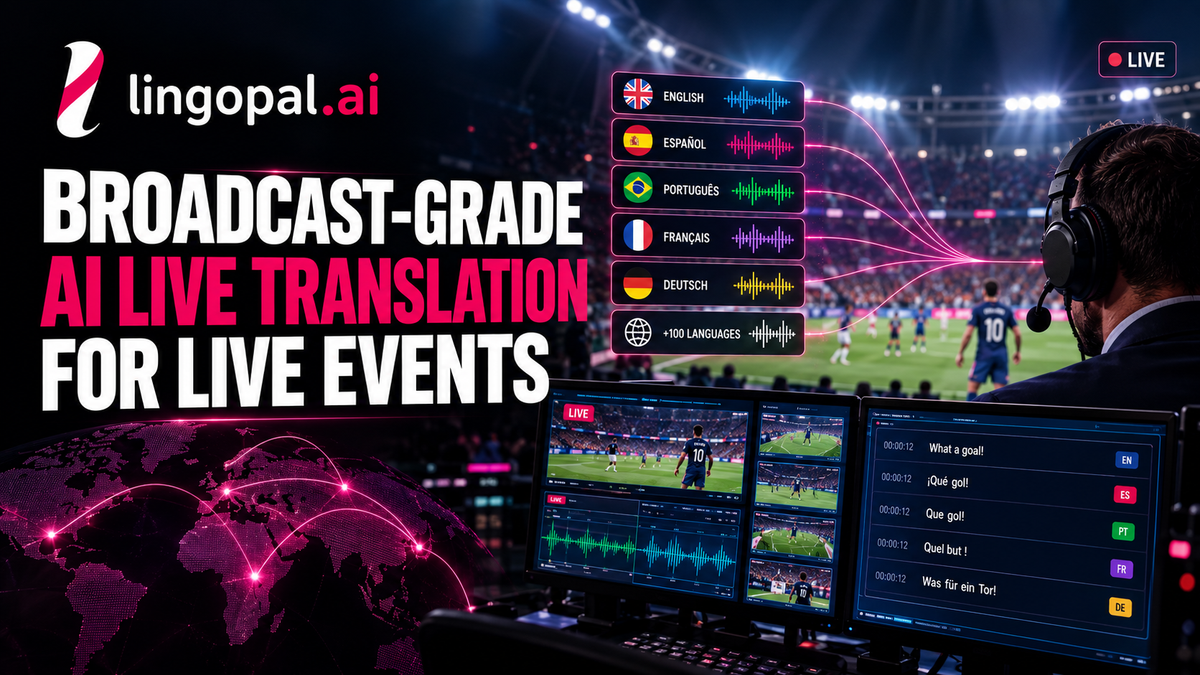
How Broadcasters Should Evaluate Multilingual Commentary, Live Captions, Latency, Voice Quality, and Reliability in 2026
AI live translation for broadcasting converts live speech into multilingual commentary, dubbed audio, and captions while an event is happening. But making translation happen in real time is only the starting point. For sports, news, and entertainment, a system also needs predictable latency, accurate captions, natural voices, reliable speaker diarization, terminology controls, and an infrastructure that can remain stable throughout a live production.
A platform may translate a sentence correctly in a demonstration and still struggle during an actual broadcast.
Real events introduce crowd noise, interruptions, changing speakers, unexpected names, emotional commentary, network variation, and hours of continuous operation.
That is why broadcasters should evaluate the complete source-to-viewer experience rather than translation accuracy alone.
Quick Answer: What Makes AI Live Translation Broadcast-Grade?
Broadcast-grade AI live translation combines real-time speech recognition, contextual translation, multilingual commentary, live captions, natural voice generation, speaker diarization, low and predictable latency, broadcast integrations, monitoring, and operational failover.
A typical workflow is:
Live Source → Speech Recognition → Speaker Diarization → Translation → AI Voice + Captions → Encoding → Distribution → Viewer
For broadcasters, five questions matter most:
- Is the translation accurate?
- Is the latency predictable?
- Does the voice sound natural?
- Are captions synchronized and readable?
- Does the workflow remain reliable under real broadcast conditions?
If any one of these fails, the viewer experience can fail with it.
What Is AI Live Translation for Broadcasting?
AI live translation for broadcasting is the use of speech recognition, machine translation, voice synthesis, captioning, and media-delivery technology to localize a live program while it is still being produced.
One English source broadcast could, for example, produce:
English — Original
Spanish — Translated Commentary
Portuguese — Translated Commentary
French — Translated Commentary
plus translated captions for each audience.
The video production does not need to be recreated for every language.
Instead:
One production becomes multiple language experiences.
This is particularly valuable for live events where traditional localization can be difficult to scale across languages.
Why Is Live Event Translation Hard?
Live broadcasting removes the luxury of post-production.
There is no opportunity to stop the event, rewrite the translation, regenerate a voice, and publish it tomorrow.
The localization pipeline needs to operate while the event continues.
That means processing:
Speech → Meaning → Translation → Voice / Captions → Distribution
in seconds while maintaining enough linguistic context to produce useful output.
And the source itself is rarely perfect.
Live events can include:
- Fast speakers
- Multiple commentators
- Interruptions
- Background noise
- Music
- Crowds
- Accents
- Unscripted dialogue
- Unexpected names
- Technical terminology
The challenge is therefore not merely translation.
It is translation under live production conditions.
1. Measure Translation Latency End to End
Latency is one of the first metrics broadcasters should evaluate.
But there is an important distinction between:
AI processing latency
and:
Viewer latency
The complete signal path can include:
Speaker → Audio Capture → Recognition → Translation → Voice Generation → Encoding → Network → CDN → Player → Viewer
Every stage can add delay.
That means a vendor claiming very fast model processing may still produce a significantly delayed audience experience.
What should broadcasters measure?
Start the measurement when a recognizable phrase or event occurs in the source.
Stop when the multilingual viewer receives the corresponding translated audio or caption.
Repeat the test throughout the event.
This is end-to-end translation latency.
2. Evaluate Latency Consistency
Average latency does not tell the entire story.
Imagine two workflows.
Workflow A
5s → 5s → 5s → 5s
Workflow B
2s → 3s → 11s → 2s
Workflow B occasionally delivers faster translation.
But Workflow A creates a more predictable broadcast experience.
This matters particularly for sports.
Translated commentary that constantly moves closer to and farther away from the picture can become distracting.
Broadcasters should therefore monitor:
- Average latency
- Maximum latency
- Latency variation
- Recovery after interruptions
- Long-session stability
Predictability is part of broadcast quality.
BOOK A FREE DEMO
Want to measure multilingual translation using your own live content?
3. Evaluate Real-Time Multilingual Commentary as a Performance
Sports commentary, live entertainment, interviews, and news are not simply collections of words.
Speakers communicate through:
- Pace
- Pitch
- Excitement
- Urgency
- Pauses
- Emphasis
- Emotion
A translated voice can be linguistically accurate while sounding completely disconnected from the event.
Consider a commentator celebrating a championship-winning goal.
If the translated voice calmly reads the correct sentence, the translation has preserved the words but lost the broadcast.
When testing real-time multilingual commentary, evaluate whether translated speech preserves the character and intent of the source delivery.
4. Test Voice Quality in the Target Language
A realistic AI voice in English does not automatically guarantee a realistic voice in Spanish, Portuguese, Arabic, French, or another target language.
Evaluate:
- Pronunciation
- Rhythm
- Pacing
- Pauses
- Emotional range
- Sentence endings
- Proper nouns
- Native-language naturalness
Also listen for accent transfer.
A voice that retains the source speaker's timbre but produces unnatural target-language pronunciation may still feel artificial.
Voice preservation and target-language fluency need to work together.
5. Understand Why Speaker Diarization Matters
Speaker diarization identifies who is speaking and when.
That becomes essential during multi-speaker broadcasts.
Consider:
Host → Commentator → Analyst → Athlete → Host
or:
Anchor → Reporter → Guest → Anchor
Without reliable diarization, AI systems may:
- Merge speakers
- Misattribute captions
- Use an incorrect voice
- Lose context during interruptions
- Mishandle rapid exchanges
Broadcasters should test diarization with natural conversations rather than carefully scripted alternating speakers.
Include:
- Interruptions
- Crosstalk
- Similar voices
- Remote guests
- Rapid handoffs
- Background speakers
6. Evaluate Live Caption Accuracy Separately
Good translation does not automatically produce good live captions.
Caption quality includes both language and presentation.
Evaluate:
- Word accuracy
- Translation accuracy
- Proper names
- Numbers
- Punctuation
- Line breaks
- Segmentation
- Speaker attribution
- Reading speed
- Synchronization
Imagine a translated caption that is perfectly accurate but appears after the presenter has already changed slides.
The language is correct.
The viewing experience is not.
Caption accuracy therefore needs to be tested while watching the actual broadcast.
7. Test Proper Names and Terminology
Names are among the easiest ways for an otherwise impressive AI translation to lose credibility.
Sports may include:
- Athletes
- Clubs
- Stadiums
- Sponsors
- Competitions
- Statistics
News may include:
- Political figures
- Cities
- Government organizations
- Companies
- Financial terminology
Entertainment may include:
- Performers
- Titles
- Brands
- Cultural references
Broadcasters should prepare terminology and pronunciation resources before major events.
A reusable glossary can turn recurring corrections into part of the production infrastructure.
8. Start With Clean Source Audio
Translation quality begins before translation.
Whenever possible, send clean speech into the localization workflow.
For sports:
Commentary → Translation Input
while:
Crowd + Music + Effects → Program Mix
For news:
Anchor / Reporter → Translation Input
For events:
Presenter Microphone → Translation Input
Crowd noise, echo, music, clipping, and overlapping microphones can affect speech recognition.
Recognition errors then propagate into translation, captions, and dubbing.
Better input improves every downstream language.
9. Evaluate Multilingual Scale
A successful English-to-Spanish demo proves that one language pair works in that test.
It does not prove that the platform can operate 10 or 20 language outputs simultaneously.
Ask:
How many languages can operate concurrently?
Then test what happens to:
- Latency
- Caption timing
- Voice generation
- Routing
- Monitoring
- Stability
A scalable architecture should look like:
ONE SOURCE
↓
TRANSLATION LAYER
↓
ES | PT | FR | DE | AR | JA | More
rather than requiring a separate production for every language.
10. Evaluate Broadcast Workflow Fit
The best translation model can still be the wrong broadcast solution if it cannot integrate with production infrastructure.
Teams may need support for technologies and environments such as:
- SRT
- RTMP
- HLS
- APIs
- Cloud production
- Encoders
- OTT platforms
- FAST workflows
- Caption systems
Before selecting a platform, document:
Source → Translation → Output → Encoding → Distribution → Viewer
Then test the complete path.
The goal should be to add localization to the broadcast—not rebuild the broadcast around localization.
11. Build Original-Audio Fallback
AI translation should enhance a broadcast without becoming a single point of failure.
The original source audio should remain available where appropriate.
A resilient viewer experience might move from:
Translated Audio + Captions
to:
Translated Captions
to:
Original Audio
if a component fails.
This allows the program to continue while operators investigate the localized output.
12. Isolate Language Failures
Suppose a broadcast offers:
English
Spanish
Portuguese
French
Arabic
If the French audio fails, Spanish and Portuguese should ideally continue normally.
Language-specific isolation makes troubleshooting easier and prevents a single localization issue from becoming a global broadcast outage.
This becomes increasingly important as multilingual delivery scales.
13. Test the Entire Event, Not Five Minutes
A polished five-minute demonstration cannot prove broadcast-grade translation.
A three-hour event creates different conditions.
Speakers change.
Network performance changes.
Terminology changes.
Audio sources change.
The audience may spike.
Systems operate continuously.
Run a production-length pilot whenever possible.
The objective is not to discover whether the technology can work for a few minutes.
It is to determine whether it can remain stable for the entire event.
How to Evaluate AI Live Translation for Sports
Sports is one of the most demanding environments for multilingual AI.
Test:
- Rapid play-by-play
- Athlete names
- Statistics
- Crowd noise
- Multiple commentators
- Interruptions
- Emotional reactions
- Replays
The key question is:
Does translated commentary remain connected to the action?
Sports viewers should not hear a goal call after the broadcast has moved into an unrelated moment.
How to Evaluate AI Live Translation for News
News has different priorities.
Test:
- Breaking stories
- Reporter handoffs
- Interviews
- Numbers
- International names
- Acronyms
- Unexpected developments
- Unscripted speech
For news organizations, speed cannot come at the expense of factual meaning.
A fast mistranslation of a number, name, or location can be more damaging than a slightly delayed accurate translation.
Editorial oversight remains particularly important for high-consequence coverage.
How to Evaluate AI Live Translation for Entertainment
Entertainment often depends heavily on personality.
Test:
- Multiple speakers
- Humor
- Music
- Applause
- Audience interaction
- Emotional shifts
- Informal language
Here, voice quality and diarization become particularly important.
The translated experience should preserve enough of the source performance that the content still feels alive.
BOOK A FREE DEMO
Hear your own commentator, presenter, anchor, or live event in another language.
Test Lingopal With Your Live Content
A Broadcast-Grade AI Translation Evaluation Checklist
Before deployment, test six categories.
Language Quality
Evaluate meaning, terminology, names, numbers, idioms, and contextual accuracy.
Voice Quality
Evaluate pronunciation, pacing, emotion, target-language naturalness, and voice consistency.
Caption Quality
Evaluate accuracy, timing, segmentation, punctuation, and speaker attribution.
Live Performance
Measure end-to-end latency, latency consistency, concurrency, and long-session stability.
Production Integration
Test ingest, outputs, routing, encoding, distribution, and monitoring.
Operational Resilience
Test source loss, network degradation, individual language failure, fallback, and recovery.
A platform needs to perform across all six—not simply generate an impressive translation.
What Metrics Should Broadcasters Track?
For a production pilot, track:
End-to-End Latency
Time from source speech to translated viewer output.
Latency Variation
How much that delay changes throughout the broadcast.
Translation Accuracy
Accuracy of meaning, terminology, numbers, and names.
Caption Accuracy
Accuracy of the text viewers actually receive.
Caption Synchronization
Whether captions remain aligned with relevant visual moments.
Diarization Accuracy
Whether the system consistently identifies speaker changes.
Voice Quality
Naturalness, pronunciation, emotion, and intelligibility.
Language Availability
Whether each output remains active throughout the event.
Recovery Time
How quickly service returns after an interruption.
Operator Intervention
How much manual work is required to keep localization running.
These metrics provide a far more useful picture of production readiness than language count alone.
Where Lingopal Fits Into AI Live Translation
Lingopal helps broadcasters, sports organizations, newsrooms, streaming platforms, entertainment companies, and live event producers turn one source production into multilingual audience experiences.
Depending on the workflow, Lingopal supports capabilities including:
- Real-time AI translation
- Multilingual audio
- Live captions
- AI dubbing
- Voice preservation
- Speaker-aware workflows
- 100+ languages
- Live and VOD localization
- Broadcast and streaming integrations
The objective is straightforward:
Keep the production. Add the languages.
Instead of recreating an event for every audience, localization becomes part of the existing broadcast workflow.
Frequently Asked Questions
What is AI live translation for broadcasting?
AI live translation for broadcasting converts speech from a live program into translated audio, captions, or both while the event is happening. It typically combines speech recognition, translation, speaker diarization, captioning, and AI voice generation.
What makes live AI translation broadcast-grade?
Broadcast-grade translation requires more than accurate language output. Broadcasters should evaluate end-to-end latency, voice quality, caption accuracy, speaker diarization, terminology, integrations, monitoring, scalability, and failure recovery.
What is real-time multilingual commentary?
Real-time multilingual commentary uses AI translation and voice generation to create alternate-language commentary during a live event from the original commentary feed.
How accurate are AI-generated live captions?
Accuracy depends on source audio, language, terminology, accents, speaker overlap, speech rate, and the underlying models. Caption quality should also include synchronization, segmentation, punctuation, and readability.
What is speaker diarization?
Speaker diarization identifies who is speaking and when. It helps distinguish commentators, anchors, reporters, guests, and interview subjects during multilingual captioning and dubbing.
How should translation latency be measured?
Measure from the moment source speech occurs to the moment the translated viewer receives the corresponding audio or caption. This captures the complete source-to-viewer experience.
Can one live event support multiple translated languages?
Yes. Depending on the localization and distribution infrastructure, one source production can generate multiple translated audio and caption outputs simultaneously.
Can AI preserve a commentator's voice and emotion?
Some AI dubbing systems can preserve characteristics of the source speaker's voice and delivery. Results vary by language, model, source quality, and workflow, so broadcasters should test voice preservation with representative content.
What happens if a translated language fails?
A production-ready workflow should include fallback. This can include isolating the affected language, continuing translated captions, or returning viewers to original audio while the issue is addressed.
How should broadcasters test AI translation before a live event?
Use real content, real speakers, actual target languages, difficult terminology, noisy conditions, multiple speakers, the intended distribution infrastructure, and a test duration similar to the actual event.
Final Thoughts
AI live translation for broadcasting should be evaluated as broadcast infrastructure—not simply as an AI feature.
The viewer experiences everything together:
Translation.
Voice.
Captions.
Timing.
Video.
Distribution.
A system can excel at one of those and still create a poor multilingual experience if the others fail.
For sports, translation needs to stay connected to the action.
For news, speed must coexist with factual accuracy.
For entertainment, voice, personality, and speaker identity become central to the experience.
The strongest broadcast-grade workflows therefore combine:
Accurate translation + predictable latency + natural voices + reliable diarization + synchronized captions + resilient delivery.
That is the standard broadcasters should evaluate in 2026.
BOOK A FREE DEMO
Test Lingopal with your own live content and evaluate multilingual commentary, captions, voice quality, and latency in your real production workflow.