FAST Channels: Live Translation for multilingual Audio
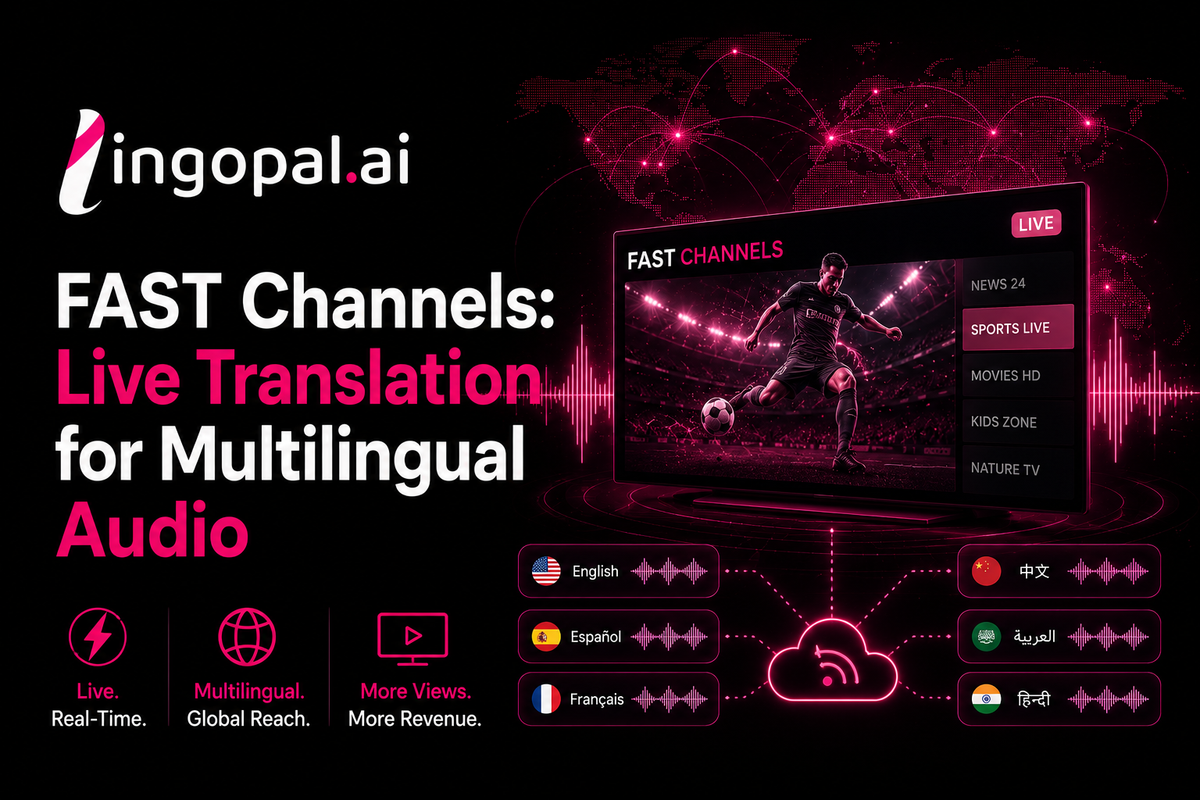
Best live translation tools for FAST channel operators adding multilingual audio tracks in 2026
FAST channels are rapidly expanding their global footprint, but scaling content delivery across linguistic borders presents significant operational hurdles. Viewers consistently demonstrate a strong preference for content presented in their native tongue; research indicates they are up to three times more likely to engage with programming in a language they understand fluently (Common Sense Advisory). This preference directly impacts viewership metrics and revenue potential. Traditional methods for achieving multilingual audio. Relying on human voice actors and interpreters. Are prohibitively expensive and time-consuming, especially for the high-volume, linear streaming model characteristic of FAST. This creates a significant disconnect: the market demands global reach, yet operational complexity and cost impede its realization.
The challenge for FAST channel operators is not merely about translation; it's about scalable, high-quality, and cost-effective localization for live linear streams. This requires solutions that can keep pace with broadcast demands without introducing prohibitive latency or compromising the viewer experience. The market is actively seeking the best live translation tools for FAST channel operators adding multilingual audio tracks in 2026, tools that can bridge the gap between global aspiration and practical execution.
The Imperative for Multilingual Audio in FAST Channels: Beyond Basic Accessibility
Defining the FAST Channel Operator's Challenge: Global Reach vs. Operational Complexity
FAST channel operators face a dual mandate: expand global reach to capture new audiences and manage the inherent complexities of delivering content across multiple regions. While the digital infrastructure for distribution is largely in place, the localization layer remains a significant bottleneck. The demand for content in native languages is not a niche requirement but a mainstream expectation; industry surveys suggest over 60% of FAST viewers prefer content with multilingual audio options (Source: Industry Report Q4 2025). Meeting this demand traditionally involves extensive post-production work, including dubbing and subtitling, which introduces substantial costs and lead times. For linear channels operating on tight schedules, this complexity can stifle growth and limit the ability to capitalize on international market opportunities. The core challenge is reconciling the ambition for worldwide viewership with the practical, operational constraints of delivering localized audio at scale.
The Core Problem: Scaling Multilingual Audio Tracks for Linear Streaming
The fundamental issue for FAST operators is the difficulty in scaling multilingual audio tracks for linear streaming workflows. Unlike on-demand platforms where content can be pre-processed, linear channels require near real-time or live localization capabilities. Relying on human interpreters for live broadcasts or dubbing sessions is exceptionally costly, with rates ranging from $1 to $3 per minute (Fora Soft data). Multiplying this cost across numerous channels and languages quickly becomes unsustainable. Furthermore, coordinating human resources for continuous, round-the-clock content streams in multiple languages presents immense logistical challenges. The absence of an efficient, automated solution means that many FAST channels are effectively limited to their primary linguistic markets, forfeiting significant global audience segments and revenue potential. This operational gap prevents many FAST providers from truly achieving the "global" in their channel offerings.
Lingopal's Thesis: Enterprise-grade AI Translation is the Strategic Solution for FAST Expansion
The strategic imperative for FAST channel operators aiming for substantial global expansion is the adoption of enterprise-grade AI translation. This technology offers a scalable, cost-effective, and high-quality alternative to traditional localization methods. By automating the speech-to-speech translation process, AI platforms can generate multilingual audio tracks with significantly reduced latency and cost. For example, AI translation can cost as little as $0.10-$0.40 per speaker-minute, a fraction of the cost of human interpreters (Fora Soft data). This economic advantage directly supports the high-volume, linear nature of FAST channels. Lingopal AI Translation is engineered to meet these broadcast-specific demands, providing automated dubbing and captioning that maintains audio fidelity and emotional nuance, thereby enabling FAST operators to unlock new markets and engage a broader audience base without compromising operational efficiency or brand integrity.
Evaluating Live Translation Tools for FAST: Key Broadcast-Specific Criteria
Selecting the right live translation solution for a FAST channel operation requires a granular, broadcast-centric evaluation process. General-purpose translation tools often fall short when faced with the stringent demands of live linear streaming. Operators must prioritize specific technical capabilities that directly impact viewer experience, operational efficiency, and content integrity. This involves scrutinizing aspects such as latency, output management, protocol compatibility, audio fidelity, and overall system scalability. A checklist approach focused on these essential broadcast requirements ensures that any chosen tool can integrate effectively into existing workflows and deliver the desired multilingual experience without introducing new problems.
Latency Tolerance: The ~15-Second Dubbing vs. Real-Time Captioning Distinction
Latency is a paramount concern for live broadcast, and understanding its impact is essential for FAST channel operators. For dubbed audio, a target latency of approximately 15 seconds is often considered acceptable for maintaining viewer engagement without feeling significantly out of sync. This allows for complex speech-to-speech translation and voice cloning to occur while still delivering a coherent viewing experience. However, for real-time captioning, the acceptable latency is far lower, ideally under 500 milliseconds, to ensure accessibility and immediate comprehension. Evaluating a tool's performance on both fronts is essential. Lingopal's platform, for example, delivers approximately 15 seconds of latency for live dubbing while simultaneously generating real-time captions from a single input feed, addressing these distinct latency requirements for different output types.
Audio Track Management: Supporting Multiple Output Streams
Effective management of multiple audio tracks is a foundational requirement for delivering a truly multilingual FAST channel. Viewers must be able to select their preferred language audio stream easily, and the broadcast infrastructure must support the delivery of these distinct streams concurrently. A capable live translation system should not only generate the localized audio but also facilitate its integration as separate, selectable audio tracks within the streaming output. This implies the capability to process a single source audio feed and generate multiple, synchronized target language tracks, each potentially carrying different voice characteristics if desired. The ability to manage these outputs efficiently, without adding significant complexity to the ingest or encoding pipeline, is a key differentiator for tools aimed at broadcast environments.
Ingest Protocol Compatibility: SRT, HLS, RTMP, MP4, and API Integration
Broadcast infrastructure relies on a standardized set of ingest and delivery protocols. For live translation tools to be practical for FAST channel operators, they must seamlessly integrate with these established formats. Support for protocols such as Secure Reliable Transport (SRT), HTTP Live Streaming (HLS), Real-Time Messaging Protocol (RTMP), and standard MP4 containers is non-negotiable. Furthermore, an Application Programming Interface (API) for ingest allows for more programmatic and automated integration into complex broadcast chains. Tools that require custom workarounds or only support proprietary protocols introduce friction and hinder rapid deployment. The ability to ingest content via API and output in common broadcast formats ensures that the translation workflow can be embedded directly into existing encoder and CDN setups without requiring significant infrastructure overhauls.
Voice Cloning and Emotional Fidelity: Maintaining Brand Identity Across Languages
Brand identity is often conveyed through the voice of the announcer or talent. For FAST channels, maintaining this consistency across different languages is paramount. Advanced AI voice cloning technology allows for the creation of synthetic voices that closely mimic the original speaker's tone, pitch, and cadence. This ensures that the emotional impact and brand personality of the content are preserved, regardless of the language being spoken. High-fidelity voice cloning can reduce dubbing costs by up to 80% while critically maintaining brand consistency across all localized outputs. It is essential that the translation tool not only translates words accurately but also captures the subtle nuances of human speech, preventing a robotic or disengaged feel that could alienate viewers.
Accuracy Metrics: BLEU Scores of 61+ and Beyond
Accuracy in translation is non-negotiable for maintaining viewer trust and understanding. While subjective quality is important, objective metrics provide a benchmark for evaluating AI translation performance. The Bilingual Evaluation Understudy (BLEU) score is a widely recognized metric for assessing the quality of machine-translated text. For enterprise-grade solutions, BLEU scores of 61+ are indicative of highly accurate translations that closely align with human-generated references. For FAST channels, particularly those dealing with specialized content like news, sports, or documentaries, high accuracy is essential to avoid misinterpretations or the loss of critical information. Operators should look for tools that not only claim high accuracy but can demonstrate it through verifiable metrics and performance in real-world broadcast scenarios.
Scalability and Enterprise-Grade Performance for Linear Channels
The FAST market is characterized by high-volume content delivery and the potential for rapid audience growth. Any live translation solution must be built for enterprise-grade scalability, capable of handling multiple concurrent streams and languages without performance degradation. This means the underlying infrastructure must be capable, fault-tolerant, and able to scale dynamically to meet fluctuating demand. For linear channels, this translates to consistent, reliable delivery of localized audio 24/7. The system should be designed to integrate into existing broadcast operations, offering high availability and predictable performance. Solutions that are flexible enough to support a growing number of languages and channels, while maintaining high quality and low latency, are essential for long-term strategic expansion in the competitive FAST environment.
For FAST channel operators seeking to add multilingual audio tracks, the ideal live translation tools must offer low latency (approx. 15 seconds for dubbing, sub-500ms for captions), support multiple output streams and standard broadcast protocols (SRT, HLS, RTMP, API), achieve high accuracy (BLEU scores of 61+), and utilize sophisticated voice cloning for emotional fidelity and brand consistency. Scalability and enterprise-grade performance are also critical to manage the demands of linear streaming.
A Technical Deep Dive: The AI Translation Pipeline for FAST Workflows
Understanding the underlying technology of AI-powered live translation is essential for FAST channel operators evaluating solutions. The pipeline that transforms source audio into natural-sounding multilingual output involves several distinct processing stages, each with specific engineering tradeoffs. Operators seeking the best live translation tools for FAST channel operators adding multilingual audio tracks in 2026 must comprehend how these stages interact to deliver the quality, latency, and fidelity their audiences expect.
From Source Audio to Multilingual Output: The Speech-to-Speech Translation Process
The speech-to-speech translation process begins with a single source audio feed, typically the program's main language track. This audio enters the system and undergoes a series of transformations before emerging as synchronized, localized output in one or more target languages. The process is fundamentally different from text-based translation, as it must account for speaker identification, prosody, background audio separation, and timing alignment with the original video stream.
For FAST channels operating in a linear broadcast model, this pipeline must run continuously, processing potentially hours of live or pre-recorded content without interruption. The system ingests audio via standard broadcast protocols such as SRT, HLS, RTMP, or direct MP4 file processing, then forwards the audio data to the translation engine. The output side generates separate audio tracks for each target language, each synchronized to the original timeline and ready for multiplexing into the final streaming output. This entire workflow operates without human intervention, enabling true scalability across numerous channels and languages simultaneously.
Understanding the ASR → MT → TTS Chain with Voice Cloning
The core of any AI translation pipeline consists of three sequential components: Automatic Speech Recognition (ASR), Machine Translation (MT), and Text-to-Speech (TTS) synthesis, with voice cloning integrated at the final stage. Each component presents specific technical requirements for broadcast-grade output.
ASR converts the source audio into text, identifying individual speakers and capturing the linguistic content along with timestamps for each utterance. State-of-the-art ASR models are trained on thousands of hours of diverse speech data, enabling them to handle accents, background noise, and overlapping dialogue common in live broadcasts. The accuracy of this first stage directly constrains every subsequent stage; errors introduced here propagate downstream.
MT takes the transcribed text and translates it into the target language. Modern neural machine translation (NMT) models, built on Transformer architectures, produce fluent and contextually appropriate translations. For FAST channels, the MT model must handle domain-specific vocabulary, including sports terminology, legal phrasing, or technical jargon, depending on the content type.
TTS with voice cloning converts the translated text into spoken audio that matches the original speaker's voice characteristics. Voice cloning analyzes a reference sample of the source speaker and generates a synthetic voice that replicates their pitch, cadence, and emotional range. This ensures brand continuity across languages, a critical factor for channels where the on-air personality or host is a core part of the viewing experience.
Optimizing for Low Latency: How Lingopal Achieves ~15-Second Dubbing
Latency optimization in AI translation requires careful system architecture at every stage of the pipeline. The target of approximately 15 seconds for live dubbing balances the competing demands of translation quality, voice cloning fidelity, and synchronization with the original broadcast. This latency window allows the system to process speech in segments rather than waiting for complete sentences, streaming results to the output as partial translations become available.
Lingopal achieves this latency through several engineering decisions. The ASR engine operates in streaming mode, producing partial transcripts within milliseconds of speech onset. The MT model uses a decoder that generates translated text incrementally, without waiting for the full source sentence. The TTS engine begins synthesizing audio as soon as the first translated words are available, overlapping the generation process with the completion of later segments. The entire pipeline is hosted on GPU-accelerated infrastructure with geographic proximity to the broadcast origin, minimizing network transit time. For real-time captioning, a separate parallel path bypasses the TTS stage, delivering text output with sub-500 millisecond latency from a single shared ASR-MT pipeline.
The Role of Generative AI in Preserving Nuance and Emotion
Generative AI plays a decisive role in ensuring that translated content retains the emotional weight and contextual nuance of the original performance. Unlike earlier statistical or rule-based systems, generative models are trained on vast corpora of human speech and text, enabling them to recognize and reproduce conversational patterns such as emphasis, hesitation, sarcasm, and excitement. This capability is particularly important for FAST channels carrying live sports, talk shows, or dramatic content where emotional delivery is integral to the viewing experience.
The generative models used by Lingopal AI Translation process not just the words being spoken but also the acoustic features that convey meaning: pitch variation, speaking rate, and volume dynamics. During the TTS phase, these features are encoded and transferred to the synthesized voice, so a goal celebration in a soccer match carries the same intensity in Italian as it does in English. This preservation of emotional context differentiates enterprise-grade AI translation from simpler alternatives that produce flat, monotone output. For FAST operators, this means their content does not lose its appeal when localized; the viewing experience remains engaging and authentic across all language tracks.
As the market continues to evolve, the technical sophistication of the translation pipeline will increasingly determine which platforms can deliver truly global FAST channels. Operators investing in best live translation tools for FAST channel operators adding multilingual audio tracks in 2026 should prioritize solutions that demonstrate mastery of this full pipeline, from ASR accuracy through to emotionally faithful voice synthesis.
Strategic Implementation: Adding Multilingual Audio to Your FAST Channel
Integrating advanced AI translation into a FAST channel workflow requires a systematic approach, moving beyond the testing phase to full operational deployment. The goal is to embed this capability into existing broadcast chains without disruption, ensuring scalability and reliability. This involves understanding the technical integration points, the financial models that support continuous operation, and addressing common operator concerns head-on. Successful implementation hinges on a clear roadmap that prioritizes efficiency and viewer experience.
Step-by-Step: Integrating Live AI Translation into Your Broadcast Chain
The integration process begins with identifying the optimal point for AI translation within the existing broadcast pipeline. Typically, this involves ingesting the primary audio feed from the content source or master control room. The AI translation engine then processes this audio, generating the translated tracks. These new audio streams are then multiplexed with the original video feed and metadata before being sent to the encoder and Content Delivery Network (CDN) for distribution. For live content, this requires an end-to-end solution capable of processing audio in near real-time, supporting standard broadcast protocols such as SRT, HLS, RTMP, and API ingest for automated workflows. The system must be configured to output multiple language tracks, allowing viewers to select their preferred audio stream.
Case Study: Juventus FC's Live English-to-Italian Translation at the Turin Kickoff Event (Feb 2026)
In February 2026, Lingopal partnered with Juventus FC for a live kickoff event, demonstrating the practical application of AI translation in a high-profile sports broadcast context. The event required live English commentary to be translated into Italian for a global audience. Using Lingopal AI Translation, the system processed the English audio feed and generated a high-fidelity Italian dub in real-time. The approximately 15-second latency for the dubbed audio ensured synchronization with the live action, while maintaining the passionate tone expected for football commentary. This deployment showcased how advanced AI can bridge linguistic gaps for major sporting events, improving fan engagement by delivering content in preferred languages without compromising the live broadcast experience.
Cost Considerations: Per-Hour, Per-Language Models for Scalable Operations
Scaling multilingual audio for FAST channels necessitates a cost-effective operational model. Traditional human localization methods can cost $1-$3 per speaker-minute, quickly becoming prohibitive for linear streams. AI translation offers a significant economic advantage, with costs often falling between $0.10-$0.40 per speaker-minute (Fora Soft data). Enterprise solutions typically employ per-hour or per-language pricing structures, allowing operators to scale their investment based on viewership and content volume. For example, a model charging per hour of processed audio per language provides predictable costs for continuous linear channels. This flexibility enables FAST operators to offer comprehensive multilingual support without the unsustainable overhead associated with manual translation, making global reach financially viable.
Common Operator Questions: Addressing Latency, Accuracy, and Integration Hurdles
FAST channel operators frequently inquire about the practicalities of implementing AI translation. A primary concern is latency: while approximately 15 seconds is acceptable for dubbed audio, real-time captioning demands sub-500ms. Systems like Lingopal's are designed to manage both, providing distinct latency profiles for different outputs. Accuracy is another key point; with BLEU scores of 61+ achievable, AI translation meets broadcast standards for clarity, though domain-specific tuning may be required for highly specialized content. Integration challenges are mitigated by choosing tools that support standard broadcast protocols (SRT, HLS, RTMP, API ingest). By selecting solutions engineered for broadcast environments, operators can overcome these hurdles and effectively deploy multilingual audio tracks to expand their audience reach.
The Future of Global Connectivity: Beyond Translation to True Content Accessibility
Empowering Global Audiences: The Business Case for Comprehensive Multilingual Support
Providing content in viewers' native languages is no longer a differentiator but a fundamental expectation for global audiences. Research consistently shows viewers are more likely to engage with and retain content when it's presented in their primary language; studies indicate they are up to three times more likely to watch content in their native language (Common Sense Advisory). For FAST channels, this translates directly into increased viewership, longer watch times, and greater advertising revenue potential. By embracing comprehensive multilingual support, FAST operators can unlock new markets, foster viewer loyalty, and establish a significant competitive advantage in the increasingly crowded streaming space.
Lingopal's Commitment: Enterprise-Grade Solutions for Evolving Broadcast Needs
Lingopal AI Translation is engineered to meet these enterprise-grade requirements, offering continuous innovation in areas like AI voice cloning for emotional fidelity and optimized low-latency processing. Our commitment is to provide FAST channel operators with the tools they need to navigate linguistic barriers efficiently, ensuring that content reaches a global audience with the quality and authenticity it deserves. We focus on delivering proven performance metrics, such as BLEU scores of 61+ and approximately 15-second latency for live dubbing, enabling broadcast professionals to achieve their global expansion objectives.
Next Steps: Evaluating Your FAST Channel's Multilingual Potential
For FAST channel operators looking to expand their international footprint, the strategic adoption of AI-powered live translation is a clear path forward. Evaluating current content offerings against the demand for multilingual audio presents an immediate opportunity. Consider which content segments would benefit most from localization and assess the technical feasibility of integrating a solution that supports standard broadcast protocols and offers predictable, scalable costs. The journey toward true global connectivity for your FAST channel begins with understanding the capabilities of modern AI translation and identifying a partner committed to enterprise-grade performance and continuous advancement in the field of automated localization.
References
Frequently Asked Questions
What is the best live translation tool for FAST channel operators adding multilingual audio tracks in 2026?
The best live translation tool for FAST channel operators adding multilingual audio tracks in 2026 is an enterprise-grade AI translation platform like Lingopal. These systems automate speech-to-speech translation at broadcast scale, delivering high-quality dubbing with low latency and costs as low as $0.10 to $0.40 per speaker-minute. They integrate directly into linear streaming workflows to support multiple languages without the logistical overhead of human interpreters.
Can general-purpose AI like ChatGPT handle live translation for FAST channels?
General-purpose AI like ChatGPT cannot handle live translation for FAST channels because it is not designed for real-time speech-to-speech dubbing or linear broadcast workflows. ChatGPT excels at text generation but lacks the low-latency audio processing, protocol compatibility, and output management required for live multilingual streaming. FAST operators need specialized enterprise AI translation platforms built for broadcast environments.
What hardware is needed for live translation in a FAST channel broadcast environment?
Live translation for FAST channels typically runs on cloud-based AI platforms, so operators do not need dedicated on-premise hardware. The key requirement is a stable network connection and integration with existing broadcast encoders and streaming servers. Some solutions offer optional hardware accelerators for ultra-low latency, but most enterprise AI translation tools operate entirely in the cloud.
What is the best tool for simultaneous translation in linear streaming?
The best tool for simultaneous translation in linear streaming is an enterprise AI dubbing platform that supports near real-time speech-to-speech output with latency under 15 seconds. Lingopal is one example engineered for FAST channel workflows, providing automated captioning and dubbing while preserving audio fidelity and emotional nuance. These tools replace the need for human simultaneous interpreters at a fraction of the cost.
Which AI platform is best for live translation of FAST channels?
The best AI platform for live translation of FAST channels is one that meets broadcast-specific criteria such as low latency, high audio quality, and support for multiple output languages. Lingopal AI Translation is built for this purpose, offering automated dubbing and captioning at $0.10 to $0.40 per speaker-minute. It scales across numerous channels and languages without the operational complexity of human-based localization.
How do FAST channel operators scale multilingual audio tracks for linear streaming?
FAST channel operators scale multilingual audio tracks for linear streaming by adopting enterprise AI translation platforms that automate the dubbing process. These tools generate localized audio in near real time, eliminating the need for costly post-production or round-the-clock human interpreters. With costs as low as $0.10 per speaker-minute, operators can add multiple language tracks across dozens of channels without increasing headcount or lead time.
About the Author
This article was crafted by the expert team at Lingopal, an AI-powered platform built for real-time translation and transcription in live broadcast environments. From sports and news to education and global events, Lingopal helps professional teams deliver multilingual audio and captions with voice cloning, emotion preservation, and enterprise-grade accuracy.