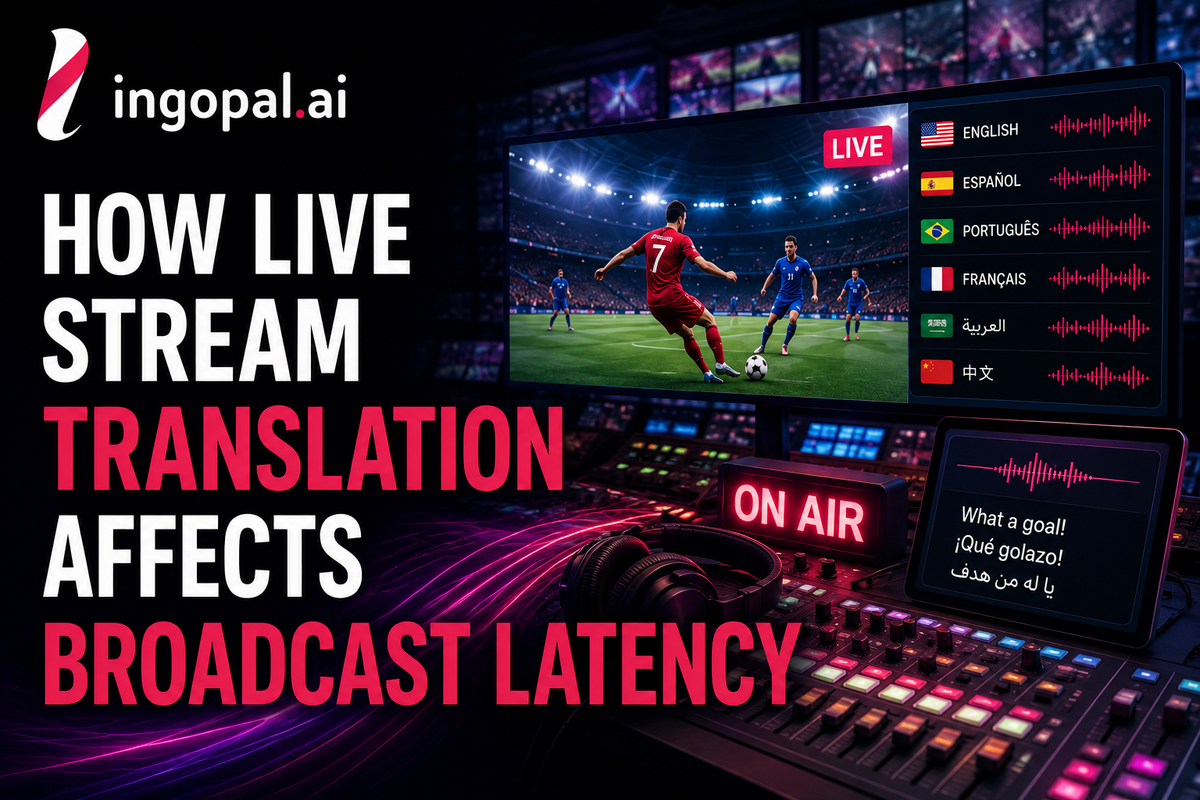
How Live Stream Translation Affects Broadcast Latency
A Practical Guide to Latency, Reliability, and Real-Time Multilingual Broadcast Workflows in 2026
Live stream translation affects broadcast latency because every stage required to turn source speech into translated captions or audio adds processing and transport time. Speech recognition, translation, voice generation, captioning, encoding, network routing, CDN delivery, and player buffering can all contribute to the delay experienced by the viewer.
For broadcasters, this means the most useful latency measurement is not simply how fast the AI translates.
It is:
How much time passes between the original speaker talking and the multilingual audience receiving the translated message?
That distinction is essential for sports, news, entertainment, conferences, and other live media where timing is part of the experience.
This guide explains where latency enters a live translation workflow, why lower latency is not always better, how translation quality and streaming reliability interact, and what broadcast teams should test before deploying multilingual live production.
Quick Answer: Does Live Stream Translation Increase Broadcast Latency?
Yes. Live stream translation adds some latency because the system must recognize speech, understand context, translate it, and generate captions or translated audio before delivering the result to viewers.
However, AI translation is only one source of delay.
A typical broadcast path may look like:
Speaker → Audio Capture → Speech Recognition → Translation → Captions / AI Voice → Encoding → Network → CDN → Player → Viewer
Each stage contributes to end-to-end latency.
For broadcast teams, the objective should therefore not be zero latency. The goal is to achieve the lowest practical and most predictable delay while maintaining translation accuracy, intelligibility, synchronization, and streaming reliability.
What Is Broadcast Latency?
Broadcast latency is the time between an event occurring at the source and the audience receiving it through the final viewing experience.
Even a single-language livestream already contains delay.
Cameras capture the event. Audio and video are processed. The program is encoded. Data travels across networks and CDNs. The player buffers content before presenting it to viewers.
Live translation introduces additional language-processing stages into that existing chain.
The important distinction is between translation latency and end-to-end broadcast latency.
Translation latency
The processing time required to recognize, translate, and generate the localized output.
End-to-end latency
The complete source-to-viewer delay, including translation plus the surrounding broadcast infrastructure.
The viewer experiences the second number.
That is the number production teams should optimize.
Where Does Latency Enter a Live Translation Workflow?
Understanding latency begins with understanding the complete signal path.
A multilingual broadcast may include the following stages.
1. Audio Capture
The speaker's voice enters the production environment.
Microphone quality, audio routing, buffering, and mixing can already affect timing before translation begins.
2. Speech Recognition
Automatic speech recognition converts spoken language into text.
The system may need to wait for enough speech to determine sentence boundaries and context.
3. Translation
The transcript is translated into the target language.
Context, terminology, language pair, sentence complexity, and model architecture can influence processing.
4. Caption Generation
If the audience receives subtitles, translated text needs to be segmented, timed, formatted, and delivered.
5. AI Voice Generation
For multilingual audio, translated text may be converted into synthesized speech.
Voice quality, pacing, emotion, and target-language pronunciation can affect processing requirements.
6. Audio Mixing and Routing
The translated voice may need to be mixed with crowd sound, music, effects, or other program audio.
Each language must then reach the correct destination.
7. Encoding and Distribution
Translated content enters the broadcast or streaming infrastructure.
8. Viewer Playback
The final application or player may introduce additional buffering.
The total latency is the sum of the complete workflow—not simply the AI model.
Why Does Translation Need Context?
One of the most important technical tradeoffs in real-time translation is the relationship between context and speed.
Consider:
“He challenged the call.”
In sports, "challenge" may refer to formally requesting a review of an official's decision.
A translation system that immediately processes every individual word may misunderstand the sentence.
Waiting for more context can improve interpretation.
But waiting also adds latency.
The same problem appears in news, entertainment, finance, politics, and live interviews.
Words can change meaning based on what comes next.
This creates a fundamental tradeoff:
Less context → potentially lower latency
More context → potentially better translation
Broadcast-grade workflows need to balance both rather than optimize one metric in isolation.
Why the Lowest Latency Is Not Always the Best Latency
A platform advertising extremely low latency can sound automatically superior.
It isn't necessarily.
Imagine two systems.
System A delivers translated commentary almost immediately but frequently misinterprets names, sentence endings, or contextual meaning.
System B takes slightly longer but delivers consistently understandable commentary that remains synchronized with the program.
For most broadcasters, System B may provide the better viewer experience.
The correct question is therefore:
What is the lowest latency at which the platform can maintain acceptable translation quality and reliability?
That is a much more useful production metric.
Latency Should Be Predictable, Not Just Low
Average latency can hide an important problem: variation.
Imagine translated commentary normally arrives four seconds behind the source.
Then suddenly:
4 seconds → 5 seconds → 11 seconds → 4 seconds
Even if the average looks reasonable, the audience experiences inconsistent synchronization.
This is particularly disruptive during sports.
A viewer might hear a translated reaction to a goal after the replay has already begun.
Broadcast teams should therefore measure:
- Average latency
- Maximum latency
- Latency variation
- Recovery behavior
- Long-session stability
Predictable latency is often more operationally valuable than occasional ultra-low latency.
How Source Audio Affects Translation Latency
Translation begins before the translation model.
Poor source audio can increase uncertainty in speech recognition, which affects everything downstream.
Common problems include:
- Crowd noise
- Music
- Multiple speakers
- Echo
- Room ambience
- Microphone clipping
- Low speech levels
- Overlapping commentary
Whenever possible, send a clean speech feed into the translation workflow.
For example, a sports production can separate:
Commentary → Translation
from:
Crowd + Music + Effects → Program Audio
The localized commentary can then be mixed back with the appropriate broadcast sound.
Cleaner source audio can improve both translation quality and workflow consistency.
How AI Dubbing Affects Latency
Translated audio introduces processing that captions do not necessarily require.
The system must generate speech that is:
- Intelligible
- Correctly pronounced
- Appropriately paced
- Natural
- Synchronized
- Consistent with the source speaker
More sophisticated voice generation may also attempt to preserve:
- Voice identity
- Emotion
- Emphasis
- Speaking style
That creates another tradeoff.
Broadcasters want translated voices to sound natural, but they also need them quickly.
The right implementation balances voice quality with production latency rather than maximizing either independently.
Are Live Captions Faster Than AI Dubbing?
In many workflows, captions can be delivered with fewer processing stages than synthesized translated speech because the translated text does not need to pass through voice generation.
However, caption latency still depends on:
- Speech recognition
- Translation
- Sentence segmentation
- Formatting
- Delivery
- Player behavior
And lower latency does not automatically mean better captions.
If text appears too early, updates constantly, or breaks sentences unnaturally, readability can suffer.
Broadcasters should evaluate caption delay and caption quality together.
Why Sports Is Particularly Sensitive to Translation Latency
Sports is one of the most demanding environments for live stream translation.
Commentary is directly connected to visual events.
A goal happens.
A commentator reacts.
The audience expects those experiences to remain connected.
Long delays can create situations where translated viewers:
- See the goal before hearing the call
- Hear commentary after the replay begins
- Receive statistics after the graphic disappears
- Hear reactions after the moment has passed
Sports also introduces:
- Rapid commentary
- Crowd noise
- Proper names
- Statistics
- Multiple commentators
- Interruptions
- Emotional delivery
For sports, latency testing should use actual match conditions rather than clean studio samples.
How Broadcast Latency Affects Live News
News has a different timing requirement.
A few seconds can matter significantly during:
- Breaking news
- Elections
- Emergency coverage
- Financial announcements
- Live press conferences
- Correspondent reports
Translated audiences need confidence that the language feed represents what is happening now.
News teams should also evaluate what happens when speakers interrupt each other or a presenter switches unexpectedly to a reporter.
Low latency is valuable, but factual and contextual accuracy remain essential.
A fast mistranslation of a number, location, or public statement can be more damaging than a slightly delayed accurate translation.
How Entertainment Broadcasting Changes the Tradeoff
Entertainment often places greater emphasis on performance.
Award shows, interviews, creator streams, concerts, talk shows, and live entertainment rely heavily on:
- Humor
- Timing
- Personality
- Emotion
- Audience reaction
Here, broadcasters may decide that slightly more processing time is acceptable if it produces a significantly more natural translated voice.
The optimal latency target therefore depends partly on the content.
There is no single latency number that defines every successful multilingual broadcast.
How Network Infrastructure Affects Translation Reliability
The AI translation system may perform correctly while the overall stream still experiences problems.
Network architecture can introduce:
- Packet loss
- Jitter
- Buffering
- Connection instability
- Routing delays
Protocols, encoders, cloud infrastructure, CDNs, and playback environments all influence the final result.
This is why translation vendors should be evaluated within the actual broadcast technology stack.
Testing an AI model through a web demo does not prove that the complete workflow will perform reliably inside a production environment.
How Many Languages Can Affect Latency
Scaling from one translated language to many introduces additional operational considerations.
One source may need to generate:
Spanish
Portuguese
French
German
Arabic
and many other language outputs simultaneously.
Broadcast teams should determine whether latency remains stable as concurrency increases.
Ask:
- Does adding languages affect processing time?
- Are all languages processed simultaneously?
- Can operators monitor each language?
- Can one failing language be isolated?
- Does audio routing remain consistent?
- Do captions remain synchronized?
Language count is only useful when the platform can deliver those languages reliably at the same time.
How to Measure Translation Latency Correctly
A useful test measures what the viewer actually experiences.
Start a timer when the source speaker delivers a recognizable phrase.
Stop when the translated audience receives the corresponding:
Caption
or:
Translated speech
Repeat the test throughout the production.
Do not measure only one sentence.
Test:
- Short statements
- Long sentences
- Rapid speech
- Pauses
- Names
- Numbers
- Speaker changes
- Interruptions
Then compare latency across languages.
This provides a much more realistic picture of production performance.
Translation Latency vs. Streaming Latency
These terms are often confused.
Translation latency is the delay created by the language-processing workflow.
Streaming latency is the delay created by the video delivery infrastructure.
A viewer experiences both.
For example:
Translation processing + Encoding + CDN + Player buffering = Final multilingual viewer delay
Optimizing translation while ignoring streaming configuration may produce little visible improvement.
Likewise, an ultra-low-latency streaming stack cannot eliminate processing time required for accurate multilingual speech.
The two systems need to be optimized together.
How to Reduce Latency Without Sacrificing Reliability
Broadcast teams can improve multilingual performance by focusing on the complete workflow.
Use Clean Source Audio
Give speech recognition the clearest possible input.
Separate Audio Tracks
Keep commentary, music, effects, and translated audio independently routable.
Prepare Terminology
Provide names, acronyms, brands, and recurring technical vocabulary before the event.
Remove Unnecessary Handoffs
Every additional platform or network connection can introduce delay and failure risk.
Test Real Content
Use actual commentary, presenters, interviews, and production conditions.
Optimize Streaming Configuration
Evaluate encoding, network routing, CDN behavior, and player buffering alongside translation.
Monitor End to End
Measure what the viewer receives rather than what one AI component reports.
Prioritize Stability
A consistent translated feed is more useful than one that alternates between extremely fast and noticeably delayed.
How Does Reliability Relate to Latency?
Reducing buffers can lower delay.
But buffers also help systems absorb network variation.
This creates another tradeoff:
Smaller buffers → lower latency but potentially less resilience
Larger buffers → more stability but potentially greater delay
Broadcast engineers already manage this tradeoff throughout streaming infrastructure.
AI translation adds another processing layer that needs to fit within the overall reliability strategy.
The correct configuration depends on the event, network, platform, and audience expectations.
What Should Broadcasters Test Before Going Live?
A production-ready test should include:
- Actual source audio
- Multiple speakers
- Proper names
- Rapid speech
- Long sentences
- Numbers
- Technical terminology
- Background noise
- All target languages
- Captions
- Translated audio
- Real distribution infrastructure
- Long-session operation
- Feed interruption
- Recovery behavior
Measure:
- Translation accuracy
- End-to-end latency
- Latency consistency
- Caption timing
- Voice quality
- Speaker attribution
- Audio synchronization
- Feed stability
- Operator workload
The objective is not simply determining whether translation works.
It is determining whether the complete multilingual broadcast works.
Where Lingopal Fits Into Low-Latency Live Translation
Lingopal is designed to help broadcasters, sports organizations, streaming platforms, enterprises, educators, and live event producers integrate multilingual localization into existing live media workflows.
Depending on production requirements, Lingopal supports capabilities including:
- Real-time AI translation
- Multilingual audio
- Live captions
- AI dubbing
- Voice preservation
- 100+ languages
- Live and VOD localization
- Professional broadcast and streaming workflows
Rather than treating translation as an isolated service after production, the goal is to make language part of the live media pipeline.
That allows one source production to support multiple audiences without creating an entirely separate production for every language.
Want to test latency using your own live content?
BOOK A FREE DEMO and evaluate Lingopal using your actual speakers, languages, and broadcast workflow.
Frequently Asked Questions
Does live stream translation increase latency?
Yes. Live stream translation adds processing because speech needs to be recognized, translated, and converted into captions or translated audio. The final viewer delay also includes encoding, networking, CDN delivery, and playback buffering.
What causes the most latency in live translation?
There is no universal single cause. Speech recognition, translation, voice generation, buffering, network routing, encoding, CDN configuration, and playback can all contribute. Broadcasters should measure the complete source-to-viewer workflow.
What is acceptable latency for live translation?
Acceptable latency depends on the content and production environment. Sports and breaking news are highly timing-sensitive, while some conferences or long-form discussions may tolerate greater delay. Consistency, accuracy, and synchronization should be evaluated alongside the absolute latency figure.
Is captioning faster than AI dubbing?
Captioning can involve fewer processing stages because it does not require synthesized speech, but actual performance varies by workflow. Caption quality also depends on timing, segmentation, readability, and synchronization.
Does adding more languages increase translation latency?
It can depending on the platform architecture and available processing resources. Broadcasters should test the actual number of simultaneous languages they plan to use rather than assuming performance remains identical at scale.
How should broadcasters measure translation latency?
Measure from the original speaker's speech to the moment the translated viewer receives the corresponding caption or audio. Repeat this throughout a realistic production and monitor average latency, maximum latency, and variation.
Why is predictable latency important?
Large fluctuations can disconnect commentary from the video even when average latency appears low. Predictable delay allows production teams to maintain a more consistent viewer experience.
Can low latency reduce translation quality?
Potentially. Translation systems need enough linguistic context to interpret meaning accurately. Processing speech too aggressively can reduce context, while waiting longer may increase accuracy at the cost of delay.
How does source audio affect latency and accuracy?
Clean, isolated speech makes automatic speech recognition easier and more reliable. Crowd noise, music, overlapping speakers, clipping, and poor microphone quality can introduce recognition errors and instability that affect downstream translation.
How can broadcasters reduce live translation latency?
Start with clean audio, reduce unnecessary workflow handoffs, prepare terminology, optimize network and streaming infrastructure, test real production content, and monitor end-to-end performance instead of focusing only on the AI translation engine.
Final Thoughts
Live stream translation affects broadcast latency because it adds language processing to an already complex real-time media pipeline.
But translation should not be treated as the only source of delay.
The viewer experiences the complete chain:
Speech → Recognition → Translation → Voice or Captions → Encoding → Distribution → Playback
That means the best multilingual broadcast is not necessarily the one with the lowest advertised AI latency.
It is the one that achieves the right balance between:
Speed + Accuracy + Synchronization + Reliability.
Sports organizations need translated commentary that remains connected to the action.
News organizations need immediacy without compromising factual meaning.
Entertainment broadcasters need timing while preserving personality and emotion.
Across all of these use cases, the correct strategy is the same:
Measure the complete workflow under real production conditions.
That is how broadcast teams can separate impressive latency claims from genuinely reliable multilingual broadcasting.
Build Faster, More Reliable Multilingual Broadcasts With Lingopal
Live translation should expand your audience without compromising the live experience.
Lingopal helps professional media teams add real-time AI translation, multilingual audio, live captions, AI dubbing, and voice preservation across 100+ languages to live and recorded content.
Test Lingopal using your own commentary, newsroom feed, event, or streaming workflow and evaluate the result where it matters most: the viewer experience.
BOOK A FREE DEMO