How to Add Multilingual Audio to One Live Stream
The practical guide for broadcasters building scalable multilingual streaming workflows in 2026
Live content is no longer limited by geography.
A football match produced in Spain is watched in Brazil, Japan, and Germany. A corporate town hall includes employees across five continents. A live news broadcast reaches viewers who expect to consume content in their own language.
For broadcasters, the question is no longer whether to support multiple languages.
The question is how to add multilingual audio to one live stream without multiplying production complexity.
Fortunately, modern AI and cloud broadcasting technologies now make it possible to generate multiple live language feeds from a single production workflow.
This guide explains how multilingual audio streaming works, the technology behind it, and what broadcasters should evaluate before deploying it.
What Is Multilingual Audio Streaming?
Multilingual audio streaming is the process of delivering multiple language audio tracks from a single live video stream.
Instead of producing separate broadcasts for every audience, broadcasters create one primary live feed while AI generates additional language audio streams that viewers can select during playback.
A single live event can simultaneously offer:
- Original commentary
- Spanish commentary
- Portuguese commentary
- French commentary
- German commentary
- Arabic commentary
—all synchronized to the same live video.
This dramatically reduces production costs while expanding global reach.
How Does Multilingual Audio Streaming Work?
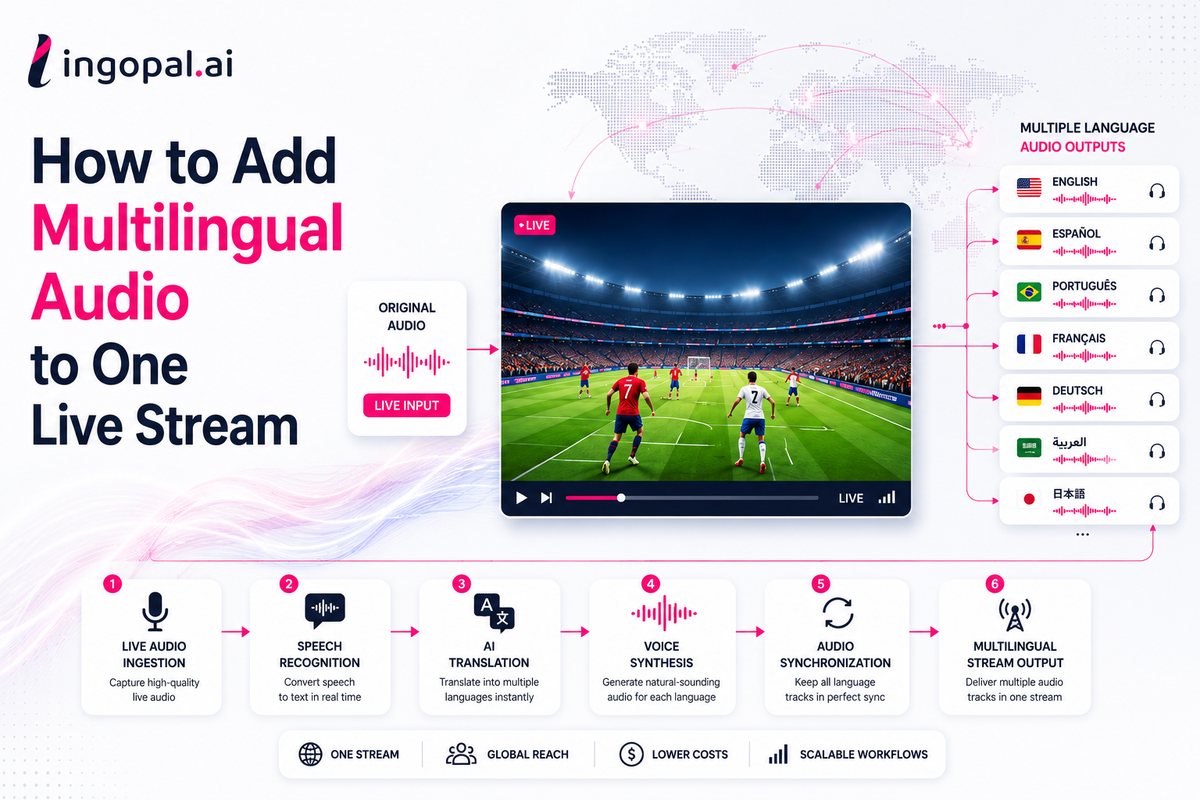
Modern AI platforms combine several technologies into one workflow.
A typical system includes:
- Live audio ingestion
- Automatic Speech Recognition (ASR)
- AI translation
- Voice synthesis
- Audio synchronization
- Multiple language output streams
Instead of creating separate production pipelines for every language, AI processes one source feed and generates multiple localized audio tracks automatically.
Can You Add Multiple Audio Languages to One Live Stream?
Yes.
Modern broadcasting platforms support multiple audio tracks attached to the same video stream.
Depending on your distribution platform, viewers can select their preferred language while watching the same live event.
This approach is increasingly common across:
- Sports broadcasting
- OTT platforms
- FAST channels
- Live news
- Conferences
- Religious services
- Corporate events
Rather than publishing multiple identical video streams, organizations distribute one video with several synchronized language options.
What Equipment Is Needed for Multilingual Audio Streaming?
One of the biggest misconceptions is that multilingual broadcasting requires multiple production teams.
Today, much of the process is software-based.
A typical workflow includes:
- Live production system
- Streaming encoder
- AI translation platform
- Audio routing
- CDN or streaming platform
- Video player supporting multiple audio tracks
Most organizations already own much of this infrastructure.
The AI translation layer becomes another component in the existing broadcast workflow rather than replacing it.
Step-by-Step: How to Add Multilingual Audio to One Live Stream
Step 1: Capture the Original Audio
Start with your primary production feed.
This could be:
- commentator audio
- presenter microphone
- studio program feed
- conference audio
- mixed broadcast output
Clean source audio improves translation quality.
Step 2: Convert Speech into Text
Automatic Speech Recognition (ASR) continuously transcribes spoken audio during the broadcast.
Modern systems can recognize:
- multiple speakers
- changing accents
- technical terminology
- sports vocabulary
- fast-paced conversations
This transcription becomes the foundation for translation.
Step 3: Translate the Audio in Real Time
AI translates the transcript into one or more target languages.
Unlike traditional machine translation, modern AI preserves:
- meaning
- context
- terminology
- conversational flow
This is particularly important for:
- sports commentary
- live interviews
- breaking news
- entertainment shows
Step 4: Generate Natural Audio
The translated text is converted into speech using AI voice synthesis.
Advanced platforms preserve:
- pacing
- emotion
- natural rhythm
- speaker consistency
The goal isn't simply translating words.
It's delivering a natural listening experience.
Step 5: Synchronize Audio with Video
Every translated audio stream must remain synchronized with the live broadcast.
This is where latency becomes critical.
Broadcasters should evaluate:
- end-to-end latency
- synchronization stability
- language consistency
- audio quality
Well-designed systems keep translated commentary closely aligned with live action.
Step 6: Deliver Multiple Audio Tracks
Finally, each language becomes an additional audio option within the same stream.
Depending on the platform, viewers can switch languages during playback without changing the video.
This creates a far better viewing experience than maintaining separate streams for every market.
What Makes Multilingual Audio Streaming Difficult?
Adding multiple languages sounds straightforward.
In practice, several challenges must be managed simultaneously.
Low Latency
Live translation cannot introduce noticeable delays.
For sports, even a few seconds can affect the viewing experience.
Audio Synchronization
Every language must remain synchronized with the same video.
If one language falls behind while another stays current, audiences notice immediately.
Speaker Changes
Broadcasts often include:
- commentators
- presenters
- analysts
- reporters
- interview guests
AI must correctly identify speakers and maintain consistency across languages.
Technical Terminology
Sports, finance, healthcare, and technology all include specialized vocabulary.
Translation systems should understand context rather than translating terms literally.
Scalability
Major live events may require:
- millions of viewers
- dozens of languages
- multiple concurrent streams
Enterprise platforms should scale automatically without reducing quality.
Which Streaming Technologies Support Multilingual Audio?
Modern AI translation platforms integrate with existing broadcast workflows rather than replacing them.
Broadcasters should look for support for common technologies such as:
- SRT
- RTMP
- HLS
- MPEG-TS
- APIs
- Cloud production environments
Compatibility with existing infrastructure reduces deployment time and operational complexity.
Questions to Ask Before Choosing a Multilingual Audio Streaming Platform
Before selecting a solution, broadcasters should ask:
- Can it generate multiple audio tracks from one source feed?
- Does it support real-time translation?
- How is latency measured?
- Does it preserve speaker identity?
- Can viewers switch audio languages during playback?
- Does it integrate with our streaming technology?
- Does it support broadcast automation?
- Can it scale for major live events?
- Does it generate captions alongside translated audio?
- How many simultaneous languages are supported?
These questions help distinguish enterprise broadcast solutions from general-purpose translation tools.
Frequently Asked Questions
What is multilingual audio streaming?
Multilingual audio streaming allows broadcasters to deliver multiple language audio tracks within a single live stream, giving viewers the option to select their preferred language while watching the same video.
Can one live stream have multiple audio languages?
Yes. Modern streaming platforms support multiple synchronized audio tracks attached to a single live video stream.
How do broadcasters add multilingual audio to live streams?
Broadcasters use AI to transcribe live speech, translate it into multiple languages, generate natural voice audio, and distribute each language as a separate audio track alongside the original video.
What technologies are used for multilingual audio streaming?
Typical workflows include Automatic Speech Recognition (ASR), AI translation, voice synthesis, audio synchronization, and streaming protocols such as SRT, RTMP, and HLS.
Why is multilingual audio better than creating separate streams?
A single multilingual stream reduces production complexity, lowers localization costs, simplifies distribution, and provides a better viewer experience by allowing audiences to switch languages instantly.
The Future of Media Production Is Multilingual
Global audiences increasingly expect live content in their own language.
Fortunately, broadcasters no longer need separate production teams or entirely different workflows to make that possible.
Modern multilingual audio streaming platforms enable organizations to generate multiple live language feeds from a single source stream, simplifying broadcasting localization while improving accessibility and international reach.
As AI continues to advance, multilingual streaming will become a standard capability for media production, not an optional enhancement.