How to Audit Multilingual Streaming Handoffs in 2026
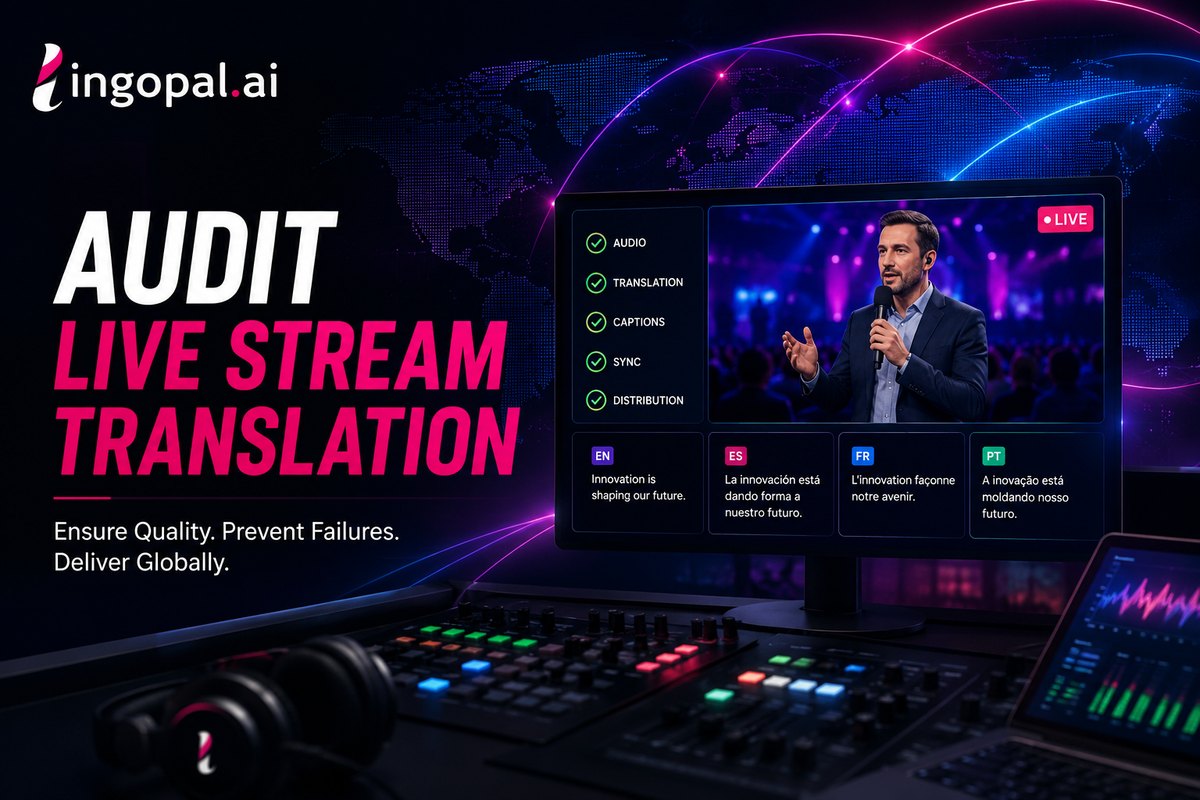
A Complete Guide to Eliminating Failures in Live Stream Translation Workflows
Primary Keyword: live stream translation
Table of Contents
- Why multilingual streaming handoffs matter
- What is a streaming handoff?
- The most common workflow failures
- A step-by-step audit checklist
- Best practices for reliable multilingual broadcasting
- Frequently Asked Questions
- Final Thoughts
Why Multilingual Streaming Workflows Break
Modern live broadcasts involve far more than cameras and microphones.
Today's productions often include:
- AI live translation
- Live captions
- AI dubbing
- Multiple language feeds
- Cloud production
- Streaming platforms
- CDN distribution
- Social media simulcasts
Every additional component creates another workflow handoff.
When one handoff fails, the entire multilingual experience can suffer.
Viewers may experience:
- Delayed translations
- Missing captions
- Audio synchronization problems
- Incorrect language routing
- Broken subtitle feeds
- Poor viewer experience
As broadcasters continue expanding global distribution, auditing these handoffs has become a critical operational practice.
What Is a Multilingual Streaming Handoff?
A handoff occurs whenever one system passes information to another.
In a multilingual livestream, that might include:
Broadcast Feed
↓
Speech Recognition
↓
Translation Engine
↓
Caption Generation
↓
AI Voice Dubbing
↓
Streaming Encoder
↓
Distribution Platform
↓
Viewer
Each transition introduces potential risk.
Professional broadcast teams regularly audit every step to ensure reliability before going live.
Why Handoff Failures Are Increasing
Broadcast workflows have become significantly more complex.
Instead of managing one television signal, organizations now operate:
- Multiple languages
- Multiple audio tracks
- Live captions
- Cloud production platforms
- Streaming services
- Social platforms
- Regional feeds
- Mobile apps
Without structured workflow validation, complexity grows faster than operational visibility.
The result is inconsistent multilingual delivery.
Step 1: Audit Source Audio Quality
Everything begins with clean audio.
Poor audio quality negatively impacts:
- Speech recognition
- Translation accuracy
- Caption generation
- Voice cloning
- AI dubbing
Review:
- Microphone quality
- Background noise
- Crowd interference
- Audio levels
- Speaker isolation
Translation quality can never exceed source quality.
Step 2: Validate Speech Recognition Accuracy
AI translation depends on accurate transcription.
Before evaluating translations, verify that the speech recognition engine correctly identifies:
- Speaker changes
- Proper names
- Sports terminology
- Company names
- Technical vocabulary
- Numbers
- Statistics
Errors introduced here propagate throughout every downstream workflow.
Step 3: Review Translation Consistency
Translation quality involves more than literal accuracy.
Audit whether the platform consistently preserves:
- Context
- Brand terminology
- Athlete names
- Sponsor references
- Product names
- Industry terminology
Many organizations maintain multilingual glossaries to standardize recurring vocabulary across every broadcast.
Step 4: Check Caption Synchronization
Captions should remain synchronized throughout the entire livestream.
Watch for:
- Delayed subtitles
- Early captions
- Missing segments
- Overlapping lines
- Reading speed
- Speaker timing
Captions that drift even a few seconds reduce accessibility and viewer confidence.
Step 5: Verify AI Voice Dubbing
If multilingual audio is being generated, evaluate:
- Voice quality
- Emotion
- Speaking pace
- Synchronization
- Pronunciation
- Audio consistency
The objective is preserving the speaker's identity while maintaining natural localized speech.
Step 6: Inspect Broadcast Infrastructure
Translation may work perfectly while distribution fails.
Review compatibility with existing workflows including:
- SRT
- HLS
- RTMP
- MP4
- API ingest
- Cloud production
- Encoders
- CDNs
Every integration point should be validated before major live events.
Step 7: Test Every Language Output
Many organizations test only English.
Professional multilingual operations test every language individually.
Review:
- Audio routing
- Caption feeds
- Subtitle formatting
- Language selection
- Metadata
- Regional delivery
Small configuration errors frequently affect only one language.
Step 8: Stress-Test Large Events
Small product demonstrations rarely expose production issues.
Simulate:
- Peak audience traffic
- Multiple simultaneous events
- Several language feeds
- Rapid commentary
- Breaking news
- Last-minute production changes
Stress testing identifies operational bottlenecks before viewers experience them.
Step 9: Measure End-to-End Latency
Rather than measuring only translation speed, evaluate the complete workflow.
Measure latency from:
Speaker
↓
Translation
↓
Captions
↓
Audio
↓
Distribution
↓
Viewer
This end-to-end measurement provides the most accurate operational picture.
Step 10: Build Continuous Monitoring
Workflow audits should not occur only before major events.
Professional broadcasters continuously monitor:
- Caption health
- Translation quality
- Audio synchronization
- Feed stability
- Language routing
- Platform performance
Automated monitoring dramatically reduces production risk.
Common Workflow Mistakes
Many organizations focus exclusively on AI translation quality.
In reality, operational failures often originate elsewhere.
Common mistakes include:
- Ignoring source audio quality
- Testing only one language
- Missing glossary updates
- Poor workflow documentation
- Manual routing errors
- No latency monitoring
- No failover strategy
Reliable multilingual broadcasting depends on operational discipline as much as AI capability.
Building Broadcast-Ready Localization
The strongest multilingual workflows combine:
- AI speech recognition
- Machine translation
- AI voice dubbing
- Live captions
- Terminology management
- Broadcast integrations
- Human quality review
- Continuous monitoring
Together, these components create scalable multilingual broadcasting that remains reliable under live conditions.
Industries Using Live Stream Translation
Organizations increasingly auditing multilingual workflows include:
Sports Broadcasters
Live commentary, press conferences, athlete interviews.
News Organizations
Breaking news and international reporting.
OTT & FAST Platforms
Global streaming services.
Corporate Communications
Product launches and global events.
Education
University lectures and webinars.
Faith-Based Organizations
International worship services and conferences.
Frequently Asked Questions
What is a multilingual streaming handoff?
A multilingual streaming handoff is any point where audio, captions, translations, or video move between systems during a live production workflow.
Why do livestream translation workflows fail?
Most failures occur because of poor audio quality, transcription errors, workflow integration issues, caption synchronization problems, or language routing mistakes.
How often should broadcasters audit workflows?
Ideally before every major event, while continuously monitoring live production systems during broadcasts.
Does AI translation eliminate workflow management?
No.
AI automates translation, but broadcasters must still validate integrations, monitor latency, maintain terminology, and ensure production reliability.
What is the biggest risk in multilingual broadcasting?
The biggest risk is assuming translation quality alone guarantees viewer experience.
Operational handoffs between systems often determine whether multilingual broadcasts remain synchronized and reliable.
Final Thoughts
As multilingual broadcasting becomes standard across sports, news, entertainment, education, and corporate media, workflow reliability is becoming just as important as translation quality.
Every handoff—from source audio to speech recognition, translation, captioning, AI dubbing, and final distribution—introduces opportunities for delay, quality loss, or operational failure.
Organizations that routinely audit these workflows can identify problems before they reach viewers, improve accessibility, reduce production risk, and deliver more consistent multilingual experiences at scale.
The future of live stream translation isn't just about better AI—it's about building resilient, observable, and broadcast-ready workflows.
Why Broadcasters Choose Lingopal
Lingopal helps broadcasters, streaming platforms, sports organizations, and enterprises simplify multilingual live production through AI-powered live stream translation, real-time captions, voice preservation, and broadcast-ready integrations.
Supporting 100+ languages, SRT, HLS, RTMP, MP4, API ingest, and cloud-native workflows, Lingopal enables teams to deliver reliable multilingual broadcasts without adding unnecessary production complexity.
Ready to optimize your multilingual workflow?
Book a A Complete Guide to Eliminating Failures in Live Stream Translation Workflows
Primary Keyword: live stream translation
Table of Contents
- Why multilingual streaming handoffs matter
- What is a streaming handoff?
- The most common workflow failures
- A step-by-step audit checklist
- Best practices for reliable multilingual broadcasting
- Frequently Asked Questions
- Final Thoughts
Why Multilingual Streaming Workflows Break
Modern live broadcasts involve far more than cameras and microphones.
Today's productions often include:
- AI live translation
- Live captions
- AI dubbing
- Multiple language feeds
- Cloud production
- Streaming platforms
- CDN distribution
- Social media simulcasts
Every additional component creates another workflow handoff.
When one handoff fails, the entire multilingual experience can suffer.
Viewers may experience:
- Delayed translations
- Missing captions
- Audio synchronization problems
- Incorrect language routing
- Broken subtitle feeds
- Poor viewer experience
As broadcasters continue expanding global distribution, auditing these handoffs has become a critical operational practice.
What Is a Multilingual Streaming Handoff?
A handoff occurs whenever one system passes information to another.
In a multilingual livestream, that might include:
Broadcast Feed
↓
Speech Recognition
↓
Translation Engine
↓
Caption Generation
↓
AI Voice Dubbing
↓
Streaming Encoder
↓
Distribution Platform
↓
Viewer
Each transition introduces potential risk.
Professional broadcast teams regularly audit every step to ensure reliability before going live.
Why Handoff Failures Are Increasing
Broadcast workflows have become significantly more complex.
Instead of managing one television signal, organizations now operate:
- Multiple languages
- Multiple audio tracks
- Live captions
- Cloud production platforms
- Streaming services
- Social platforms
- Regional feeds
- Mobile apps
Without structured workflow validation, complexity grows faster than operational visibility.
The result is inconsistent multilingual delivery.
Step 1: Audit Source Audio Quality
Everything begins with clean audio.
Poor audio quality negatively impacts:
- Speech recognition
- Translation accuracy
- Caption generation
- Voice cloning
- AI dubbing
Review:
- Microphone quality
- Background noise
- Crowd interference
- Audio levels
- Speaker isolation
Translation quality can never exceed source quality.
Step 2: Validate Speech Recognition Accuracy
AI translation depends on accurate transcription.
Before evaluating translations, verify that the speech recognition engine correctly identifies:
- Speaker changes
- Proper names
- Sports terminology
- Company names
- Technical vocabulary
- Numbers
- Statistics
Errors introduced here propagate throughout every downstream workflow.
Step 3: Review Translation Consistency
Translation quality involves more than literal accuracy.
Audit whether the platform consistently preserves:
- Context
- Brand terminology
- Athlete names
- Sponsor references
- Product names
- Industry terminology
Many organizations maintain multilingual glossaries to standardize recurring vocabulary across every broadcast.
Step 4: Check Caption Synchronization
Captions should remain synchronized throughout the entire livestream.
Watch for:
- Delayed subtitles
- Early captions
- Missing segments
- Overlapping lines
- Reading speed
- Speaker timing
Captions that drift even a few seconds reduce accessibility and viewer confidence.
Step 5: Verify AI Voice Dubbing
If multilingual audio is being generated, evaluate:
- Voice quality
- Emotion
- Speaking pace
- Synchronization
- Pronunciation
- Audio consistency
The objective is preserving the speaker's identity while maintaining natural localized speech.
Step 6: Inspect Broadcast Infrastructure
Translation may work perfectly while distribution fails.
Review compatibility with existing workflows including:
- SRT
- HLS
- RTMP
- MP4
- API ingest
- Cloud production
- Encoders
- CDNs
Every integration point should be validated before major live events.
Step 7: Test Every Language Output
Many organizations test only English.
Professional multilingual operations test every language individually.
Review:
- Audio routing
- Caption feeds
- Subtitle formatting
- Language selection
- Metadata
- Regional delivery
Small configuration errors frequently affect only one language.
Step 8: Stress-Test Large Events
Small product demonstrations rarely expose production issues.
Simulate:
- Peak audience traffic
- Multiple simultaneous events
- Several language feeds
- Rapid commentary
- Breaking news
- Last-minute production changes
Stress testing identifies operational bottlenecks before viewers experience them.
Step 9: Measure End-to-End Latency
Rather than measuring only translation speed, evaluate the complete workflow.
Measure latency from:
Speaker
↓
Translation
↓
Captions
↓
Audio
↓
Distribution
↓
Viewer
This end-to-end measurement provides the most accurate operational picture.
Step 10: Build Continuous Monitoring
Workflow audits should not occur only before major events.
Professional broadcasters continuously monitor:
- Caption health
- Translation quality
- Audio synchronization
- Feed stability
- Language routing
- Platform performance
Automated monitoring dramatically reduces production risk.
Common Workflow Mistakes
Many organizations focus exclusively on AI translation quality.
In reality, operational failures often originate elsewhere.
Common mistakes include:
- Ignoring source audio quality
- Testing only one language
- Missing glossary updates
- Poor workflow documentation
- Manual routing errors
- No latency monitoring
- No failover strategy
Reliable multilingual broadcasting depends on operational discipline as much as AI capability.
Building Broadcast-Ready Localization
The strongest multilingual workflows combine:
- AI speech recognition
- Machine translation
- AI voice dubbing
- Live captions
- Terminology management
- Broadcast integrations
- Human quality review
- Continuous monitoring
Together, these components create scalable multilingual broadcasting that remains reliable under live conditions.
Industries Using Live Stream Translation
Organizations increasingly auditing multilingual workflows include:
Sports Broadcasters
Live commentary, press conferences, athlete interviews.
News Organizations
Breaking news and international reporting.
OTT & FAST Platforms
Global streaming services.
Corporate Communications
Product launches and global events.
Education
University lectures and webinars.
Faith-Based Organizations
International worship services and conferences.
Frequently Asked Questions
What is a multilingual streaming handoff?
A multilingual streaming handoff is any point where audio, captions, translations, or video move between systems during a live production workflow.
Why do livestream translation workflows fail?
Most failures occur because of poor audio quality, transcription errors, workflow integration issues, caption synchronization problems, or language routing mistakes.
How often should broadcasters audit workflows?
Ideally before every major event, while continuously monitoring live production systems during broadcasts.
Does AI translation eliminate workflow management?
No.
AI automates translation, but broadcasters must still validate integrations, monitor latency, maintain terminology, and ensure production reliability.
What is the biggest risk in multilingual broadcasting?
The biggest risk is assuming translation quality alone guarantees viewer experience.
Operational handoffs between systems often determine whether multilingual broadcasts remain synchronized and reliable.
Final Thoughts
As multilingual broadcasting becomes standard across sports, news, entertainment, education, and corporate media, workflow reliability is becoming just as important as translation quality.
Every handoff—from source audio to speech recognition, translation, captioning, AI dubbing, and final distribution—introduces opportunities for delay, quality loss, or operational failure.
Organizations that routinely audit these workflows can identify problems before they reach viewers, improve accessibility, reduce production risk, and deliver more consistent multilingual experiences at scale.
The future of live stream translation isn't just about better AI—it's about building resilient, observable, and broadcast-ready workflows.
Why Broadcasters Choose Lingopal
Lingopal helps broadcasters, streaming platforms, sports organizations, and enterprises simplify multilingual live production through AI-powered live stream translation, real-time captions, voice preservation, and broadcast-ready integrations.
Supporting 100+ languages, SRT, HLS, RTMP, MP4, API ingest, and cloud-native workflows, Lingopal enables teams to deliver reliable multilingual broadcasts without adding unnecessary production complexity.
Ready to optimize your multilingual workflow?
Book a personalized demo and discover how Lingopal helps media organizations deliver seamless live experiences to audiences worldwide. and discover how Lingopal helps media organizations deliver seamless live experiences to audiences worldwide.