How to Scale Live Stream Translation in 2026
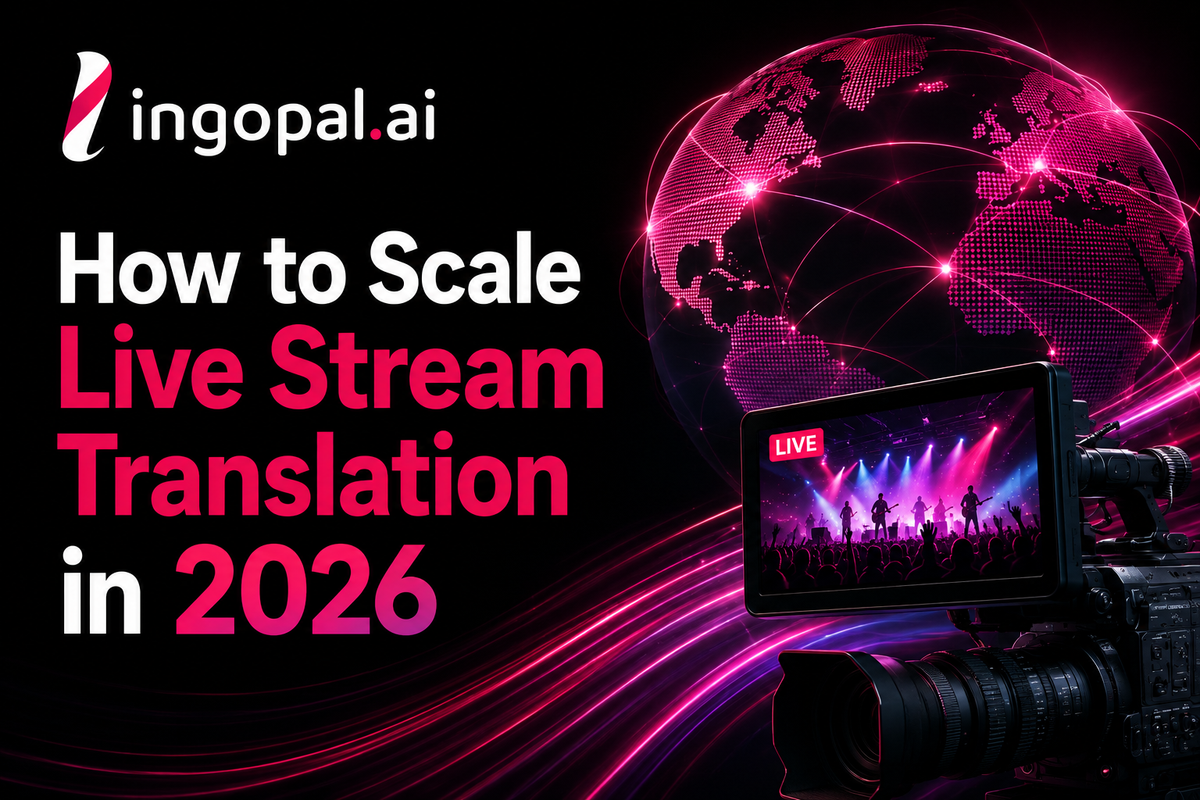
A Complete Guide to Multilingual Streaming, Low Latency, and Global Audience Growth
Live stream translation is moving from an experimental feature to a core part of global media distribution.
A broadcaster may start by translating one event into Spanish. But what happens when the same organization needs five languages, multiple simultaneous events, live captions, translated audio, OTT distribution, social streams, and thousands—or millions—of viewers?
That is where the challenge changes.
The question is no longer:
Can AI translate this livestream?
It becomes:
Can we scale live stream translation across languages, programs, and platforms without multiplying production complexity or sacrificing quality?
For media organizations in 2026, scalable multilingual broadcasting requires more than a powerful translation model. It requires an architecture that combines clean audio, real-time translation, terminology management, multilingual output, predictable latency, monitoring, and existing broadcast infrastructure.
This guide explains how to build that architecture.
What Is Scalable Live Stream Translation?
Scalable live stream translation is a production workflow that converts one live source into multiple translated audio and caption outputs while maintaining consistent quality, manageable latency, and operational reliability as languages, events, and audiences increase.
A simplified workflow looks like this:
Live Source → Speech Recognition → AI Translation → Multilingual Captions + Audio → Distribution → Global Audiences
The important word is scalable.
A workflow that performs well for one stream and one target language may become difficult to operate when a broadcaster adds:
- 10 languages
- Multiple simultaneous events
- Live captions
- AI dubbing
- Alternate audio tracks
- OTT and FAST distribution
- Social platforms
- Mobile applications
- Regional feeds
The objective is therefore not to create another production for every language.
It is to build one localization layer capable of supporting many languages from the same source production.
Why Does Live Stream Translation Become Harder to Scale?
Translation itself is only one stage of the workflow.
Every multilingual livestream may involve:
- Source audio
- Speech recognition
- Speaker identification
- Translation
- Terminology management
- Caption generation
- AI voice generation
- Audio mixing
- Encoding
- Language routing
- Streaming
- Monitoring
- Audience playback
As production volume increases, small inefficiencies become major operational problems.
If an operator manually configures five settings for every language, scaling from two languages to 20 languages creates significantly more work.
If every language requires its own independent production chain, multilingual growth quickly becomes expensive and difficult to maintain.
The scalable approach is to identify which parts of the production should remain shared and which parts actually need to change by language.
1. Build Around One High-Quality Source Feed
Scalable localization begins with a reliable source.
AI translation systems depend heavily on the quality of the audio they receive.
Whenever possible, provide isolated speech instead of a fully mixed program feed containing:
- Crowd noise
- Music
- Sound effects
- Applause
- Multiple microphones
For a sports broadcast, for example:
Commentary → Translation Layer
while:
Crowd + Effects + Music → Program Mix
The translated commentary can then be combined with the appropriate production audio later.
This architecture creates one clean input that can feed many language outputs.
And when the source improves, every translated language benefits.
2. Separate Localization From the Core Video Production
One of the most important principles for media content scaling is avoiding unnecessary duplication.
Imagine a broadcaster wants to deliver a live event in 10 languages.
The inefficient model is:
10 languages = 10 separate productions
The scalable model is:
1 video production + 10 localized language outputs
The video, graphics, cameras, switching, replays, and most of the program infrastructure remain shared.
Localization becomes an additional media layer.
This makes it easier to expand language coverage without expanding production resources at the same rate.
3. Use One Translation Layer for Multiple Outputs
Translation should ideally serve multiple audience experiences.
One source transcript can support:
Translated text → Live captions
and:
Translated text → AI voice → Multilingual audio
This is more efficient than operating completely independent captioning and dubbing systems.
For broadcasters, that means one localization workflow can potentially support:
- Real-time subtitles
- Translated commentary
- Accessibility captions
- Alternate audio tracks
- Multilingual streaming
- Post-event VOD
The same language processing becomes reusable infrastructure.
4. Treat Latency as an End-to-End Metric
Scaling translation while ignoring latency can produce a technically impressive system that viewers dislike.
Latency is not created by AI translation alone.
The complete path may include:
Speaker → Audio Capture → Speech Recognition → Translation → Voice Synthesis → Encoding → CDN → Player → Viewer
Every stage adds time.
As workflows scale, additional routing, processing, and distribution can increase that delay.
Media teams should therefore measure end-to-end latency rather than only asking how fast the translation model runs.
The key question is:
How long after the original speaker talks does the translated viewer hear or read the message?
That is the latency audiences experience.
5. Balance Speed and Translation Context
Lower latency is not automatically better.
Translation systems need enough context to understand meaning.
Consider:
"They're going to challenge the call."
In sports, "challenge" has a specific meaning.
A translation system that processes individual words too aggressively may produce output quickly but lose context.
Waiting too long creates the opposite problem: better linguistic understanding but delayed commentary.
Scalable real-time translation therefore requires a balance between:
- Speed
- Context
- Accuracy
- Natural delivery
The correct balance may also vary by content.
Sports commentary, breaking news, a corporate keynote, and a university lecture do not necessarily require identical latency strategies.
6. Centralize Terminology Before Scaling Languages
Terminology problems multiply with language count.
One incorrect athlete name translated into one language is a problem.
The same error repeated across 20 language feeds becomes a much larger issue.
Create centralized terminology resources containing:
- Names
- Teams
- Brands
- Sponsors
- Products
- Locations
- Acronyms
- Technical terminology
- Approved translations
- Terms that should remain untranslated
For recurring programming, these resources become reusable production assets.
This is especially important for sports leagues, news organizations, financial media, technology events, and branded programming.
7. Standardize Every Language Output
Scaling requires consistency.
Use standardized identifiers across the complete production workflow.
For example:
EN — English / Original
ES — Spanish
PT — Portuguese
FR — French
DE — German
The same identifiers should be used in:
- Translation configuration
- Audio routing
- Caption feeds
- Encoders
- OTT metadata
- Monitoring
- Player interfaces
When naming conventions change between systems, operators become responsible for mentally translating the routing logic.
That increases the risk of mistakes.
Standardization removes unnecessary decisions from live production.
8. Design for Simultaneous Languages
Ask vendors an important question:
What happens when we go from two languages to 20?
A platform may support a large number of languages individually without supporting them efficiently at the same time.
Evaluate:
- Concurrent language processing
- Multilingual audio generation
- Caption concurrency
- Output routing
- Monitoring
- API orchestration
- Resource allocation
The important metric is not simply:
"How many languages do you support?"
It is:
"How many languages can our production reliably deliver simultaneously?"
9. Monitor the Multilingual Experience From One Place
Operational complexity increases quickly when every language requires separate monitoring.
Ideally, production teams should have centralized visibility into:
- Source status
- Active languages
- Translation status
- Caption status
- Audio outputs
- Latency
- Errors
Operators should be able to identify questions such as:
Is Spanish working?
Are Portuguese captions delayed?
Did French audio stop?
without opening a large collection of unrelated tools.
Centralized monitoring makes multilingual scale operationally manageable.
10. Automate Repetitive Configuration
Automation becomes increasingly important as production volume grows.
If every event requires operators to manually configure:
- Languages
- Routing
- Glossaries
- Output names
- Destinations
then scaling creates more labor.
Where supported, APIs and reusable templates can automate repeatable production tasks.
For example, a sports network could define:
Football Translation Template
with predetermined languages, terminology, routing, and monitoring rules.
Operators then start from a tested configuration instead of rebuilding the workflow every weekend.
11. Build Failover Into the Architecture
A scalable system also needs graceful failure.
The objective should not be pretending failures will never occur.
The objective is making sure one problem does not destroy the entire broadcast.
Teams should define:
- Original-audio fallback
- Language-specific failure procedures
- Caption fallback
- Backup source feeds
- Escalation ownership
- Operator response procedures
If one translated language experiences an issue, the remaining language feeds should ideally continue operating.
That isolation becomes increasingly important as multilingual output grows.
12. Scale Quality Control Differently From Production Volume
Human review remains valuable, but reviewing every second of every language may become impossible as production scales.
Instead, create a risk-based quality model.
High-Risk Content
Use more human oversight for:
- Breaking news
- Sensitive interviews
- Legal statements
- Sponsor messaging
- Medical information
Predictable Content
Automation may handle more of:
- Recurring sports commentary
- Regular programming
- High-volume events
- Standard announcements
Teams can also sample outputs, monitor flagged terminology, and investigate anomalies rather than manually translating everything.
The objective is human-AI collaboration, not simply removing humans from the workflow.
How Can Live Stream Translation Grow Global Audiences?
The business value of scalable translation is not the number of languages generated.
It is what those languages make possible.
Multilingual broadcasting can help media organizations reach:
- International fans
- Diaspora communities
- New streaming territories
- Multilingual domestic audiences
- Global subscribers
- International sponsors
Consider a regional sports network.
Its English-language production already contains:
- Games
- Commentary
- Interviews
- Pregame programming
- Postgame analysis
- Highlights
Adding Spanish or Portuguese localization can potentially make the same programming accessible to entirely new audiences without recreating the underlying production.
That is the connection between live video localization and global audience reach.
Measure Audience Growth, Not Just Translation Output
A successful localization strategy should be measured through audience behavior.
Depending on the business model, teams can track:
- Language selection
- Unique multilingual viewers
- Minutes watched
- Session duration
- Completion rate
- Repeat viewing
- Geographic distribution
- Registrations
- Subscription activity
- Engagement
- Advertising impressions
Translation is infrastructure.
Audience growth is the outcome.
If a new language generates little engagement, teams can adjust the strategy.
If another language produces strong watch time and repeat viewing, additional investment may be justified.
This creates a data-driven language expansion model.
How Should Media Teams Choose Languages?
Do not automatically translate into every available language.
Start with audience opportunity.
Analyze:
- Current viewer geography
- Website traffic
- Streaming analytics
- Social audiences
- Subscriber data
- Distribution territories
- Sponsor markets
- Existing subtitle usage
Then prioritize the languages most likely to produce meaningful audience growth.
A controlled expansion might look like:
Original Language
↓
Spanish + Portuguese
↓
Measure Results
↓
French + German
↓
Measure Again
↓
Expand Further
This approach turns multilingual streaming into an audience strategy rather than a technology experiment.
What Does a Scalable Multilingual Workflow Look Like?
A practical architecture might look like:
ONE LIVE SOURCE
↓
Clean Speech Feed
↓
Speech Recognition
↓
Contextual AI Translation + Terminology
↓
Multilingual Captions + AI Audio
↓
Existing Broadcast Infrastructure
↓
OTT / FAST / Web / Mobile / Social
↓
GLOBAL AUDIENCES
The key principle is reuse.
One production.
One localization layer.
Many audience experiences.
Common Mistakes When Scaling Live Translation
Media teams should watch for several recurring problems:
- Creating separate productions for every language
- Using noisy program audio as the translation source
- Treating captions and dubbing as unrelated workflows
- Ignoring terminology until the broadcast begins
- Measuring model latency instead of viewer latency
- Manually configuring every event
- Using inconsistent language identifiers
- Monitoring every language separately
- Scaling language count before testing audience demand
- Having no fallback strategy
Most scaling problems come from workflow architecture rather than translation itself.
Where Lingopal Fits
Lingopal is designed to help media organizations make multilingual delivery part of existing live and VOD workflows.
Depending on the production configuration, Lingopal can support capabilities including:
- Real-time AI translation
- Multilingual audio
- Live captions
- AI dubbing
- Voice preservation
- VOD localization
- 100+ languages
- Broadcast and streaming workflows
For broadcasters, sports organizations, OTT platforms, newsrooms, enterprises, educators, and live event producers, the goal is to scale languages without scaling production complexity at the same rate.
Instead of:
One production → One audience
the model becomes:
One production → Many languages → Global audiences
Frequently Asked Questions
What is live stream translation?
Live stream translation uses speech recognition and translation technology to convert spoken content during a live broadcast into translated captions, subtitles, audio, or multiple language outputs while the event is happening.
How can broadcasters scale live stream translation?
Broadcasters can scale live stream translation by using one clean source feed, centralizing translation and terminology, generating multiple languages from a shared localization layer, automating repeatable configuration, standardizing routing, and integrating outputs with existing broadcast infrastructure.
Can one livestream support multiple languages?
Yes. Depending on the localization and streaming infrastructure, one source production can generate multiple translated audio and caption feeds for audiences selecting different languages.
How does latency affect multilingual streaming?
Latency determines how closely translated captions or audio remain synchronized with the original event. Teams should measure the complete source-to-viewer delay rather than evaluating translation processing in isolation.
How many languages should a broadcaster launch?
Start with languages supported by audience data, distribution strategy, geographic reach, and commercial opportunity. A small pilot can reveal which languages generate meaningful engagement before expanding further.
Does adding more languages increase production complexity?
It can, particularly when each language is treated as a separate workflow. Centralized translation, standardized routing, automation, and shared monitoring can allow language coverage to grow without production complexity increasing at the same rate.
Can AI translation help sports broadcasters grow internationally?
Yes. Live translation can make commentary, interviews, press conferences, and supporting programming accessible to fans who speak other languages, allowing rights holders and sports media organizations to test and expand into new audiences.
What metrics should broadcasters track?
Useful metrics include language selection, multilingual viewers, minutes watched, session duration, completion rates, repeat viewing, geography, registrations, subscriptions, and advertising performance.
Final Thoughts
Scaling live stream translation is not about translating one broadcast into as many languages as technology allows.
It is about building a multilingual production architecture that remains manageable as audiences grow.
The most scalable workflows share the same foundation:
One high-quality source.
One localization layer.
Centralized terminology.
Multiple standardized outputs.
Existing distribution infrastructure.
Centralized monitoring.
Audience data guiding expansion.
When these pieces work together, media organizations can expand multilingual streaming without creating a separate production operation for every market.
And that is ultimately what makes AI translation strategically valuable.
It allows the content you already produce to reach audiences your current language cannot.
Scale Global Broadcasting With Lingopal
Your audience can grow faster than your production complexity.
Lingopal helps broadcasters, sports organizations, streaming platforms, enterprises, educators, and live event producers transform one live production into multilingual experiences through real-time AI translation, captions, multilingual audio, and AI dubbing in 100+ languages.
Instead of rebuilding your workflow for every market, Lingopal helps add language as a scalable layer of your existing media infrastructure.
One production. More languages. More audiences.
Want to see how your existing live workflow could scale globally?
Book a Lingopal demo and test multilingual localization using your own production environment.