How to Translate Recorded Lectures with Accurate AI Subtitles
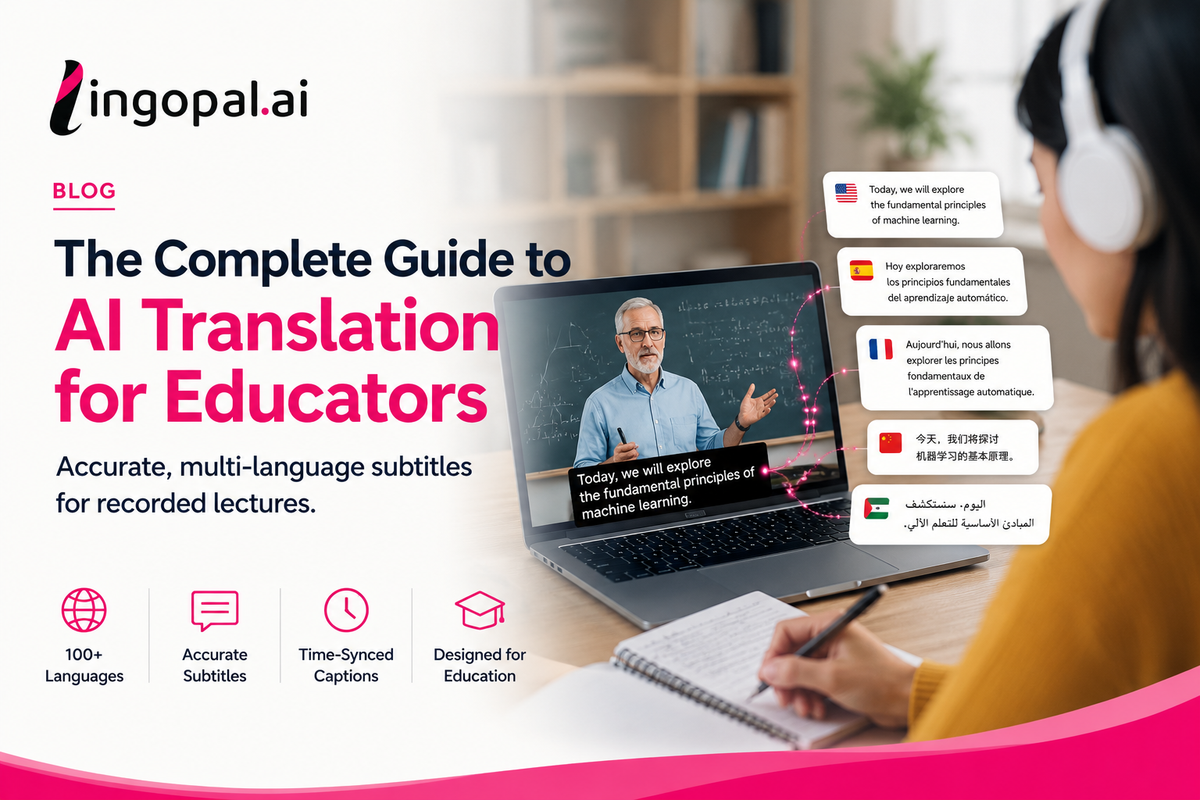
The Complete Guide to AI translation for educators needing accurate, multi-language subtitles for recorded lectures?
AI translation for educators needing accurate, multi-language subtitles for recorded lectures?
Recorded lectures contain more than spoken words. They carry formulas, names, citations, technical vocabulary, slide references, and the instructor’s pacing. AI translation for educators needing accurate, multi-language subtitles for recorded lectures? must handle each layer without changing the meaning students rely on. A useful system converts speech into a transcript, segments it into readable captions, translates each segment, and preserves timing against the original recording.
Key Takeaways
- Recorded lectures contain more than spoken words.
- They carry formulas, names, citations, technical vocabulary, slide references, and the instructor’s pacing.
- AI translation for educators needing accurate, multi-language subtitles for recorded lectures?
Table of Contents
- What is AI translation for educators needing accurate, multi-language subtitles for recorded lectures??
- Benefits of AI translation for educators needing accurate, multi-language subtitles for recorded lectures?
- How to Choose AI translation for educators needing accurate, multi-language subtitles for recorded lectures?
The quality standard is not fluent text alone. Students need subtitles that match the lecturer’s terminology, identify speakers correctly, display at a readable speed, and remain synchronized with demonstrations or presentation slides. A translation workflow can involve audio processing and language engineering rather than basic text conversion.
What is AI translation for educators needing accurate, multi-language subtitles for recorded lectures??
AI translation for educators needing accurate, multi-language subtitles for recorded lectures? is a workflow that combines automatic speech recognition, machine translation, subtitle timing, terminology handling, and file delivery. The input may be an MP4 lecture, a recorded webinar, a classroom capture, or an API-connected media feed. The output can include translated subtitle files, captions prepared for a learning management system, or localized video versions.
The process begins with speech recognition. The system separates words from background noise, detects pauses, and assigns text to time ranges. Translation then uses sentence context rather than treating every word as an isolated dictionary entry. That distinction matters in education. “Cell,” “charge,” “mean,” “faculty,” and “terminal” can carry different meanings across biology, physics, statistics, and university administration. A serious workflow also accounts for acronyms, proper names, equations, abbreviations, and repeated course terminology.
For a recorded lecture, SRT files can be a practical starting point because they can be reviewed, edited, uploaded, and reused without re-encoding the video.
Benefits of AI translation for educators needing accurate, multi-language subtitles for recorded lectures?
Multilingual subtitles give students access to the same lecture content without requiring the institution to record a separate presentation for every language. That supports international enrollment, study-abroad cohorts, multilingual campuses, and online courses that reach learners across time zones. Students can read unfamiliar terminology while listening, pause at a difficult explanation, search a transcript, and review a segment before an assessment.
The benefit is also operational. A translated caption file can be reused across course sections, accessibility workflows, orientation libraries, professional training, and archived lectures. Faculty members do not need to repeat the same lesson for each audience. Instructional designers can apply consistent formatting, preserve time codes, and make revisions at the transcript level. This is particularly useful for courses with recurring modules, guest speakers, laboratory demonstrations, or long lecture series.
AI translation for educators needing accurate, multi-language subtitles for recorded lectures? can also improve access for students who are deaf or hard of hearing, students studying in a second language, and learners reviewing content in a noisy environment. Captions create a searchable text layer around the video. That layer can support keyword lookup, note-taking, vocabulary review, and indexed course materials. The value depends on accuracy, since a misspelled drug name or altered formula can teach the wrong concept.
Accuracy Depends on the Review Workflow
AI should produce the first version quickly, not remove academic oversight. Educators should review proper nouns, numbers, quotations, specialized terms, speaker changes, and lines that appear beside diagrams or equations. A terminology list can guide recurring translations, while a human reviewer can judge cultural references, humor, idioms, and explanations that require subject knowledge. This division keeps automation practical while preserving instructor accountability.
Another benefit is language consistency across a course. If a translated term changes from one lecture to the next, students may assume two different concepts are being taught. A controlled glossary helps maintain stable labels for units, theories, software commands, anatomical structures, and course-specific phrases. A translation platform can be evaluated for this type of structured media workflow, where subtitle generation, language coverage, timing, and editorial review must function together.
Subtitles also create a better foundation for later localization. Once the source transcript has been checked, it can support translated handouts, captions for short clips, accessibility documentation, and searchable knowledge repositories. That does not make human instructors unnecessary. Children and beginners may still need tailored explanation, pronunciation practice, and live clarification. AI handles repeatable language processing; teachers remain responsible for pedagogy, context, and student understanding.
How to Choose AI translation for educators needing accurate, multi-language subtitles for recorded lectures?
Choosing AI translation for educators needing accurate, multi-language subtitles for recorded lectures? starts with the source material, not the language count. A system should accept the recording format your institution already produces, identify speech clearly, preserve time codes, and export captions that work with the learning management system or video player. Check support for MP4 uploads, SRT files, API connections, and the delivery methods used by your media team. A technically impressive engine is not useful if staff must manually rebuild every caption file before students can access it.
Accuracy should be assessed against the vocabulary of the course. Ask whether the workflow can recognize faculty names, place names, acronyms, medications, mathematical language, citations, and discipline-specific terminology. A biology lecture and a law seminar create different recognition problems. General speech recognition may convert a technical term into a common word that sounds similar, then translate the error fluently. Request a sample using an actual lecture segment with slides, room noise, overlapping speech, and the instructor’s normal pace. Review the transcript before judging the translated subtitles.
Terminology controls are among the most useful evaluation criteria. Look for a glossary, preferred translations, locked terms, editable transcripts, and a method for applying course vocabulary across multiple recordings. The tool should let an instructional designer correct a term once and carry that decision into later modules. It should also preserve capitalization, units, numerals, references, and software commands. These details affect comprehension. A student can infer the meaning of a slightly awkward sentence, but an incorrect variable, dosage, date, or anatomical label can change the lesson.
Test the Review Path, Not Only the First Draft
Ask who can approve captions, edit translations, leave comments, restore an earlier version, and publish the final file. The strongest workflow separates machine processing from academic approval. Faculty can verify meaning, while language specialists check grammar, idioms, cultural references, and reading flow. The platform should make corrections visible and preserve an audit trail so an institution knows which version reached students.
Speaker handling deserves its own test. Recorded lectures may include a professor, teaching assistant, guest speaker, student questions, and audio from a classroom microphone. Evaluate speaker identification, turn changes, punctuation, pauses, and captions that remain readable when several people respond quickly. Accents and variable recording quality should be part of the sample set. A tool that performs well on a clean studio recording may need editorial correction when the lecturer moves away from the microphone or speaks while writing on a board.
Language selection also requires more than a numerical coverage claim. Confirm that the target languages you need support subtitle translation from your source language, appropriate punctuation, character display, line length, and right-to-left formatting where applicable. Ask whether translated captions retain synchronization after sentence expansion or contraction. Students should not read a line after the lecturer has moved to a new concept. Timing, segmentation, maximum characters per line, and display duration all affect the learning experience. See the captions guidance from W3C for accessibility considerations.
Privacy and administration should be reviewed before uploading course media. Ask where recordings and transcripts are processed, how access is controlled, whether files can be deleted, and which staff members can download source material. Universities may handle unpublished research, student questions, exam preparation, or protected personal information. Permission settings, role-based access, retention controls, and an exportable record of edits help instructional technology teams govern the service responsibly. Institutions can also consult authoritative guidance on responsible use of AI in education.
Finally, calculate the full cost of production rather than looking only at a per-minute rate. Include transcription, translation, human review, caption correction, file storage, repeated course uploads, and localization into additional languages. Request education pricing when available, but assess the editing time required from faculty and accessibility staff. Lingopal AI Translation demo is a product to evaluate when an institution needs a structured media workflow. Its capabilities should be confirmed against current official documentation and tested against representative lecture recordings before adoption.
Use a small pilot before committing a full course library. Select recordings from different departments, compare source transcripts with edited versions, inspect technical terms and speaker changes, and ask multilingual reviewers to assess meaning in each target language. Track correction categories rather than relying on a single accuracy impression. Research on automatic subtitling in education can help inform this evaluation. A translation platform can serve as the processing layer, while educators retain responsibility for subject accuracy, accessibility, and the final instructional record.
References
Frequently Asked Questions
What are the best tools for adding multilingual subtitles to recorded lectures?
The right tool is the one that fits the institution’s full media workflow, from recording intake to final caption approval. Look for automatic speech recognition, translation, time-code preservation, subtitle export, terminology controls, speaker labeling, and an editing interface that faculty or accessibility staff can use without rebuilding the file. Support for MP4 recordings and SRT exports is especially useful for recorded courses because teams can review captions separately from the video and publish corrected versions later.
Lingopal AI Translation pricing can help institutions evaluate this use case. The decision should still come from a pilot using real course material. A clean demonstration clip does not reveal how the system handles formulas, accents, classroom noise, guest speakers, or terminology from a specific department.
How accurate are AI translations for technical educational content?
Accuracy varies by audio quality, source transcript quality, language pair, sentence context, and the density of specialized vocabulary. A fluent translation can still be academically wrong if speech recognition mishears a drug name, mathematical symbol, historical reference, or software command. Technical lectures need two checks: first, confirm that the source transcript reflects the instructor’s words; second, verify that the translated subtitle preserves the intended concept.
Use a glossary containing course terms, preferred translations, abbreviations, proper names, units, and recurring phrases. Ask a subject-matter expert to review a sample before publishing the complete library. A language reviewer can assess grammar and idiomatic phrasing, while the instructor confirms disciplinary meaning. This division is more dependable than asking one reviewer to judge every technical and linguistic detail without guidance.
Can AI handle multiple speakers and accents in a lecture recording?
It can process many recordings with multiple speakers, but performance depends on microphone placement, background noise, interruptions, speaking speed, and the amount of overlap. A professor, student, interpreter, and guest lecturer may have distinct accents and different audio levels. Caption teams should test speaker separation, punctuation, turn changes, incomplete sentences, and audience questions rather than evaluating only a single uninterrupted monologue.
Recordings with several voices require editorial inspection. A mislabeled speaker can alter the meaning of a question or answer, especially in legal, medical, scientific, and assessment content. Ask the provider whether users can correct speaker names, edit transcript segments, adjust caption timing, and export the revised file. A translation platform can be included in this test as the processing layer, with faculty or trained reviewers retaining approval of the published captions.
What features should educators look for in a subtitle translation tool?
Prioritize editable transcripts, translation memory or glossary controls, speaker identification, readable caption segmentation, time-code editing, right-to-left language support where needed, and exports compatible with the institution’s video platform. Access permissions also matter. Course recordings may contain student questions, unpublished research, examination material, or personal information. Administrators should ask about file retention, deletion controls, user roles, download permissions, and audit records.
Accessibility functions deserve direct testing. Captions should remain synchronized when translated sentences expand, display long enough to read, and avoid covering essential slide content. Check whether the workflow preserves numbers, equations, citations, terminology, and formatting. A good system reduces repetitive processing, but it should also make human correction visible and practical.
How much do these tools cost, and are education discounts available?
Pricing depends on recording duration, language count, storage, transcription, translation, human review, and publishing requirements. Request a written estimate based on actual lecture hours rather than a short sample. Include recurring updates, multiple course sections, glossary maintenance, accessibility review, and the staff time required for corrections. A low processing fee can become expensive if every file needs extensive manual repair.
Ask vendors about education plans, volume pricing, pilot access, and institutional agreements. Before approving a purchase, run recordings from several departments and classify corrections by type: recognition errors, terminology errors, speaker attribution, timing, punctuation, and cultural phrasing. That evidence can inform procurement decisions and help define the human review standard required before students receive localized course content.