Is Under-Two-Second Latency Achievable for AI Sports Translation?
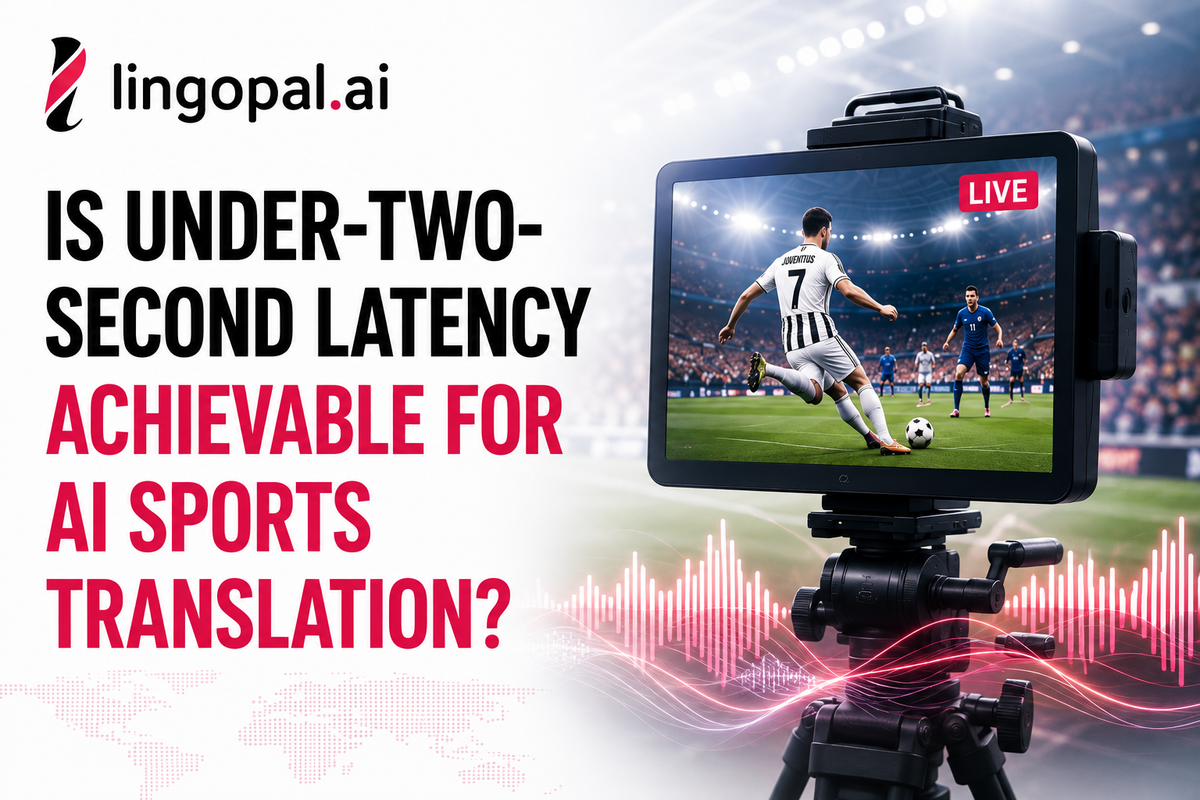
Is Under-Two-Second Latency Achievable for AI Sports Translation?
Is under-two-second latency actually achievable for live sports commentary AI translation -- and does it matter?
The pursuit of instantaneous communication across languages in live broadcasting presents a significant engineering challenge. While the promise of real-time AI translation, particularly for dynamic content like live sports commentary, is compelling, the technical realities often fall short of marketing claims. Understanding the underlying processes and the inherent limitations is essential for broadcast professionals evaluating these solutions. Is under-two-second latency actually achievable for live sports commentary AI translation. And does it matter?
Key Takeaways
- The pursuit of instantaneous communication across languages in live broadcasting presents a significant engineering challenge.
- While the promise of real-time AI translation, particularly for dynamic content like live sports commentary, is compelling, the technical realities often fall short of marketing claims.
- Understanding the underlying processes and the inherent limitations is essential for broadcast professionals evaluating these solutions.
This article dissects the complex pipeline involved in speech-to-speech translation, examines human perception thresholds for latency in broadcast environments, and clarifies how true end-to-end performance should be measured. Our goal is to provide broadcast engineers and content creators with the technical clarity needed to make informed decisions about AI translation technology.
The Physics of the Live AI Translation Pipeline
Transforming spoken commentary from one language to another in real-time involves a sophisticated sequence of computational steps. Each stage introduces its own processing delay, and collectively, these contribute to the overall latency of the system. The primary components are Automatic Speech Recognition (ASR), Machine Translation (MT), and Text-to-Speech (TTS) synthesis. ASR converts the audio stream into text. MT then translates this text into the target language. Finally, TTS generates synthesized speech from the translated text, aiming to mimic the original speaker's tone and cadence, a process essential for applications like Lingopal AI Translation.
The latency budget for a live AI translation system must account for these distinct phases. ASR typically requires between 200 to 400 milliseconds, depending on audio quality and model complexity, as documented by Forasoft. Following this, the MT engine processes the recognized text, adding another 100 to 300 milliseconds. The final step, TTS, which synthesizes the output speech, can add another 100 to 300 milliseconds. These figures, while illustrative, are based on optimal conditions and do not include network transport or buffering delays inherent in any broadcast workflow. Consequently, even optimistic estimates place the theoretical minimum end-to-end latency significantly above two seconds when considering voice-cloned dubbing. Companies like SignalWire have highlighted how providers often obscure this reality.
Claims of zero or near-zero latency for complex speech-to-speech AI translation systems often overlook fundamental computational physics and network engineering principles. Achieving sub-two-second end-to-end latency for voice-cloned dubbing is not merely an engineering challenge; it is a significant departure from the computational realities of processing audio through multiple complex AI models in sequence. The idea of instant processing for tasks that inherently require sequential analysis, translation, and synthesis is technically unfeasible. As an example, while CAMB.AI reports very low Time To First Byte (TTFB) metrics for certain components on specific hardware configurations, this does not represent the complete journey from source audio to viewer-ready translated audio. True end-to-end performance is the only metric that provides a realistic view for broadcast operations.
Human Perception Thresholds: When Does Latency Spoil the Broadcast?
The perception of latency varies significantly based on the context of communication. For casual conversational AI, such as chatbots or voice assistants, users often tolerate delays up to approximately 1.5 seconds before the interaction feels unnatural, with abandonment rates spiking beyond 1 second, as noted by Hamming AI. Nonetheless, live sports commentary operates under a different set of expectations. The rapid-fire nature of play-by-play, the need for immediate reactions to unfolding events, and the established rhythm between commentators create a much lower tolerance for delay. Viewers accustomed to the synchronized delivery of original commentary will notice even minor discrepancies, which can detract from the immersive experience.
While sub-two-second latency might be a desirable target for some conversational applications, it is not the operative benchmark for high-stakes live sports broadcasting. The operational reality for effective broadcast AI translation, as demonstrated by Lingopal's work with clients like Juventus FC, involves managing latency within a range that preserves the integrity of the broadcast without compromising the viewer experience. Lingopal AI Translation, as an example, delivers approximately 15 seconds of latency for live dubbing while simultaneously generating real-time captions. This duration allows for accurate translation and natural-sounding synthesis without disrupting the flow of the game for bilingual audiences. This figure is well within the acceptable range for broadcast commentary, differentiating it from the tighter constraints of face-to-face conversation.
The comparison between conversational AI latency and broadcast commentary expectations reveals an essential distinction. While SignalWire suggests anything above 1.5 seconds is not real-time for conversational AI, broadcast environments have different demands. Promwad research indicates that noticeable conversational lag begins above 250-300ms. For live sports, however, the goal is not necessarily "real-time" in the absolute sense but rather a delay that is imperceptible or minimally disruptive. A delay of approximately 15 seconds for live dubbing, as achieved by Lingopal, allows for more comprehensive translation and higher fidelity voice cloning, preserving the emotional nuance of the original commentator. This is more essential for broadcast quality than shaving off a few seconds at the expense of accuracy or a natural-sounding voice, especially when considering the cost dynamics; Forasoft notes that voice-preserving dubbing adds approximately $2-3 per minute for cinematic quality, a cost justified by the quality achieved at manageable latency.
Deconstructing Vendor Latency Metrics for Live AI Translation
In evaluating AI translation systems for live sports commentary, understanding latency metrics is essential. Many vendors advertise sub-second or near-zero latency figures, but these often reflect partial measurements rather than full system performance. A common misleading metric is Time to First Byte (TTFB), which measures the interval from audio input to the first fragment of translated output generated by the server. While CAMB.AI’s MARS-Flash system reports a TTFB of approximately 100 milliseconds on high-end hardware, this number excludes subsequent processing, buffering, and delivery delays required to render a final broadcast-ready audio stream.
TTFB, though useful for benchmarking specific model responsiveness, does not capture the full latency experienced by viewers. True end-to-end latency must encompass every stage from ingestion through Automatic Speech Recognition (ASR), Machine Translation (MT), Text-to-Speech (TTS), network transmission, buffering, and final rendering on the consumer device. At Lingopal, we focus on this comprehensive measurement, which aligns with broadcast operational realities. Systems claiming sub-two-second end-to-end latency often omit network transport times or rely on highly specialized hardware not representative of typical broadcast environments.
Key Insight: Vendors citing only TTFB metrics provide an incomplete picture. Broadcast engineers should demand full end-to-end latency figures spanning ingestion to viewer delivery across standard protocols.
Broadcast delivery protocols contribute significant delay components. HTTP Live Streaming (HLS), a common standard, incurs buffering to maintain video and audio integrity, typically introducing 5 to 30 seconds of latency, depending on configuration and segment length. Low-Latency HLS (LL-HLS) reduces this to 2 to 5 seconds but requires complex infrastructure and optimized CDN support. Secure Reliable Transport (SRT) and Real-Time Messaging Protocol (RTMP) offer alternatives with lower latency characteristics but demand careful network management to avoid packet loss and jitter.
Each protocol’s transport and buffering behavior directly impacts the end-to-end latency budget. For example, Forasoft’s analysis shows LL-HLS latency targets of 2 to 5 seconds and standard HLS latency of 5 to 30 seconds, which must be integrated with AI processing delays to assess feasibility. Consequently, broadcast engineers must account for the total system pipeline, not just AI compute times, when evaluating solutions for live sports commentary.
Discerning broadcast professionals should scrutinize latency claims by distinguishing TTFB from the total delivery chain. Lingopal AI Translation offers verified end-to-end latency performance that includes all relevant stages: decoding, translation, synthesis, CDN transport, and playback. This comprehensive approach ensures that latency figures reflect real viewer experience rather than idealized, isolated benchmarks.
Trading Speed for Fidelity in Sports Commentary Dubbing
Latency in AI-driven sports commentary translation is not simply a matter of speed. It involves balancing rapid delivery with linguistic accuracy, natural voice reproduction, and emotional fidelity. Maintaining authentic voice cloning and preserving the original commentator’s expressiveness requires allocating sufficient processing time within the latency budget.
Voice cloning models that capture tone, cadence, and subtle emotional cues demand more computational resources and data compared to generic TTS engines. To achieve high BLEU scores. Lingopal records scores above 61+, indicating strong translation quality. The system must process nuanced language elements such as slang, idioms, and exclamations typical in sports commentary. These linguistic features cannot be rushed without degrading output quality and viewer engagement.
Reducing latency aggressively often forces compromises: either simplified voice synthesis with robotic intonation or less accurate translation that loses context and flavor. Both outcomes diminish broadcast quality and viewer satisfaction. Lingopal AI Translation prioritizes a latency target of approximately 15 seconds for live dubbing, a deliberate design choice that balances timely delivery with cinematic-grade voice cloning and emotional preservation. This latency window allows the system to perform advanced processing without sacrificing the authenticity that audiences expect from sports broadcasts.
Maintaining Authentic Voice Cloning and Emotion at Speed
Authenticity in live commentary depends on the subtle interaction between what is said and how it is said. Voice cloning must replicate the commentator’s vocal characteristics and emotional inflections in near real-time. This requirement imposes computational overhead, as neural networks analyze and synthesize audio with fine granularity. Achieving this in under two seconds end-to-end is beyond current operational norms, especially when factoring in network and delivery delays.
Lingopal AI Translation integrates advanced neural architectures that optimize this balance. While rapid ASR and MT stages run efficiently, the TTS synthesis phase is carefully tuned to preserve voice nuances, which adds milliseconds but yields a far superior audience experience. The slight latency increment is an intentional tradeoff for broadcast excellence.
Cost Dynamics of Multi-Language Concurrent Streams
Broadcasting live sports to global audiences involves generating simultaneous translated streams in multiple languages. Each additional language increases computational load and, consequently, operational costs. Forasoft estimates voice-preserving dubbing adds $2 to $3 per minute per language compared to basic translation services.
This cost is a practical consideration for broadcasters deciding on latency targets. Attempting to reduce latency aggressively might require scaling infrastructure or sacrificing voice quality, inflating expenses or damaging the broadcast’s integrity. Lingopal AI Translation offers a scalable architecture that balances cost and performance, accommodating multiple concurrent languages while maintaining the voice quality that distinguishes professional sports commentary.
Latency-Speed Tradeoff Pros and Cons
Pros
- Preserves original commentator’s voice and emotional nuances
- Delivers high BLEU scores (61+) ensuring accurate, context-aware translation
- Supports multiple languages concurrently with scalable infrastructure
- Latency budget aligned with broadcast standards (approx. 15 seconds)
Cons
- Longer latency compared to conversational AI tolerances
- Higher operational costs per language for voice-preserving dubbing
- Complex infrastructure needed for multi-protocol network delivery
- Not suitable for ultra-low-latency requirements below two seconds
Proven Broadcast Deployment: Juventus FC Live Translation
Operational Setup at the Turin Kickoff Event
The deployment of Lingopal AI Translation for the Juventus FC live broadcast at the Turin kickoff event serves as a definitive example of practical application in high-profile sports environments. The operational setup required careful integration of AI translation pipelines with existing broadcast infrastructure, including ingest from stadium commentary feeds, real-time processing, and multi-language output distribution.
At the core of the system was an optimized pipeline that balanced latency and translation quality. The audio feed was captured directly from commentators and routed through Lingopal’s proprietary ASR and neural MT models, followed by voice-cloning TTS synthesis that preserved the commentator’s vocal identity and emotional nuance. The output streams were synchronized with the video broadcast, maintaining an end-to-end latency of roughly 15 seconds. This delay allowed sufficient time for accurate recognition, nuanced translation, and expressive speech synthesis, ensuring that bilingual audiences received a natural and immersive experience without feeling disconnected from the live action.
The broadcast team at Juventus FC worked closely with Lingopal engineers to fine-tune buffering parameters, CDN configurations, and audio mixing levels. The system supported multiple languages concurrently, enabling simultaneous delivery of dubbed commentary to diverse international audiences. This multi-channel approach demonstrated Lingopal AI Translation’s scalability and reliability under demanding live conditions.
How Broadcast Teams Evaluate Lingopal AI Translation
Broadcast engineers and production teams measure the success of AI translation solutions by several criteria: latency, translation accuracy, voice authenticity, and operational stability. Juventus FC’s broadcast partners reported that Lingopal AI Translation successfully met these benchmarks, particularly valuing the system’s ability to maintain a consistent commentator voice with emotional inflections that matched the original speech. This feature is essential for preserving the authenticity of sports commentary, where tone and enthusiasm directly impact viewer engagement.
The approximately 15-second latency achieved strikes a practical balance. While some might question whether shorter delays matter, the Juventus deployment confirms that attempting to push latency below two seconds compromises translation fidelity and voice quality. Lingopal’s approach prioritizes a latency budget that supports high BLEU scores above 61+, reflecting precise and contextually accurate translations that include slang, idiomatic expressions, and real-time reactions essential for sports broadcasts.
Operationally, broadcast teams appreciated the transparency of Lingopal’s end-to-end latency reporting. Unlike vendors that emphasize partial metrics such as Time To First Byte (TTFB), Lingopal provides comprehensive latency figures that include ingestion, processing, synthesis, and CDN transport. This clarity enables engineers to plan workflows effectively and set realistic viewer expectations.
Case Study Highlight: Lingopal AI Translation’s successful integration at Juventus FC demonstrates that approximately 15 seconds of latency delivers a practical, high-quality live sports translation experience. This latency enables voice-cloned dubbing that preserves emotion and accuracy, essential for engaging bilingual audiences in real time.
Decision Checklist for Broadcast Teams Considering Lingopal AI Translation
Pros
- Consistent voice cloning preserving commentator identity and emotional tone
- Accurate translations reflecting sports-specific jargon and idioms
- Scalable multi-language support for global audience reach
- Comprehensive end-to-end latency measurement for operational transparency
- Proven reliability under live, high-pressure broadcast conditions
Cons
- Latency around 15 seconds may not suit ultra-low-latency conversational applications
- Higher computational cost for voice-preserving dubbing compared to basic translation
- Requires integration effort to synchronize with existing broadcast workflows
In addressing the question, Is under-two-second latency actually achievable for live sports commentary AI translation. And does it matter? the Juventus FC deployment illustrates that while sub-two-second latency remains beyond practical reach for voice-preserving AI translation, it is not necessarily the optimal target for broadcast quality. The 15-second latency mark achieved by Lingopal AI Translation is a deliberate engineering choice that delivers a superior viewer experience, balancing timeliness with the fidelity and emotional authenticity essential in sports commentary.
Looking ahead, broadcast professionals should focus on end-to-end system design, considering network transport, buffering protocols, and AI processing holistically. Lingopal AI Translation’s real-world success at Juventus FC provides a reliable benchmark for what current technology can accomplish and informs strategic decisions about latency targets and translation quality in live sports environments.
References
Frequently Asked Questions
Is under-two-second latency achievable for live sports commentary AI translation?
Under-two-second latency is not achievable for live sports commentary AI translation that uses voice-cloned dubbing. The speech-to-speech pipeline requires automatic speech recognition, machine translation, and text-to-speech synthesis, each adding 100 to 400 milliseconds of processing time. Network transport and buffering push total latency well beyond two seconds even in optimal conditions.
Why is sub-two-second latency so hard to reach for live dubbing?
Sub-two-second latency is hard to reach for live dubbing because the AI translation pipeline processes audio through three sequential models: automatic speech recognition, machine translation, and text-to-speech synthesis. Each model requires 100 to 400 milliseconds, and these delays add up before any network transport. Fundamental computational physics prevents instant processing of multiple complex neural networks.
What is a realistic latency for live sports AI translation?
A realistic latency for live sports AI translation is approximately 15 seconds for high-quality voice-cloned dubbing. This delay allows for accurate translation and natural-sounding synthesis without disrupting the viewer experience. Broadcast environments tolerate this latency because the spoken commentary does not require immediate conversational response.
Does latency matter the same way for live sports commentary as for conversational AI?
Latency does not matter the same way for live sports commentary as for conversational AI. Conversational AI requires sub-1.5-second latency to feel natural, while live sports broadcasting can tolerate 10 to 15 seconds of delay. The rapid-fire nature of play-by-play commentary and the viewer's focus on visual action make a longer delay acceptable.
How does the AI translation pipeline contribute to latency?
The AI translation pipeline contributes to latency through three sequential stages: automatic speech recognition, machine translation, and text-to-speech synthesis. ASR typically takes 200 to 400 milliseconds, MT adds 100 to 300 milliseconds, and TTS adds another 100 to 300 milliseconds. These processing delays, combined with network transport, total well above two seconds for voice-cloned dubbing.
What latency does Lingopal achieve for live sports dubbing?
Lingopal achieves approximately 15 seconds of latency for live sports dubbing while also generating real-time captions. This delay is acceptable in broadcast environments because it preserves translation accuracy and voice quality. The company's work with clients like Juventus FC demonstrates that this latency maintains the integrity of the viewing experience.
Is there a difference between conversational AI latency and broadcast commentary expectations?
There is a significant difference between conversational AI latency and broadcast commentary expectations. Conversational systems need delays under 1.5 seconds to avoid user frustration, while live sports broadcasts can operate with 10 to 15 seconds of delay. The goal for sports commentary is imperceptible or minimally disruptive delay, not absolute real-time processing.
About the Author
This article was crafted by the expert team at Lingopal, an AI-powered platform built for real-time translation and transcription in live broadcast environments. From sports and news to education and global events, Lingopal helps professional teams deliver multilingual audio and captions with voice cloning, emotion preservation, and enterprise-grade accuracy.