Lingopal at IBC 2026: Making Live Content Accessible in Any Language
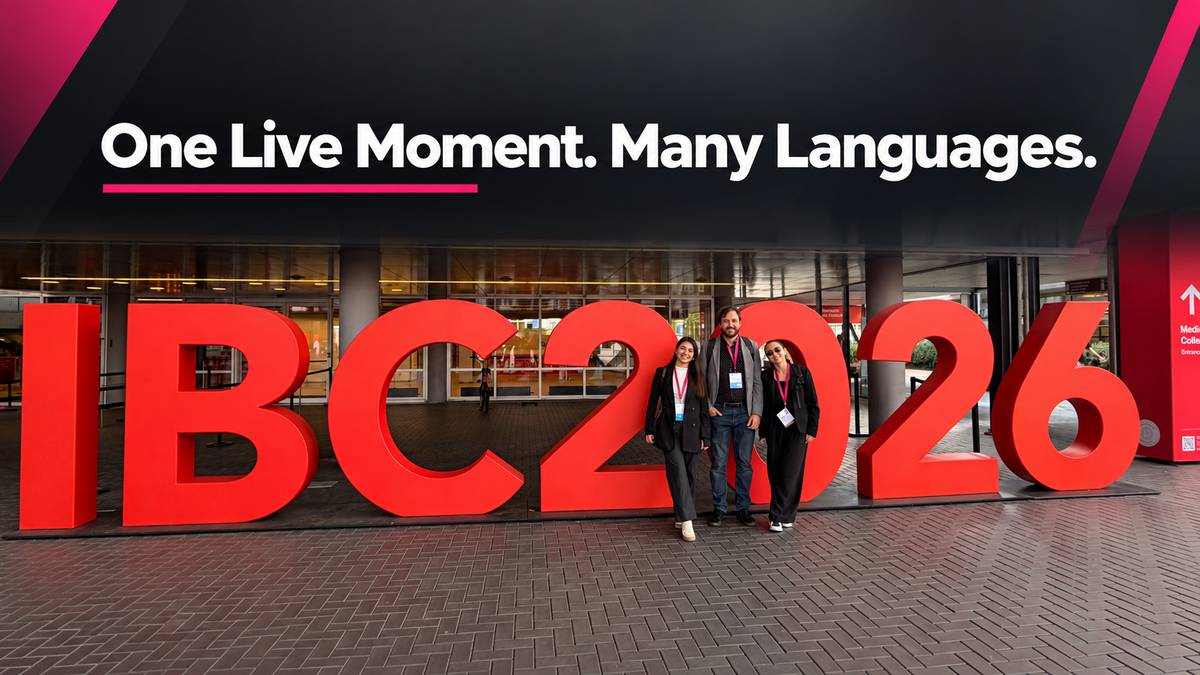
Lingopal participated in IBC 2026 in Amsterdam to demonstrate how AI-powered translation, captioning, and dubbing can help broadcasters, sports organizations, and content platforms reach multilingual audiences in real time.
Throughout the event, Lingopal showcased live and on-demand localization, participated in industry discussions, collaborated with partners including Grabyo, and met with broadcasters and technology companies looking for practical ways to make their content more accessible worldwide.
What Did Lingopal Showcase at IBC 2026?
At IBC 2026, Lingopal demonstrated how broadcasters and content owners can translate live and recorded content into multiple languages while preserving the speaker’s voice, tone, meaning, and emotional delivery.
Visitors to Stand 14.B52 learned how Lingopal supports:
- Real-time AI translation and dubbing
- Multilingual audio for live broadcasts
- Live captioning and accessibility
- Video-on-demand translation and dubbing
- Localization for sports, news, OTT, FAST, and digital content
- Integration with existing cloud and broadcast workflows
The goal is simple: help organizations make one piece of content accessible to many different audiences without rebuilding their entire production workflow.
Why Is Live AI Translation Important for Broadcasters?
Live AI translation helps broadcasters make sports, news, interviews, and other time-sensitive content available to international viewers as the event happens.
Traditional localization often takes place after production. That approach can work for recorded programming, but it limits the global potential of live content. Viewers increasingly expect to follow important moments in their preferred language without waiting for a translated version.
Lingopal brings localization closer to the core production workflow, helping broadcasters create multilingual outputs with low latency while maintaining the energy and context of the original content.
How Does Lingopal Preserve Emotion in AI Dubbing?
Lingopal’s technology is designed to translate more than words. It aims to preserve the voice, tone, pace, and emotional intensity of the original speaker.
This is particularly important for live sports. A goal, a final lap, or a decisive moment loses much of its impact if the translated voice sounds flat or disconnected from the action.
At IBC, Lingopal emphasized an important principle:
If you lose the emotion of live sports, you lose part of the experience.
By maintaining the character of the original broadcast, multilingual content can feel more natural and engaging to viewers.
Lingopal and Grabyo Demonstrated Live Motorsport Localization
One of Lingopal’s key IBC highlights was its participation in a live demonstration involving Grabyo and the Targa Newfoundland rally.
The workflow showed how one live event could be produced, localized, and distributed for different languages and audiences. Lingopal provided live French localization, demonstrating how real-time translation can become part of a cloud-based production and distribution workflow.
Motorsport is a demanding use case for AI localization because it combines:
- Fast and unpredictable action
- Specialist terminology
- Multiple speakers
- Background noise
- Rapid changes in tone
- High audience expectations around latency
The demonstration illustrated how broadcasters and rights holders can use cloud production and AI localization together to create multilingual live outputs more efficiently.
What Opportunities Does Multilingual Live Streaming Create?
Multilingual streaming can help media companies expand their reach without producing completely separate broadcasts for every market.
Potential use cases include:
- International sports coverage
- Breaking news
- Live interviews
- Press conferences
- Creator streams
- Alternative commentary
- Corporate communications
- Educational content
- Faith-based broadcasts
- Social and digital video
For sports organizations and rights holders, this can make content available to fans who may already follow a team, athlete, or competition but cannot fully engage with coverage in its original language.
For broadcasters and streaming platforms, multilingual content can also support audience growth, accessibility, distribution partnerships, and new commercial opportunities.
Lingopal Joined the Conversation About the New Global Viewer
IBC was also an opportunity to discuss how audience expectations are changing.
Bartell Cope, VP of GTM at Lingopal, joined the session “The New Global Viewer” on the Future Tech Stage. The discussion explored how emerging technology is changing the way media companies create and distribute content for audiences across different markets.
Today’s viewers discover content across platforms, countries, and languages. As a result, language can no longer be treated only as a final post-production step. It is increasingly becoming part of the infrastructure used to produce, distribute, and monetize content.
How Can Broadcasters Evaluate AI Translation Quality?
A technically successful translation is not automatically a good viewer experience.
Broadcasters evaluating live AI localization should consider:
- Translation accuracy: Is the meaning conveyed correctly?
- Latency: Does the translated audio remain synchronized with the live action?
- Voice quality: Does the output sound clear and natural?
- Emotion and tone: Does it reflect the energy of the original speaker?
- Terminology: Can the system handle names, brands, teams, and industry-specific vocabulary?
- Workflow integration: Can it work within the broadcaster’s current production environment?
- Scalability: Can the organization add languages, channels, or events efficiently?
- Audience experience: Would a viewer choose to continue watching the localized version?
These factors help organizations move beyond technical testing and evaluate whether the experience is genuinely ready for regular production.
From Industry Conversations to Real-World Workflows
During IBC, the Lingopal team met with broadcasters, production companies, technology providers, rights holders, and other media professionals exploring multilingual content.
Many conversations reflected the same shift: localization is moving from an optional post-production service to an essential part of modern content distribution.
Organizations are now asking how they can:
- Reach more international viewers
- Make live events accessible in additional languages
- Localize more content without increasing operational complexity
- Add multilingual audio to existing workflows
- Preserve brand identity, meaning, and emotion
- Turn successful pilots into repeatable production systems
Lingopal helps answer those questions with technology built for both live and on-demand content.
Sustainability at IBC 2026
Technology was not the only focus at the Lingopal stand.
The team also distributed tote bags made from 100% recycled materials, which became one of the stand’s most popular giveaways. It was a small but intentional choice reflecting Lingopal’s belief that event merchandise should be useful, thoughtfully produced, and more sustainable.
What Was Lingopal’s Main Message at IBC 2026?
Lingopal’s message at IBC was clear:
Language should not be a barrier between content and its audience.
With AI-powered live translation, captioning, and dubbing, broadcasters can make one live moment available in many languages while protecting the meaning and emotional impact that make the content worth watching.
This is what Lingopal means by treating language as infrastructure.
Frequently Asked Questions
What is Lingopal?
Lingopal is an AI-powered localization platform for live and recorded content. It helps organizations translate, caption, and dub content into multiple languages while preserving the original speaker’s voice, tone, and emotion.
Does Lingopal support live translation?
Yes. Lingopal supports real-time translation and dubbing for live content, including sports, news, events, interviews, corporate communications, and digital broadcasts.
Can Lingopal translate recorded videos?
Yes. Lingopal provides localization for video-on-demand content, including AI dubbing, translated audio, subtitles, and captions.
How many languages does Lingopal support?
Lingopal supports more than 120 languages, helping content owners reach audiences across different markets and regions.
Can Lingopal integrate with existing broadcast workflows?
Lingopal is designed to work with modern broadcast, cloud production, streaming, and distribution workflows. The specific integration depends on the organization’s production environment and delivery requirements.
Does AI dubbing preserve the original speaker’s emotion?
Lingopal is designed to retain important characteristics of the original delivery, including voice, tone, pace, and emotional intensity. This helps the translated version feel connected to the original content.
Who can use Lingopal?
Lingopal works with broadcasters, sports organizations, rights holders, OTT and FAST platforms, production companies, educational institutions, corporations, creators, and other organizations producing live or recorded content.
Make Your Content Accessible in Any Language
IBC 2026 may be over, but the conversations about multilingual audiences are only beginning.
If your organization wants to bring live or recorded content to new markets, Lingopal can help you explore the right localization workflow for your audience, platform, and production environment.
One live moment. Many languages.