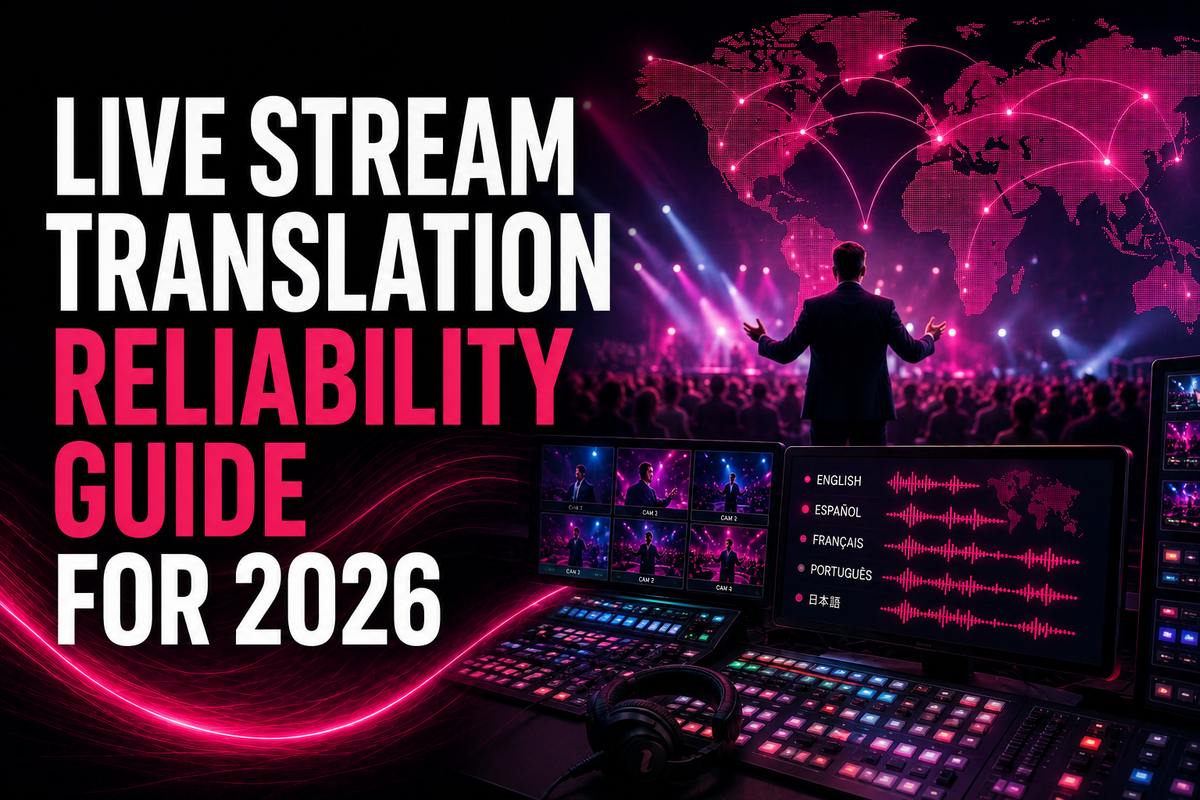
Live Stream Translation Reliability Guide for 2026
How to Build Low-Latency Multilingual Broadcast Workflows That Stay Stable at Scale
Live stream translation is reliable when the entire source-to-viewer workflow—not just the AI model—is designed for predictable latency, stable language outputs, accurate translation, continuous monitoring, and graceful recovery when something fails.
That distinction matters.
A translation engine can perform perfectly while the multilingual broadcast still fails because of poor source audio, network instability, incorrect routing, caption drift, encoding delays, or player buffering.
For media organizations in 2026, streaming reliability therefore depends on the complete chain:
Source Audio → Speech Recognition → Translation → Voice / Captions → Encoding → Distribution → Player → Viewer
Every link affects what audiences ultimately hear and see.
This guide explains how broadcasters can design live stream translation workflows that remain reliable as languages, audiences, events, and distribution endpoints scale.
Quick Answer: What Makes Live Stream Translation Reliable?
Reliable live stream translation requires five things working together:
- Clean, stable source audio.
- Predictable end-to-end latency.
- Accurate and context-aware translation.
- Resilient broadcast and network infrastructure.
- Continuous monitoring with tested fallback procedures.
The biggest mistake is treating translation reliability as an AI accuracy problem alone.
For viewers, reliability means the Spanish audio works when they select Spanish. Captions stay synchronized. Commentary remains connected to the action. Language tracks do not disappear. And if something fails, the broadcast recovers without taking the entire stream offline.
What Is Live Stream Translation Reliability?
Live stream translation reliability is the ability to deliver translated audio and captions consistently throughout a live broadcast while maintaining acceptable accuracy, synchronization, latency, and availability.
That means reliability has several dimensions.
Translation reliability
Does the system consistently understand and translate the content?
Audio reliability
Does every translated language remain audible, intelligible, and correctly routed?
Caption reliability
Do captions remain accurate and synchronized throughout the broadcast?
Infrastructure reliability
Can the ingest, network, encoder, cloud environment, CDN, and player remain stable?
Operational reliability
Can production teams detect and recover from problems quickly?
A broadcast is only as reliable as the weakest part of this chain.
Why Does Low Latency Affect Streaming Reliability?
Low latency is desirable because translated viewers want to remain close to the live moment.
But reducing latency creates technical tradeoffs.
Streaming systems use buffering partly because networks are imperfect.
Packets arrive late.
Connections fluctuate.
Bandwidth changes.
Buffers absorb some of those variations.
Reducing buffers aggressively can make a stream faster while also making it more vulnerable to:
- Jitter
- Packet loss
- Audio interruptions
- Playback stalls
- Synchronization problems
This creates one of the central engineering tradeoffs in broadcast technology:
Lower buffering → Lower latency, potentially lower resilience
Higher buffering → Greater resilience, potentially higher latency
The goal is not simply minimizing every buffer.
It is finding the lowest stable configuration for the production environment.
1. Start Reliability at the Audio Source
The reliability of an AI translation workflow begins before AI processing.
Poor source audio can create errors throughout the pipeline.
Common problems include:
- Crowd noise
- Music
- Echo
- Clipping
- Multiple speakers
- Overlapping microphones
- Inconsistent levels
Speech recognition is the foundation of the translation chain.
If the system hears the wrong words, everything downstream can be wrong even if the translation model performs correctly.
Whenever possible, provide clean speech directly from the production mixer.
For sports:
Commentary → Translation Input
Crowd + Music + Effects → Program Mix
For conferences:
Presenter Microphone → Translation Input
For news:
Anchor / Reporter Feed → Translation Input
Cleaner inputs reduce uncertainty and improve consistency across every target language.
2. Measure End-to-End Latency, Not AI Processing Time
One of the most important rules for evaluating real-time translation is:
Measure what the viewer experiences.
A vendor may report how quickly its AI model generates an output.
That is useful—but incomplete.
The viewer's experience includes:
Capture + Recognition + Translation + Voice Generation + Encoding + Network + CDN + Playback
If the AI translates in two seconds but the remaining infrastructure adds another eight seconds, the multilingual viewer does not experience two-second latency.
They experience ten seconds.
Broadcasters should measure from a recognizable source event to the corresponding translated output at the final viewing endpoint.
3. Monitor Latency Variation, Not Just the Average
Consider two translation systems.
Workflow A
5s → 5s → 5s → 5s → 5s
Workflow B
2s → 3s → 9s → 2s → 10s
Workflow B may occasionally be faster.
But Workflow A provides the more predictable viewer experience.
This is why reliability teams should monitor:
- Average latency
- Maximum latency
- Minimum latency
- Latency variation
- Recovery time
- Long-session stability
For sports commentary in particular, large fluctuations can disconnect translated audio from the action.
4. Design Translation Workflows With Fewer Unnecessary Handoffs
Every system-to-system transition creates another potential failure point.
Consider:
Mixer → Transcription Vendor → Translation Vendor → Voice Vendor → Caption Vendor → Encoder → CDN
Every handoff may introduce:
- Network dependency
- Authentication
- Buffering
- Format conversion
- Monitoring requirements
- Latency
- Failure risk
This does not mean broadcasters must use one platform for everything.
It means every handoff should have a clear operational reason to exist.
Where possible, consolidating related translation, captioning, and multilingual audio functions can reduce workflow complexity.
5. Separate Language Outputs
One language should not be capable of taking down the entire multilingual production.
Imagine a broadcast supporting:
EN — Original
ES — Spanish
PT — Portuguese
FR — French
DE — German
If the French translation feed fails, the Spanish and Portuguese audiences should ideally continue watching normally.
Language outputs should therefore be designed with appropriate isolation.
This makes troubleshooting easier and prevents localized problems from becoming global broadcast failures.
6. Keep Original Audio Available as a Fallback
One of the simplest resilience mechanisms is also one of the most valuable:
Never lose the original feed.
If translated audio becomes unavailable, audiences may be able to return temporarily to the source language.
For some productions, captions may remain available even if AI dubbing encounters a problem.
This creates several possible fallback states:
Translated Audio + Captions
↓
Captions Only
↓
Original Audio
A degraded experience is usually better than a completely unavailable stream.
7. Treat Captions and Dubbing as Related but Independent Outputs
Multilingual captions and translated audio may share the same recognition and translation foundation.
But their delivery paths can differ.
This creates an opportunity for resilience.
If AI voice generation becomes unavailable, translated captions may still operate.
Likewise, an issue with the caption renderer does not necessarily need to interrupt multilingual audio.
Designing outputs with some independence creates additional recovery options.
8. Prepare Terminology Before the Broadcast
Terminology errors can create the perception that the entire translation system is unreliable.
This is particularly important for:
Sports
Player names, clubs, leagues, sponsors, statistics, venues.
News
Politicians, locations, organizations, financial terminology, government agencies.
Entertainment
Names, brands, titles, cultural references.
Corporate Events
Products, executives, technical terminology, acronyms.
Maintain reusable glossaries containing approved terminology and pronunciations.
A predictable language workflow is easier to operate than one requiring repeated manual corrections during every broadcast.
9. Test Reliability at the Language Count You Actually Need
A platform working with one target language does not automatically prove that it will perform identically with 20.
Before deployment, test:
- Concurrent language processing
- Audio routing
- Caption generation
- Latency
- Resource utilization
- Monitoring
- Output stability
Ask vendors:
How does performance change as simultaneous language count increases?
Language coverage and simultaneous language capacity are different measurements.
10. Monitor the Complete Multilingual Production
Production teams need visibility into the health of the translation workflow.
Useful monitoring can include:
- Source feed availability
- Speech recognition status
- Translation status
- Active languages
- Audio output health
- Caption health
- End-to-end latency
- Network status
- Error conditions
Ideally, operators should not need to search through multiple unrelated systems to answer:
Is Spanish working right now?
Fast diagnosis is an important part of broadcast reliability.
11. Build Automatic and Manual Failover
Not every failure requires the same response.
Some problems can be handled automatically.
Others need an operator.
Examples include:
Source feed loss
Switch to a backup source.
Translation service interruption
Maintain original audio or captions where possible.
One language failure
Disable or restart only the affected output.
Network degradation
Move to a backup path where the infrastructure supports it.
Persistent terminology error
Update the glossary or route for editorial review.
Every major production should have a written response procedure before the broadcast starts.
12. Test Long-Session Stability
A five-minute demo does not prove broadcast reliability.
Live events can last:
- 90 minutes
- 3 hours
- 6 hours
- All day
Problems may emerge only over time.
Memory usage can increase.
Network conditions can change.
Audio sources can switch.
Speakers can change.
Translation context can evolve.
Before deploying multilingual translation for an important event, test the system for approximately the same duration as the real production.
What Reliability Metrics Should Broadcast Teams Track?
The right metrics turn reliability from a subjective impression into something measurable.
End-to-End Latency
How long does it take for source speech to reach the translated viewer?
Latency Variation
How consistent is that delay throughout the broadcast?
Translation Accuracy
Are meaning, names, numbers, and terminology correct?
Caption Accuracy
Are subtitles accurate and readable?
Caption Synchronization
Do captions remain connected to the relevant visual moment?
Audio Availability
How often is each translated language available without interruption?
Error Rate
How frequently do technical or language failures occur?
Recovery Time
How quickly does the workflow return to normal after a failure?
Operator Intervention
How often must production staff manually fix the workflow?
These metrics are more useful together than any single advertised latency figure.
Streaming Protocols and Reliability
The transport layer can materially affect multilingual performance.
Broadcast workflows may use technologies such as:
- SRT
- RTMP
- HLS
- Low-Latency HLS
- Cloud-based contribution and distribution
- APIs
Each architecture makes different tradeoffs around latency, buffering, compatibility, and resilience.
The correct choice depends on the production environment.
Translation should therefore be tested through the same protocols and infrastructure the broadcaster intends to use publicly.
A browser demonstration on a local network is not an adequate reliability test for a global live broadcast.
Reliability for Live Sports Translation
Sports exposes translation weaknesses quickly.
A production may contain:
- Rapid commentary
- Multiple speakers
- Crowd noise
- Names
- Statistics
- Interruptions
- Emotional reactions
- Sudden peaks in audience traffic
A sports reliability test should include actual match footage and commentary.
Measure whether translated audio remains stable during high-intensity moments—not just quiet pregame discussion.
Reliability for Live News Translation
News creates different risks.
A system must handle:
- Unexpected names
- Breaking developments
- Reporter handoffs
- Remote interviews
- Numbers
- Locations
- Unscripted speech
News organizations should prioritize factual reliability alongside technical availability.
A perfectly stable mistranslation is still a failure.
Editorial monitoring remains important for high-consequence content.
Reliability for Global Events
Conferences, product launches, worship services, and corporate events often serve viewers across different networks, devices, and countries.
That means production teams need to test both translation and audience access.
Questions include:
- Can viewers find their language?
- Does translated audio work on mobile?
- Do captions display correctly?
- Does performance change geographically?
- What happens on slower networks?
- Can audiences return to original audio?
Reliability should be measured from the audience's endpoint—not only from the control room.
How to Stress-Test a Live Translation Workflow
A useful stress test intentionally introduces difficult conditions.
Test:
- Rapid speech
- Multiple speakers
- Background noise
- Long sentences
- Unusual names
- Network degradation
- Source interruption
- Multiple simultaneous languages
- Extended runtime
- Peak traffic
- Language switching
Then observe:
Does latency increase?
Does translation quality fall?
Do captions drift?
Do audio tracks remain available?
Does one failure affect other languages?
Can the system recover?
The objective is to discover weaknesses before viewers do.
A Practical Reliability Architecture
A simplified resilient workflow can look like:
PRIMARY SOURCE + BACKUP SOURCE
↓
CLEAN SPEECH INPUT
↓
SPEECH RECOGNITION
↓
CONTEXTUAL TRANSLATION + TERMINOLOGY
↓
MULTILINGUAL AUDIO + CAPTIONS
↓
ENCODING / DISTRIBUTION
↓
AUDIENCE LANGUAGE SELECTION
↓
CONTINUOUS MONITORING
with:
ORIGINAL AUDIO FALLBACK
The most important concept is not any individual technology.
It is the presence of a deliberate recovery path.
Reliability vs. Latency: Which Matters More?
Neither should be evaluated alone.
An extremely low-latency stream that constantly breaks is not production-ready.
A perfectly reliable translated stream arriving far behind the source may also provide a poor experience.
The target is:
The lowest predictable latency that still delivers the required reliability and translation quality.
That definition is more useful for broadcasters than chasing an arbitrary latency number.
Common Live Translation Reliability Mistakes
Avoid these recurring problems:
- Measuring only AI processing latency
- Sending noisy mixed audio to speech recognition
- Testing only one language
- Testing only short demonstrations
- Having no original-audio fallback
- Treating captions and dubbing as one failure domain
- Adding unnecessary system handoffs
- Ignoring terminology preparation
- Monitoring only the source stream
- Having no written recovery procedure
- Assuming language count equals simultaneous capacity
- Testing on infrastructure different from production
Reliability comes from workflow design.
Where Lingopal Fits Into Reliable Multilingual Broadcasting
Lingopal helps broadcasters, sports organizations, streaming platforms, enterprises, educators, faith-based organizations, and live event producers add multilingual localization to existing media workflows.
Depending on production requirements, Lingopal supports capabilities including:
- Real-time AI translation
- Multilingual audio
- Live captions
- AI dubbing
- Voice preservation
- 100+ languages
- Live and VOD localization
- Professional broadcast and streaming workflows
The objective is not simply generating translated speech.
It is helping professional teams create multilingual media workflows that can operate within real production environments.
Want to test reliability with your own stream?
BOOK A FREE DEMO and test Lingopal using your actual content, languages, and production workflow.
Frequently Asked Questions
What makes live stream translation reliable?
Reliable live stream translation combines clean source audio, accurate speech recognition, contextual translation, stable multilingual audio and captions, predictable latency, resilient streaming infrastructure, monitoring, and tested fallback procedures.
Does lower latency make live translation more reliable?
Not automatically. Aggressively reducing buffers can decrease latency while making the workflow more sensitive to network variation. Broadcasters should optimize for the lowest stable latency rather than simply the lowest possible number.
How should broadcasters measure translation reliability?
Measure end-to-end latency, latency variation, translation accuracy, caption synchronization, audio availability, error rate, recovery time, and required operator intervention throughout realistic live productions.
Can one translated language fail without affecting the others?
A well-designed architecture should isolate language outputs where practical so an issue affecting one language does not automatically interrupt the entire multilingual production.
What happens if AI dubbing fails during a livestream?
A resilient workflow should have fallback options. Depending on the production, audiences may continue with translated captions, return to original audio, or use another available language output while operators address the issue.
Why does source audio matter for translation reliability?
Speech recognition depends on the quality of its input. Crowd noise, music, clipping, echo, and overlapping speakers can create recognition errors that propagate through translation, captions, and AI dubbing.
Does adding more languages reduce reliability?
It can increase operational and processing complexity. Teams should test the exact number of simultaneous languages required for production and monitor whether latency, routing, captions, or audio stability change as concurrency increases.
How long should a reliability test run?
Ideally, test for a duration similar to the intended live event. Short demonstrations may not reveal network changes, long-session instability, routing problems, or other issues that appear during extended broadcasts.
What is the relationship between broadcast latency and streaming reliability?
Streaming systems often use buffering to absorb network variation. Reducing buffers can lower latency but may reduce resilience. The correct configuration balances viewer delay with stable delivery.
What should media teams test before launching multilingual streaming?
Test source audio, terminology, all target languages, translated audio, captions, synchronization, end-to-end latency, network behavior, long-session stability, fallback procedures, and the actual viewer experience across intended distribution platforms.
Final Thoughts
Reliable live stream translation is not created by one fast AI model.
It is created by an entire production architecture.
Clean input.
Accurate recognition.
Contextual translation.
Stable audio and captions.
Predictable latency.
Resilient infrastructure.
Continuous monitoring.
Tested fallback.
As broadcasters expand into multilingual streaming, reliability becomes increasingly important because every new language represents another audience trusting the production to work.
The best workflow is therefore not the one that produces the lowest number on a latency dashboard.
It is the one that consistently delivers the right language, at the right quality, with predictable timing—and keeps doing so when real-world broadcast conditions become difficult.
Build Reliable Multilingual Live Streams With Lingopal
Your global audience should receive the same dependable live experience regardless of language.
Lingopal helps professional media teams add real-time AI translation, multilingual audio, live captions, AI dubbing, and voice preservation across 100+ languages to live and recorded content.
BOOK A FREE DEMO
Test your own stream, languages, and workflow with Lingopal.