Replace Human Interpreters with Real-Time AI Translation
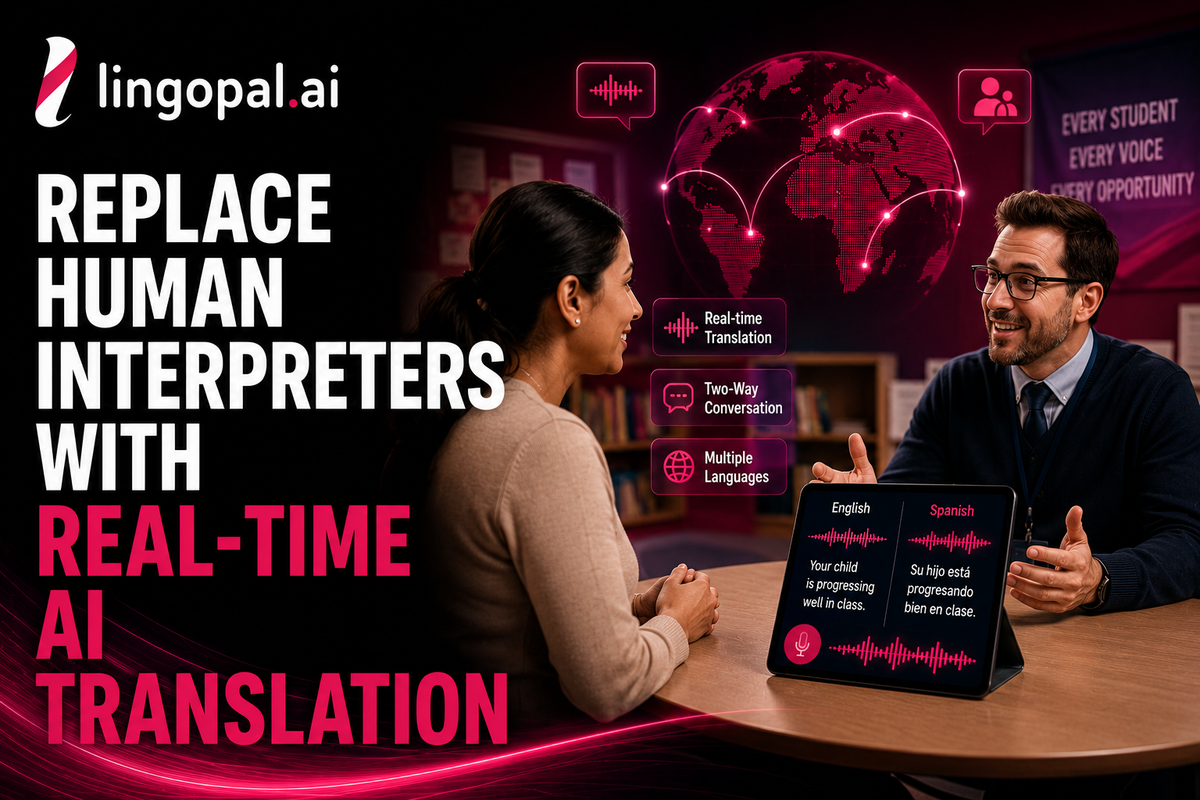
How to replace a human interpreter at a school district parent-teacher conference with real-time AI translation
School districts can evaluate real-time AI translation for routine parent-teacher conferences when interpreter availability creates delays, but the technology should not replace human judgment in high-risk meetings. A sound policy separates ordinary progress updates, attendance discussions, classroom questions, and scheduling conversations from IEP meetings, disciplinary proceedings, evaluations, and legally sensitive matters.
Key Takeaways
- School districts can evaluate real-time AI translation for routine parent-teacher conferences when interpreter availability creates delays, but the technology should not replace human judgment in high-risk meetings.
- A sound policy separates ordinary progress updates, attendance discussions, classroom questions, and scheduling conversations from IEP meetings, disciplinary proceedings, evaluations, and legally sensitive matters.
- The objective is two-way communication, not the removal of professional oversight.
The objective is two-way communication, not the removal of professional oversight. Teachers and families need to ask questions, clarify statements, and respond in their preferred languages. Districts evaluating a real-time translation platform for live multilingual communication should confirm language coverage, communication quality, privacy controls, and escalation procedures through current first-party documentation.
Why School Districts Need an Alternative to Human Interpreters at Parent-Teacher Conferences
The Operational Bottleneck: Interpreter Availability and Scheduling Delays
Human interpreters remain necessary for many school meetings, yet arranging one for every short conference can create avoidable delays. Staff must identify the family’s preferred language, find an appropriately qualified professional, coordinate calendars, arrange a phone or video connection, and manage cancellations. Less common languages can require longer lead times.
Districts should measure postponed meetings, cancellation rates, contractor costs, and languages with limited coverage. The data will show where a controlled AI workflow could support routine communication without reducing access for meetings that require a qualified interpreter.
Meeting Legal Obligations Under Title VI, the ADA, and State Mandates
Districts should consult qualified legal and compliance personnel to determine the language-access, nondiscrimination, consent, accessibility, and special-education requirements that apply to each meeting. AI translation is not automatically suitable for every meeting. IEP meetings, disciplinary hearings, evaluations, disputed records, and formal consent discussions may require a qualified human interpreter or another formally approved accommodation.
How Real-Time Generative AI Translation Can Support Two-Way Parent-Teacher Communication
Real-time speech translation may capture spoken language, process meaning in context, and return translated speech or captions to the other participant. This can allow a parent to answer in a preferred language while the teacher continues in English. Districts should test whether a selected system supports dialogue, clarification, acknowledgment, and turn-taking.
Speech-to-Speech Translation
Districts should confirm current language coverage, access requirements, participant limits, and configuration through current vendor documentation before deployment. Test language pairs with regional accents, background noise, interruptions, and normal classroom vocabulary.
How Parents Join Without Dedicated Equipment
Participants can join from a phone, tablet, or computer with a microphone and internet connection. Staff should select the language, verify audio, explain turn-taking, and offer captions when appropriate.
The Support Playbook: Steps to Use AI Translation Alongside Human Interpreters
Step 1: Audit Interpreter Spend and Language Demand
Record preferred language, meeting type, duration, interpreter cost, cancellation frequency, notice period, and postponements. Separate routine conferences from IEP meetings, disciplinary proceedings, evaluations, and other high-risk interactions.
Step 2: Evaluate a Two-Way Platform and Its FERPA Controls
Assess speech-to-speech translation, captions, speaker separation, language selection, mobile access, and turn-taking. Confirm supported languages, latency, audio quality, browser requirements, administrative controls, and integrations.
Step 3: Run a Controlled Pilot
Select one school, a defined group of routine conferences, and a limited set of language pairs. Exclude meetings involving formal eligibility decisions, contested facts, or sensitive disciplinary action.
Step 4: Train Staff and Prepare Parent Communications
Show staff how to start a session, select languages, pause for turn-taking, correct misunderstood phrases, read captions, and escalate when output is unclear.
Step 5: Measure Accuracy, Cost, and Participation
Track scheduling time, contractor expenditure, meeting completion, language coverage, connection failures, caption corrections, and participation.
Human Interpreters and AI Translation: A Direct Comparison for School Districts
Professional interpreters provide human judgment and can manage sensitive context. Generative AI platforms may combine conversational processing, speaker detection, speech synthesis, and captions during a live exchange. The appropriate option depends on meeting risk, language demand, turnaround time, and district policy.
Retain a qualified human interpreter for IEP meetings, eligibility determinations, disciplinary consequences, evaluation results, formal complaints, disputed records, and legal consent when required.
Data Security, FERPA Review, and Privacy Requirements for AI Translation in Schools
Privacy review must precede districtwide deployment. A conference can include a student’s name, grades, attendance history, behavior, disability status, medical information, family circumstances, or teacher observations. The district must determine how the platform collects, processes, stores, accesses, and deletes that information.
What FERPA Requires Districts to Review
FERPA privacy requirements should be reviewed with qualified district legal and compliance personnel. The contract should restrict use to the authorized service, prohibit unauthorized redisclosure, define personnel access, and require appropriate safeguards. A live translated exchange need not become a permanent transcript.
References
Frequently Asked Questions
Is there an AI that can translate in real-time for parent-teacher conferences?
Real-time AI translation systems are available. Their ability to capture speech, identify languages, translate context, and provide translated speech or captions varies by platform and should be tested before use.
Does AI translation replace human interpreters in schools?
AI translation does not automatically replace human interpreters for every school meeting. Routine academic updates and scheduling conversations may be suitable for AI, while special education meetings, disciplinary hearings, and legally sensitive discussions may require qualified human interpreters.
About the Author
This article was crafted by the expert team at Lingopal, an AI-powered platform built for real-time translation and transcription in live broadcast environments. From sports and news to education and global events, Lingopal helps professional teams deliver multilingual audio and captions with voice cloning, emotion preservation, and enterprise-grade accuracy.