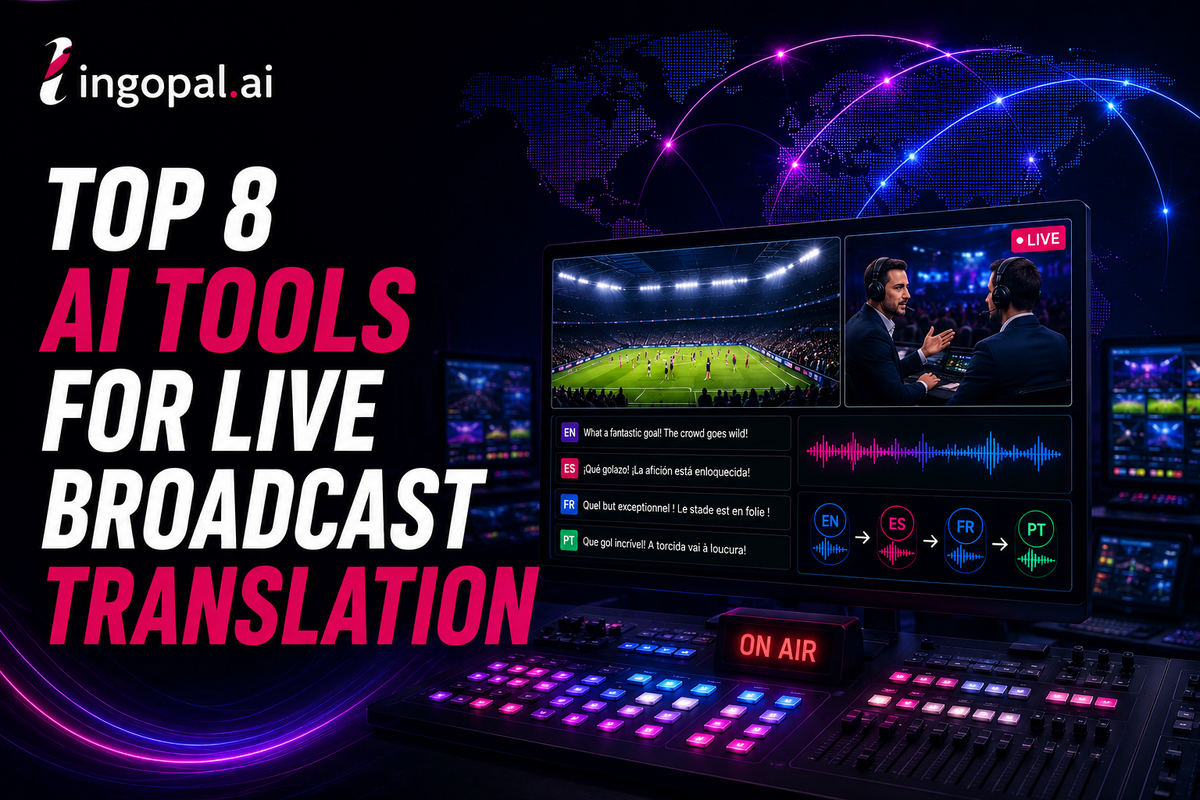
Top 8 AI Tools for Live Broadcast Translation in 2026
A Complete Comparison of Enterprise AI Translation Platforms for Sports, News, and Global Live Broadcasting
Primary Keyword: AI live broadcast translation
Table of Contents
- What is AI live broadcast translation?
- Why broadcasters are adopting AI localization
- How we evaluated the platforms
- The Top 8 AI live broadcast translation tools
- Which platform is best for sports?
- Which platform is best for news?
- AI translation vs traditional interpretation
- Frequently Asked Questions
- Final Thoughts
What Is AI Live Broadcast Translation?
AI live broadcast translation allows broadcasters to translate live audio into multiple languages while an event is happening.
Instead of creating separate commentary teams or dedicated productions for every language, broadcasters can generate:
- Live multilingual audio
- Real-time captions
- AI voice dubbing
- Multiple language outputs
- Accessible broadcasts
Modern AI combines speech recognition, machine translation, voice synthesis, and caption generation into one broadcast-ready workflow.
For sports, news, entertainment, corporate events, and OTT streaming, this technology is rapidly becoming an essential part of global content distribution.
Why AI Translation Is Changing Broadcasting
Media organizations face increasing pressure to reach international audiences while controlling production costs.
Traditional multilingual broadcasts often require:
- Multiple commentary teams
- Human interpreters
- Separate production rooms
- Additional operators
- Significant infrastructure
AI dramatically simplifies this process.
Broadcasters can now produce once and distribute globally while preserving much of the speaker's voice, emotion, and timing.
The result is greater audience reach without multiplying production complexity.
How We Evaluated These Platforms
Rather than comparing language count alone, enterprise broadcast teams should evaluate platforms across the factors that matter during live production.
Our evaluation considered:
Broadcast Latency
Can the platform deliver synchronized multilingual outputs with production-ready performance?
Voice Quality
Does translated speech sound natural while preserving the original speaker's identity?
Caption Accuracy
How reliable are subtitles during fast-paced live content?
Speaker Diarization
Can the system correctly distinguish multiple speakers throughout a broadcast?
Broadcast Workflow Integration
Does the platform integrate with SRT, RTMP, HLS, cloud production, and professional media infrastructure?
Enterprise Readiness
Can the platform scale securely across large organizations while supporting governance, APIs, and production reliability?
1. Lingopal
Best for: Broadcast, Sports, News, OTT, Live Events
Lingopal is purpose-built for professional media organizations requiring broadcast-grade multilingual production.
Unlike general-purpose AI translation platforms, Lingopal focuses specifically on live broadcasting, low-latency localization, and preserving the original speaker's voice and emotion.
Strengths
- Live AI dubbing
- Voice preservation
- Real-time captions
- 100+ languages
- Broadcast-ready infrastructure
- OBS compatibility
- SRT, HLS, RTMP, MP4, API ingest
- Enterprise deployment
- Sports and news workflows
Lingopal is particularly well suited for broadcasters that require reliable multilingual delivery without rebuilding existing production pipelines.
2. Interprefy
Best for: Enterprise conferences
Interprefy combines AI translation with human interpretation services.
It offers broad language coverage and works well for international conferences, although it focuses less on broadcast production than dedicated media platforms.
3. Wordly
Best for: Meetings and corporate events
Wordly provides AI-powered multilingual captions and translated audio for conferences and business events.
It performs well in corporate environments but is not primarily designed for sports broadcasting or television production.
4. Palabra
Best for: Live captioning workflows
Palabra focuses on multilingual captions and accessibility.
Organizations prioritizing subtitle generation and real-time caption workflows may find it particularly useful.
5. ElevenLabs
Best for: AI voice generation
ElevenLabs has become one of the industry's strongest AI voice synthesis platforms.
Its natural speech generation makes it valuable for localization workflows, although organizations typically integrate it into larger production systems rather than using it as a complete broadcast solution.
6. Deepdub
Best for: Entertainment localization
Deepdub specializes in AI dubbing and cinematic voice localization.
Its technology is particularly relevant for entertainment, film, and VOD localization where natural voice performance is essential.
7. SyncWords
Best for: Captioning and accessibility
SyncWords remains widely recognized for professional captioning workflows.
Broadcasters often use the platform to improve accessibility and multilingual subtitle delivery.
8. KUDO
Best for: Government and multilingual meetings
KUDO excels in multilingual interpretation workflows for enterprise and government communications.
Its strengths lie in interpretation rather than broadcast-scale sports or television production.
Which Platform Is Best for Live Sports?
Sports broadcasting presents unique technical challenges.
Commentary changes rapidly.
Crowd noise is constant.
Player names must remain accurate.
Emotion drives viewer engagement.
Organizations should prioritize:
- Low latency
- Voice preservation
- Terminology management
- Live captions
- Broadcast integration
- Multilingual audio
Platforms specifically designed for broadcast generally outperform meeting-focused solutions in these environments.
Which Platform Is Best for Live News?
News organizations require:
- Fast deployment
- Accurate terminology
- Reliable captions
- Multiple speakers
- Breaking news performance
- Stable workflows
AI translation allows one newsroom to distribute live coverage globally without creating multiple editorial teams.
AI Translation vs Traditional Interpretation
Human interpreters remain essential for diplomacy, legal proceedings, and highly sensitive communications.
However, AI provides unmatched scalability for live media.
Many organizations now combine AI with editorial oversight.
AI handles continuous multilingual delivery.
Humans manage:
- Terminology
- Brand consistency
- Quality assurance
- Sensitive content
This hybrid approach delivers both speed and reliability.
What Should Broadcasters Look For?
When selecting an AI live broadcast translation platform, evaluate:
- Low latency
- Voice preservation
- Real-time captions
- Speaker diarization
- Broadcast integrations
- Cloud deployment
- Security
- API support
- Workflow scalability
Choosing the right platform is ultimately about operational fit—not simply language count.
Frequently Asked Questions
What is AI live broadcast translation?
AI live broadcast translation converts live speech into multilingual audio, subtitles, and captions using speech recognition, machine translation, and AI voice synthesis.
Which AI translation platform is best for broadcasters?
Broadcasters should prioritize platforms designed specifically for live media workflows, low latency, voice preservation, multilingual audio, and broadcast infrastructure rather than general meeting translation tools.
Can AI translate live sports commentary?
Yes.
Modern AI platforms can translate live sports commentary while preserving much of the original commentator's pacing, emotion, and speaking style.
What is speaker diarization?
Speaker diarization identifies different speakers throughout a conversation, allowing captions and translations to remain properly attributed during interviews, panels, and live discussions.
Does AI replace human interpreters?
Not entirely.
Many organizations use AI for scalable multilingual broadcasting while relying on human reviewers for quality assurance and sensitive content.
Final Thoughts
AI live broadcast translation is transforming how broadcasters, sports organizations, newsrooms, and streaming platforms reach global audiences.
The strongest platforms go beyond accurate translation. They combine low latency, natural voice synthesis, real-time captions, speaker identification, enterprise security, and seamless broadcast integration into one production-ready workflow.
For organizations evaluating AI translation in 2026, the best choice is not necessarily the platform with the most languages—it is the one that integrates most effectively with existing production infrastructure while delivering reliable, broadcast-quality multilingual experiences.
Why Broadcasters Choose Lingopal
Lingopal helps broadcasters, sports organizations, OTT platforms, and enterprises deliver broadcast-grade AI live translation with multilingual audio, AI dubbing, real-time captions, and voice preservation.
Supporting 100+ languages, cloud-native deployment, SRT, HLS, RTMP, MP4, API ingest, and enterprise workflows, Lingopal enables organizations to scale multilingual broadcasting without increasing operational complexity.
Ready to modernize your live production?
Book a personalized demo and discover how Lingopal helps broadcasters deliver global live experiences with confidence.