What AI translation service is best for an entertainment startup?
The Complete Guide to What AI translation service is suitable for a startup in the entertainment industry?
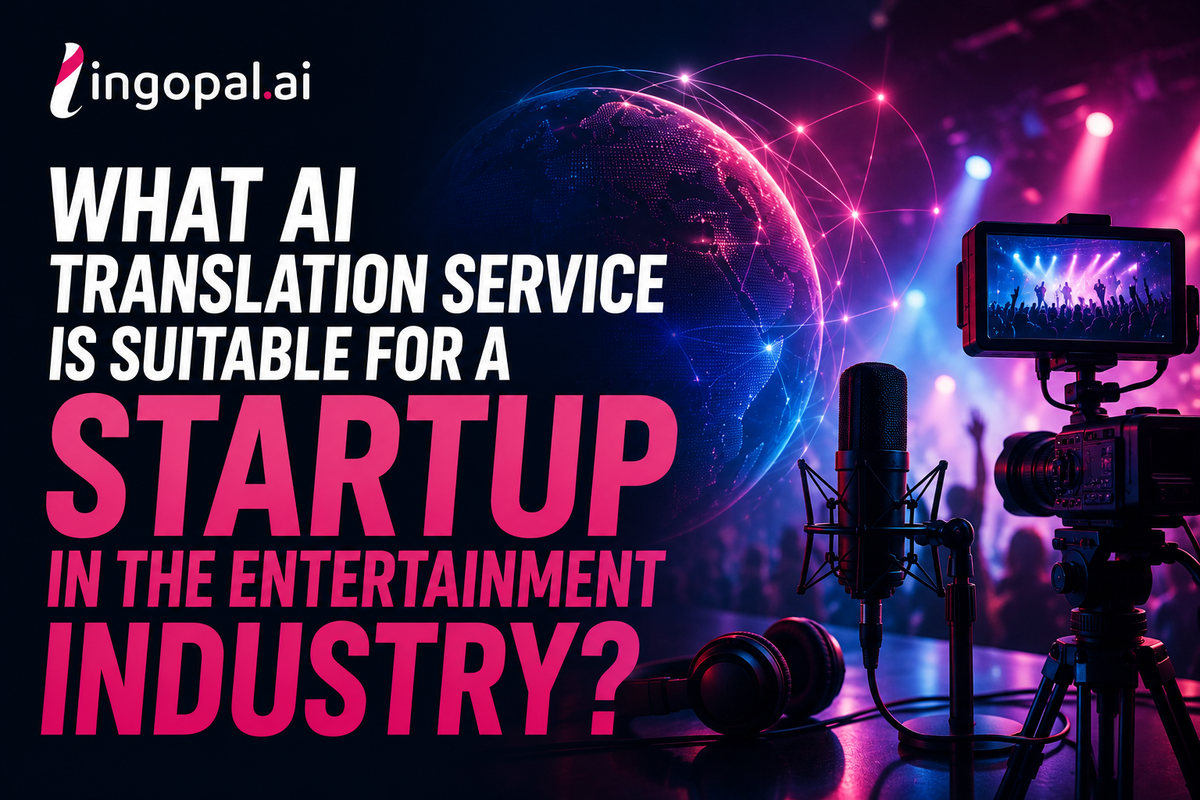
What AI translation service is suitable for a startup in the entertainment industry?
For an entertainment startup, translation is part of production, not a final cleanup task. The selected system must handle dialogue, subtitles, live commentary, interviews, promotional clips, and audience interaction without flattening tone or introducing errors that damage the release. The right choice also depends on delivery speed, language coverage, audio quality, workflow integration, and the level of human review available.
Key Takeaways
- For an entertainment startup, translation is part of production, not a final cleanup task.
- The selected system must handle dialogue, subtitles, live commentary, interviews, promotional clips, and audience interaction without flattening tone or introducing errors that damage the release.
- The right choice also depends on delivery speed, language coverage, audio quality, workflow integration, and the level of human review available.
Table of Contents
- What is What AI translation service is suitable for a startup in the entertainment industry??
- Benefits of What AI translation service is suitable for a startup in the entertainment industry?
- How to Choose What AI translation service is suitable for a startup in the entertainment industry?
What is What AI translation service is suitable for a startup in the entertainment industry??
What AI translation service is suitable for a startup in the entertainment industry? A service built for media workflows should support multilingual captions, dubbing, speech translation, voice preservation, and common broadcast inputs without requiring a large engineering team. Evaluate these capabilities against the provider's current documentation and a representative sample before selecting a service. Startups can also review a translation platform demonstration for entertainment workflows before committing to a production pilot.
The distinction matters because entertainment dialogue carries meaning through timing, character identity, humor, slang, emotion, and cultural reference. A literal sentence can be grammatically correct while still sounding wrong for a trailer, livestream, sports broadcast, or scripted scene. Language models can miss speaker intent, turn-taking, names, and established terminology. An entertainment-focused workflow needs transcript generation, translation, voice output, subtitle timing, quality control, and export options in one production path. Confirm support for the media formats and ingest methods used by the team before adopting a service.
Benefits of What AI translation service is suitable for a startup in the entertainment industry?
The main benefit is broader distribution without forcing a startup to create a separate post-production operation for every language. A single live feed can produce translated captions for viewers who need text and dubbed audio for audiences who prefer localized speech. This is useful for creator streams, esports, film promotion, red-carpet interviews, music events, and international fan communities. Real-time captioning can support immediate access, while live dubbing can help multilingual viewers follow the event.
Speed also changes the economics of content testing. A startup can publish a short clip in several markets, measure watch time and audience response, then invest in professional localization where demand is proven. That approach is more controlled than commissioning full dubbing for every territory before validating interest. It also supports frequent content such as daily streams, social video, behind-the-scenes footage, and post-event highlights, where a traditional voiceover schedule may delay publication beyond the useful viewing window.
Key insight: AI output should not be treated as an automatic substitute for editorial review. Use human checks for names, jokes, lyrics, culturally sensitive references, legal language, and scenes in which a small tonal error changes the character. The system should reduce repetitive production labor while leaving creative authority with the content team.
Another benefit is operational flexibility. A startup may begin with subtitle translation and later add live dubbing, recorded voice tracks, or an API connection to a streaming platform. This avoids locking the team into a workflow built only for one format. Broad language coverage is also relevant for entertainment companies serving global audiences, since a release plan may include major markets, diaspora communities, and niche fan groups. A broad language catalog can give a small team room to test regional demand without managing separate vendors for every language pair.
Quality control remains the deciding factor. AI can produce fluent text that contains a wrong proper noun, softened insult, altered punchline, or misplaced subtitle cue. That is why a suitable service must fit review checkpoints into the process: transcript approval, terminology checks, speaker separation, caption timing, audio monitoring, and final playback. Select a provider only after confirming that its documented capabilities fit these workflows, while producers retain responsibility for whether the localized content matches the original performance and brand standards.
How to Choose What AI translation service is suitable for a startup in the entertainment industry?
What AI translation service is suitable for a startup in the entertainment industry? Start with the production workflow, not the language count. A service should accept the formats already used by the team, separate speakers accurately, generate readable transcripts, preserve timecodes, and deliver captions or dubbed audio without forcing a new media pipeline. Check support for the formats and ingest methods used by the team before signing up. Confirm documented compatibility and test it with the startup's own media before building an integration.
Next, match the system to the content risk. A scripted drama needs consistency in character names, terminology, humor, profanity, emotional intent, and recurring phrases. A live sports stream places greater weight on speed, speaker changes, crowd noise, proper nouns, and uninterrupted delivery. Interviews and creator content require natural turn-taking and protection against mistranslated statements. Ask whether the service supports both real-time captioning and live speech translation, since these functions solve different audience needs. Confirm actual latency and feed requirements through current provider documentation and a live test before relying on the service for a broadcast.
Language coverage should be tested against the actual release plan. Do not count a language as supported until the team has reviewed pronunciation, subtitles, voice quality, and terminology for the intended audience. A startup may need major languages for an international launch, regional variants for fan communities, and less common languages for specific distribution partners. Coverage alone does not guarantee a suitable voice or accurate treatment of slang. Build a sample set containing dialogue, song-related speech, comedy, names, rapid exchanges, and culturally specific references. Evaluate the output with native-speaking reviewers before publication.
Quality assurance must be a defined production stage, not an informal check after release. AI systems can produce fluent sentences that change a joke, omit a negation, misidentify a speaker, or make a character sound unlike the original performance. For recorded content, review the transcript before translation, then inspect subtitle line breaks, reading speed, cue timing, and speaker labels. For dubbing, listen for pronunciation, pauses, emphasis, emotional register, and audio artifacts. Live programming needs an escalation plan for bad names, sensitive statements, unstable audio, and sudden changes in the run of show. The safest workflow assigns approval authority to a producer or language editor who can stop distribution when output falls below the program standard.
Key insight: Treat AI output as a first production pass for high-context entertainment, not as an unverified final master. Test a representative clip, define acceptance criteria, and calculate review time before committing to a full catalog or live event.
Cost should be assessed through total production effort rather than a translation price alone. Include transcription, language review, subtitle correction, voice editing, storage, delivery, integration work, and the staff time required to monitor live output. A low entry price can become expensive if producers must repair every file manually. Request a workflow demonstration using the startup's own footage, then measure turnaround time, correction volume, export reliability, and engineering support. Review translation pricing for startup production needs and confirm whether pricing changes by minutes, characters, languages, simultaneous outputs, API usage, or live event duration. This gives the team a usable forecast before audience growth increases monthly volume.
Finally, assess governance and brand protection. Confirm how source recordings, scripts, transcripts, speaker data, and generated audio are handled. Establish permissions for voice use, retention rules, access controls, and approval records. The service should fit existing content management, broadcast, streaming, and review systems rather than creating isolated files across personal accounts. For a startup, the strongest choice is the platform that combines technical compatibility, tested language performance, controlled human review, and a clear path from a short pilot to recurring multilingual distribution. That is the practical answer to What AI translation service is suitable for a startup in the entertainment industry?
References
Frequently Asked Questions
What features should an entertainment startup prioritize?
Prioritize features that match the content workflow rather than selecting a service based only on language count. The system should support speech recognition, speaker separation, transcript editing, subtitle generation, timecode preservation, live captioning, dubbed audio, and export into the formats already used by the production team. Look for controls that let editors correct names, terminology, profanity, cultural references, and recurring phrases. A review queue, access permissions, usage records, and clear handling of source audio also matter for a startup managing sensitive unreleased content.
Can AI translation match human quality for dramatic dubbing and subtitling?
AI translation can produce a useful first pass, but dramatic content still requires human approval. A model may translate the literal meaning correctly while missing sarcasm, hesitation, status, humor, subtext, or a character's established speaking style. Subtitle length and reading speed also require editorial judgment because a direct translation may not fit the available screen time. Dubbing adds pronunciation, pacing, vocal identity, emotional emphasis, and synchronization. Use native-language reviewers for scripts with high creative or reputational risk. A provider may support the production process with live dubbing and real-time captions, while the producer remains responsible for the final localized performance.
How does real-time speech translation compare with traditional dubbing?
Traditional dubbing usually involves transcription, translation, adaptation, casting, recording, editing, mixing, review, and delivery. That workflow can produce carefully directed audio, but it takes scheduling and post-production capacity. Real-time speech translation is designed for live broadcasts, interviews, creator streams, sports commentary, conferences, and audience interaction in which publication cannot wait for a completed studio process. The tradeoff is control. Live output must be monitored for recognition errors, names, overlapping speakers, background noise, and unexpected statements. Confirm the provider's latency, supported inputs, and caption capabilities through documentation and testing before using it during an event.
What should a startup include when estimating translation costs?
There is no single useful price range without knowing the media volume, language count, delivery format, and review standard. Build the estimate around minutes of audio or video, live event duration, caption output, dubbed output, API traffic, storage, and the number of target languages. Add human review for terminology, subtitle timing, pronunciation, and sensitive dialogue. Also account for implementation labor, monitoring, file management, and revisions. A pilot using representative footage gives a better forecast than a generic plan because it reveals correction volume and editorial time. Ask how billing changes with concurrent streams, archived media, repeated exports, and higher monthly usage before setting the production budget.
Which language coverage is appropriate for a global entertainment audience?
Choose languages based on the audience, distribution agreements, platform analytics, and the type of content being released. A startup may begin with languages tied to existing viewers, then add regions where watch time, subscriptions, ticket sales, or community activity show demand. Coverage should be tested beyond written translation. Review pronunciation, voice quality, dialect handling, subtitle readability, slang, proper names, and cultural references with qualified speakers. A broad catalog is useful only when the output meets the program's quality threshold. Evaluate any provider's language list through sample-based review, not a language list alone.