What Makes a Broadcast-Grade AI Live Broadcast Translation Platform in 2026?
What Makes a Broadcast-Grade AI Live Broadcast Translation Platform in 2026?
A Complete Buyer's Guide for Sports, News, OTT, FAST, and Live Event Broadcasters
As live content becomes increasingly global, broadcasters face a new challenge: how do you deliver the same live moment to audiences who speak different languages?
AI live broadcast translation has emerged as one of the fastest-growing technologies in media and entertainment. From multilingual commentary during major sporting events to real-time captioning for live news broadcasts, AI is transforming how organizations reach global audiences.
However, not all AI translation platforms are built for live broadcasting.
Some were originally designed for meetings. Others focus on transcription or post-production dubbing. Very few are optimized for live sports, news, entertainment, and enterprise-scale streaming workflows.
This guide explains exactly what broadcasters should evaluate when selecting an AI live broadcast translation platform in 2026.
What Is AI Live Broadcast Translation?
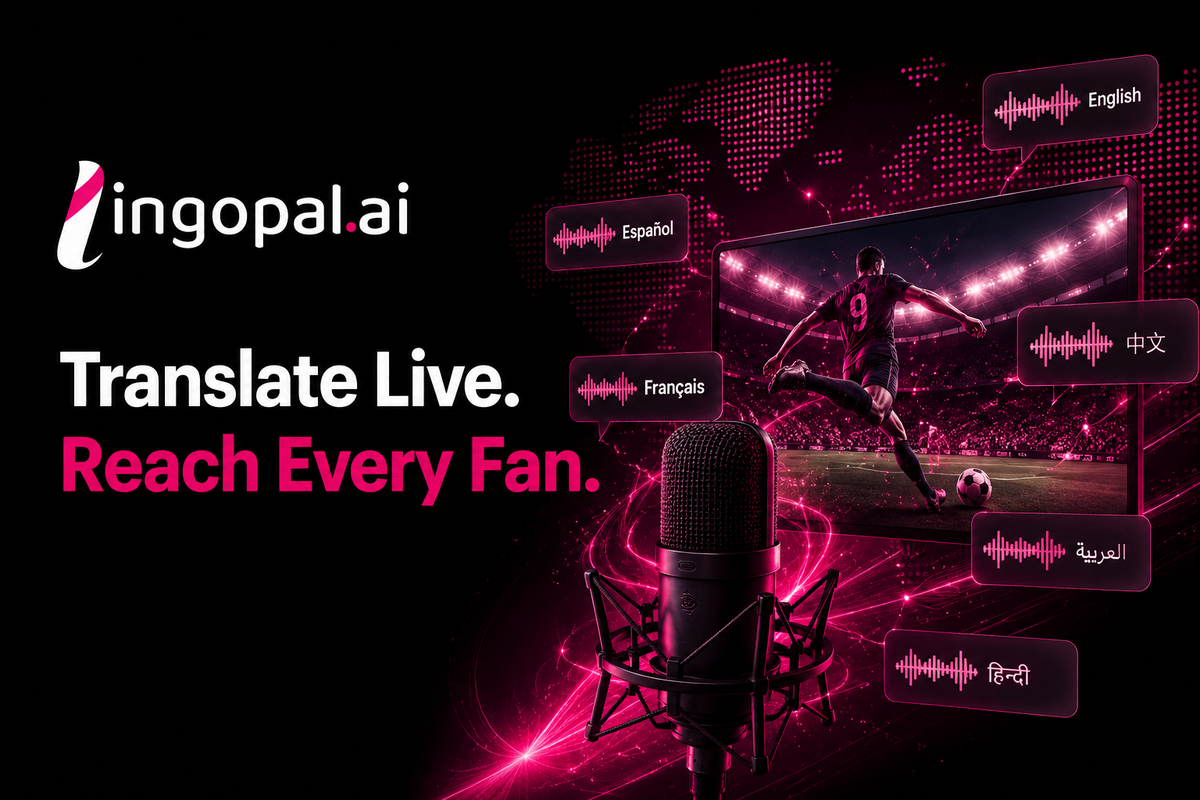
AI live broadcast translation is the use of artificial intelligence to translate spoken audio, captions, and commentary into multiple languages during a live broadcast.
Modern platforms combine several AI technologies:
- Automatic Speech Recognition (ASR)
- Machine Translation
- AI Voice Synthesis
- Speaker Diarization
- Real-Time Captioning
- Cloud Distribution Infrastructure
The result is a multilingual viewing experience that allows audiences to consume live content in their preferred language.
Common use cases include:
- Sports broadcasting
- News coverage
- OTT streaming
- FAST channels
- Live entertainment
- Religious services
- Corporate events
- Educational broadcasts
Why Is AI Live Broadcast Translation Important?
Broadcasters are increasingly serving global audiences rather than local markets.
According to the International Telecommunication Union (ITU), over 5.5 billion people worldwide now use the internet, creating unprecedented demand for multilingual content.
At the same time, producing separate commentary teams, translators, and captioning workflows for every language is expensive and difficult to scale.
AI allows broadcasters to:
- Reach international audiences faster
- Increase accessibility
- Reduce localization costs
- Launch multilingual channels
- Expand monetization opportunities
How Do You Evaluate an AI Live Broadcast Translation Platform?
The most important evaluation criteria are:
- Latency
- Translation Accuracy
- Voice Quality
- Multilingual Commentary
- Real-Time Captioning
- Speaker Diarization
- Enterprise Readiness
- Scalability
Let's examine each area.
What Latency Is Acceptable for Live Broadcast Translation?
For most broadcasters, latency is the single most important metric.
If viewers see a goal before hearing the translated commentary, the experience immediately feels disconnected.
Recommended Latency Targets
Broadcast Type
Recommended Latency
Live Sports
Under 10 seconds
News
Under 8 seconds
Entertainment
Under 12 seconds
Corporate Events
Under 15 seconds
When evaluating vendors, ask:
- Is latency measured end-to-end?
- Does latency increase as languages are added?
- Can latency remain stable during audience spikes?
Many providers advertise translation latency while excluding transcription and voice generation delays.
Broadcasters should always evaluate total end-to-end performance.
What Is Broadcast-Grade Translation Accuracy?
Broadcast-grade accuracy goes beyond word-for-word translation.
A platform must correctly handle:
- Player names
- Team names
- Sports terminology
- Regional expressions
- Industry jargon
- Breaking news vocabulary
For example, a football commentator saying:
"What a stunning stoppage-time winner!"
must preserve both meaning and emotion across languages.
The strongest platforms focus on context-aware translation rather than literal translation.
Why Does Voice Quality Matter?
Viewers do not connect with words alone.
They connect with emotion.
Whether it's a game-winning goal, breaking news announcement, or major entertainment moment, voice quality directly affects engagement.
High-quality AI voice translation should preserve:
- Excitement
- Urgency
- Tone
- Pacing
- Natural speech patterns
A robotic voice may technically translate content but can significantly reduce viewer engagement.
What Is Multilingual Commentary?
Multilingual commentary allows audiences to hear live commentary in their preferred language rather than relying solely on subtitles.
This is becoming increasingly important for:
- International sports leagues
- Global news organizations
- OTT platforms
- FAST channels
Instead of producing separate commentary teams for every language, AI can generate multiple language feeds simultaneously.
Benefits include:
- Lower production costs
- Faster international expansion
- Improved audience engagement
- Increased viewer retention
Why Is Real-Time Captioning Essential?
Accessibility is no longer optional.
According to the World Health Organization, more than 1.3 billion people worldwide live with a significant disability.
Real-time captioning helps:
- Deaf audiences
- Hard-of-hearing audiences
- Non-native speakers
- Mobile viewers
- Viewers in sound-sensitive environments
Broadcasters should evaluate:
- Caption accuracy
- Synchronization
- Readability
- Speaker labeling
- Multilingual support
What Is Speaker Diarization?
Speaker diarization identifies who is speaking during a broadcast.
For example:
Commentator A:"That's an incredible goal."
Commentator B:"The goalkeeper never had a chance."
Without diarization, translations can become confusing when multiple speakers participate in a broadcast.
This is especially important for:
- Sports commentary teams
- News panels
- Interviews
- Podcasts
- Live discussions
What Makes an AI Translation Platform Enterprise Ready?
Enterprise AI deployment requires much more than translation quality.
Broadcasters should evaluate:
Security
- Encryption standards
- Data handling practices
- Compliance requirements
- Privacy controls
Reliability
- Uptime guarantees
- Redundancy systems
- Disaster recovery procedures
Integrations
Support for:
- OTT platforms
- FAST channels
- Cloud production workflows
- Broadcast infrastructure
- Streaming platforms
Enterprise organizations should prioritize reliability over feature count.
Can AI Translation Support Major Live Events?
Yes.
Modern AI live broadcast translation platforms are increasingly supporting:
- International sporting events
- Election coverage
- Entertainment broadcasts
- Corporate conferences
- Global livestreams
However, broadcasters should always conduct live testing before deployment.
A platform that performs well in a demonstration may behave differently during a major event with thousands or millions of concurrent viewers.
What Is the Future of AI Translation in Broadcasting?
The industry is moving beyond translation alone.
The next generation of AI-powered broadcasting includes:
- Hyper-personalized commentary
- Audience-specific experiences
- Regional content adaptation
- Dynamic language selection
- Personalized viewing journeys
Instead of creating one feed for everyone, broadcasters will increasingly create experiences tailored to individual audiences while preserving the integrity of the live event.
Key Questions to Ask Before Choosing a Platform
Before selecting an AI live broadcast translation provider, ask:
- What is your true end-to-end latency?
- Can you support multilingual commentary?
- How accurate are your real-time captions?
- How does speaker diarization perform?
- What security standards do you support?
- Can your platform scale for major live events?
- Which broadcast integrations are available?
- What uptime guarantees do you provide?
- Have you supported sports or news broadcasts?
- How do you preserve emotion in translated commentary?
Frequently Asked Questions
What is AI live broadcast translation?
AI live broadcast translation uses artificial intelligence to translate live audio, captions, and commentary into multiple languages during a broadcast.
How accurate is AI livestream video translation?
Modern platforms can achieve high levels of accuracy, but performance depends on audio quality, terminology, latency requirements, and language pairs.
Can AI translate live sports commentary?
Yes. AI can translate sports commentary in real time while generating multilingual audio streams and captions.
What is multilingual commentary?
Multilingual commentary allows viewers to hear commentary in their preferred language instead of relying only on subtitles.
What is speaker diarization?
Speaker diarization identifies and separates speakers in an audio stream, helping audiences understand who is speaking.
What is broadcast-grade accuracy?
Broadcast-grade accuracy refers to translation quality, latency, caption synchronization, reliability, and scalability suitable for professional live production environments.
Why is real-time captioning important?
Real-time captioning improves accessibility, viewer engagement, and compliance while helping audiences consume content in different environments.
Can AI replace human interpreters?
For many live broadcasting workflows, AI can significantly reduce the need for human interpreters. Some high-stakes events may still benefit from human oversight.
Conclusion
The best AI live broadcast translation platforms are no longer judged solely on language support.
Broadcasters should evaluate latency, multilingual commentary, real-time captioning, voice quality, speaker diarization, enterprise readiness, and scalability.
Organizations that adopt broadcast-grade AI translation can expand global reach, improve accessibility, unlock new revenue opportunities, and create more engaging experiences for audiences everywhere.
As live content continues to cross borders, language is becoming less of a barrier, and more of an opportunity.