Why Live Stream Translation Workflows Get Complex (And How Modern Broadcasters Simplify Them)
Live streaming has never been more global.
A football match produced in London is watched in São Paulo, Seoul, and Dubai at the exact same moment. A product launch reaches customers across five continents. A breaking news story becomes international within seconds.
The challenge is no longer distributing live video.
The challenge is delivering it in multiple languages without slowing everything else down.
That's why live stream translation has become one of the fastest-growing priorities for broadcasters, streaming platforms, sports organizations, and media companies.
Yet many organizations discover that translation itself isn't the difficult part.
Managing the entire live stream translation workflow is.
If you've ever wondered why multilingual live streaming becomes so operationally complex, this guide explains where that complexity comes from—and how modern broadcast teams are removing it.
What Is a Live Stream Translation Workflow?
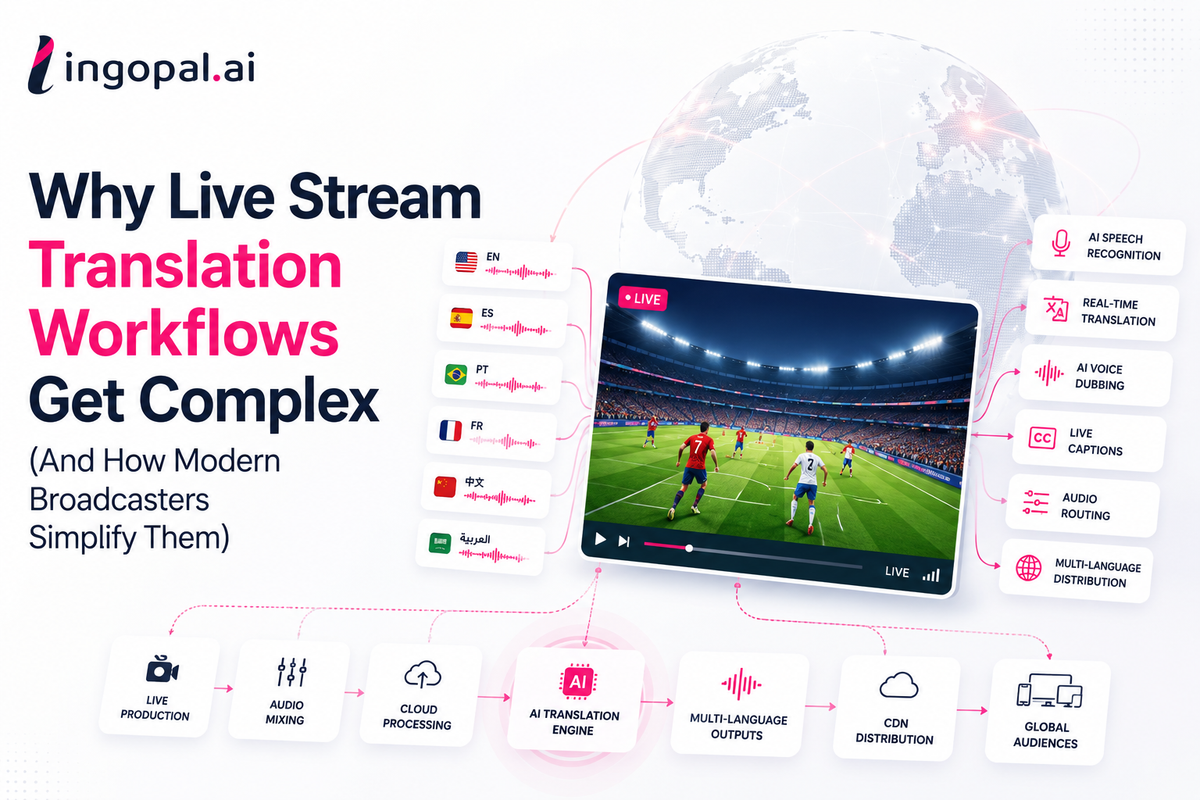
A live stream translation workflow is the complete process of converting a live broadcast into one or more additional languages while the event is still happening.
Depending on the production, this can include:
- AI speech recognition
- Real-time translation
- AI voice dubbing
- Live captions
- Subtitle generation
- Audio routing
- Language selection
- Distribution across multiple platforms
The goal is simple:
One live event. Multiple languages. One production workflow.
In reality, achieving that consistently requires much more than simply translating speech.
Why Do Live Stream Translation Workflows Become So Complex?
Most organizations assume translation is the difficult part.
In practice, translation is only one component.
Complexity usually comes from trying to coordinate dozens of systems simultaneously.
A typical multilingual live stream might involve:
- Live production
- Graphics
- Audio mixing
- Cloud switching
- CDN distribution
- Caption generation
- Audio encoding
- Multiple language feeds
- OTT delivery
- Social streaming
- Accessibility requirements
Adding multilingual support means inserting translation into every stage—not just at the end.
The Biggest Bottlenecks in Live Stream Translation
1. Every Additional Language Creates More Operational Work
Traditional localization scales almost linearly.
Need Spanish?
Add another workflow.
Need Portuguese?
Another workflow.
Need French?
Repeat the process.
Each language often requires:
- Additional operators
- Separate audio feeds
- Extra monitoring
- More QA
- More routing
- More distribution endpoints
As language count grows, production complexity grows with it.
Modern AI platforms remove much of this operational burden by generating multiple language outputs from a single source feed.
2. Real-Time Translation Leaves No Room for Error
Unlike video-on-demand localization, live broadcasts cannot be paused.
Translation must happen while:
- commentators are speaking
- presenters interrupt each other
- crowd noise increases
- interviews begin unexpectedly
- breaking news develops
This requires AI systems capable of handling dynamic speech in real time—not just clean studio recordings.
3. Live Audio Is Harder Than Most People Think
Broadcast audio is rarely simple.
A single stream may contain:
- host
- guest
- commentators
- sideline reporter
- crowd noise
- music
- stadium announcements
- audience reactions
An effective live stream translation platform must determine:
- Who is speaking?
- What should be translated?
- What should remain ambient?
- Which voice belongs to which speaker?
Without speaker separation, multilingual broadcasts quickly become confusing.
4. Timing Matters More Than Perfect Translation
Many organizations focus exclusively on translation accuracy.
Broadcast teams often prioritize synchronization.
Imagine:
The audience watches a goal...
Eight seconds later they hear the translated celebration.
Even a technically accurate translation feels disconnected.
Successful real-time translation balances:
- accuracy
- latency
- natural speech
- synchronization
rather than maximizing only one metric.
5. Every Broadcast Infrastructure Is Different
Broadcasters rarely use identical workflows.
Some rely on:
- SRT
- RTMP
- HLS
- SDI
- cloud production
- hybrid production
- proprietary distribution systems
Translation platforms that require rebuilding production workflows often create more problems than they solve.
The most successful deployments fit into existing broadcast automation instead of replacing it.
Why Localization Complexity Increases Over Time
Many organizations begin with one additional language.
Then demand grows.
Soon they're supporting:
- regional broadcasts
- international events
- FAST channels
- OTT platforms
- partner feeds
- social clips
- archived VOD
Each new destination introduces additional localization requirements.
Without automation, workflows become increasingly difficult to manage.
How Broadcast Automation Changes Multilingual Streaming
Modern AI platforms treat translation as another automated production layer.
Instead of creating separate localization pipelines for every language, they automate:
- speech recognition
- translation
- voice generation
- caption creation
- subtitle formatting
- multilingual output
This dramatically reduces manual intervention while allowing production teams to maintain familiar workflows.
Broadcast automation doesn't replace production teams.
It removes repetitive localization tasks so teams can focus on producing better live content.
Why Multilingual Streaming Requires More Than Translation
The strongest multilingual streaming platforms combine several technologies simultaneously:
Speech Recognition
Converts live audio into text with minimal delay.
AI Translation
Preserves meaning rather than translating word-for-word.
Voice Synthesis
Generates natural multilingual audio.
Speaker Diarization
Identifies who is speaking.
Caption Generation
Creates synchronized accessibility captions.
Distribution
Delivers multiple language outputs to streaming platforms.
Organizations evaluating live stream translation solutions should consider the entire workflow—not just the translation engine.
Questions to Ask Before Choosing a Live Stream Translation Platform
Before investing in any platform, broadcasters should ask:
- Can it integrate into our existing streaming workflows?
- Does it support multilingual streaming from a single source?
- How is end-to-end latency measured?
- Can it generate live captions alongside translated audio?
- Does it preserve speaker identity?
- How many languages can run simultaneously?
- Does it support broadcast automation?
- Can it scale for major live events?
- Does it integrate with our cloud production environment?
These questions often reveal more than product demonstrations.
Frequently Asked Questions
What is live stream translation?
Live stream translation is the process of translating spoken audio during a live broadcast into one or more languages while the event is happening. Modern platforms can generate multilingual audio, captions, and subtitles simultaneously.
Why are live stream translation workflows so complex?
Because they combine live production, audio processing, translation, captioning, localization, and content distribution—all under strict timing requirements where delays directly affect the viewer experience.
What causes localization complexity in live streaming?
Localization complexity comes from supporting multiple languages, synchronizing audio and captions, integrating with broadcast infrastructure, and maintaining quality across different platforms and audiences.
How does broadcast automation improve multilingual streaming?
Broadcast automation reduces manual work by automatically handling speech recognition, translation, voice synthesis, captioning, and multilingual distribution from a single workflow.
What should broadcasters look for in a live stream translation platform?
Look for low latency, natural voice quality, multilingual streaming support, caption generation, broadcast integration, scalability, and compatibility with existing streaming workflows.
The Future of Live Stream Translation
The future of live broadcasting isn't about creating more workflows.
It's about creating smarter ones.
As AI continues to mature, broadcasters will increasingly move away from managing separate localization pipelines for every language and toward unified workflows that generate multilingual audio, captions, and translations automatically.
Organizations that simplify live stream translation today will be better positioned to expand globally, improve accessibility, and reach audiences wherever they choose to watch—without multiplying operational complexity.